


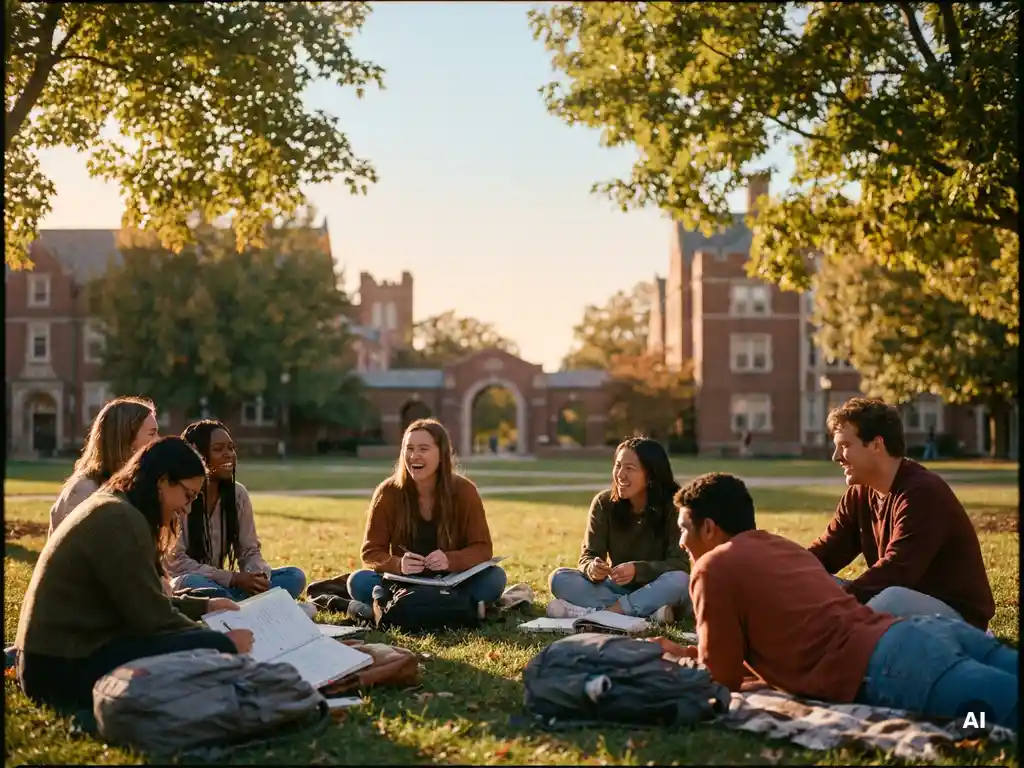
Living on a residential college campus gives students more than just a place to sleep. It places learning, community, and personal growth in the same physical space, making every part of daily life an extension of the educational experience. For students considering a university where campus life and academic life are genuinely integrated, the benefits go far deeper than convenience. This article walks through the key questions prospective students and their families most often ask about on-campus living.
How does living on campus affect academic performance?
Living on a residential college campus has a measurable positive effect on academic performance. When students live where they study, they spend less time commuting and more time engaging with coursework, peers, and faculty. The physical proximity to classrooms, libraries, and study spaces lowers the barrier to participation and makes it easier to stay consistently involved in academic life.
Beyond logistics, the social environment on a residential campus reinforces learning. When your neighbours are your classmates, academic conversations naturally extend beyond the classroom. Study groups form organically, ideas get tested over dinner, and students hold each other accountable in informal but powerful ways. This kind of peer-to-peer learning is difficult to replicate when students scatter across a city after lectures.
Faculty access is another factor. At smaller residential colleges, staff often live nearby and are genuinely embedded in the campus community. That closeness shortens the distance between a student with a question and a professor with an answer, making academic support feel accessible rather than formal or intimidating.
What social benefits does a residential campus offer?
A residential campus creates the conditions for deep, lasting social connections because students share not just a degree programme but an entire daily life. Friendships form faster and go deeper when people eat together, live in the same buildings, and spend evenings in the same spaces. The social fabric of a residential campus is woven through everyday moments, not just scheduled events.
On a campus like UCR’s in Middelburg, with around 500 students from over 70 nationalities, that social richness takes on a genuinely international dimension. Students are not simply exposed to diversity in a theoretical sense. They live alongside it, navigate cultural differences in real time, and build friendships that span continents. This kind of cross-cultural connection is one of the most valuable things a student can take away from their undergraduate years.
Student-led campus culture also plays a significant role. When students are responsible for organising events, running clubs, and shaping the social environment, they develop a sense of ownership and belonging that a commuter experience rarely provides. The campus becomes a home rather than a facility.
How does campus living support personal development?
Campus living supports personal development by placing students in an environment where they must navigate independence, relationships, and responsibility simultaneously. Moving away from home, managing a shared living space, and building a new social network all require adaptability and self-awareness. These are not incidental challenges. They are formative ones.
At a residential liberal arts college, personal development is also built directly into the curriculum. UCR, for example, requires every student to complete a Personal and Professional Development trajectory alongside their academic courses. This programme focuses on communication, teamwork, study skills, and career preparation, ensuring that the growth happening outside the classroom is also supported inside it.
The residential setting amplifies this. Students who live on campus are constantly practising the skills they are formally learning: how to collaborate, how to resolve conflict, how to lead, and how to listen. The campus becomes a kind of low-stakes rehearsal space for adult life, with a support network close at hand when things get difficult.
Is living on a residential campus more affordable than living off campus?
For many students, living on a residential campus is more affordable than renting privately, particularly in countries where housing markets are competitive and student accommodation is scarce. Guaranteed on-campus housing removes the cost and uncertainty of searching for private rentals, dealing with deposits, and managing utility bills independently.
At UCR, all students are guaranteed affordable housing for the full duration of their studies. This is a significant practical advantage. In the Netherlands, finding suitable student housing in many cities has become genuinely difficult, with long waiting lists and high rents. UCR’s residential model sidesteps that problem entirely, offering students a secure and affordable place to live from day one.
There are also indirect financial benefits to living on campus. Shorter distances mean lower transport costs. Access to campus facilities reduces the need to pay for external gyms, study spaces, or co-working environments. And the time saved by not commuting has real value, whether students invest it in academics, extracurricular activities, or rest.
What is the difference between a residential college and a regular university?
The key difference between a residential college and a regular university is that a residential college integrates where students live with where they learn, creating a single, cohesive community rather than separating academic and personal life. Regular universities are often large institutions where students attend lectures and then disperse across a city. A residential college keeps that community together, on campus, around the clock.
This structural difference shapes almost everything else about the experience. Class sizes at residential colleges tend to be smaller, faculty relationships more personal, and student involvement in campus life more active. The college functions as a community in the fullest sense, not just an educational provider.
There are also academic differences. Residential liberal arts colleges like UCR typically offer interdisciplinary programmes rather than single-subject degrees, encouraging students to draw connections across fields rather than specialise early. The Bachelor of Liberal Arts and Sciences at UCR, for instance, allows students to design their own curriculum across six academic clusters, earning either a Bachelor of Arts or a Bachelor of Science. This flexibility is characteristic of the residential college model, where academic breadth and personal growth are seen as equally important.
Who benefits most from a residential college campus experience?
Students who benefit most from a residential college campus are those who want their university years to be genuinely formative rather than purely transactional. If a student is looking for more than a degree, and wants to develop intellectually, socially, and personally within a close-knit community, the residential college model is designed for them.
More specifically, the residential campus experience tends to suit students who:
- Are curious across multiple disciplines and want the freedom to explore rather than specialise immediately
- Value small-scale, discussion-based learning over large lecture halls
- Are ready to take on independence but benefit from a structured, supportive environment
- Want to build genuine international friendships and develop cross-cultural competencies
- Are motivated to get involved in campus life, student organisations, and community projects
- Are looking for close access to faculty and a learning environment where they are known as individuals
Students who prefer the anonymity of a large city campus, or who already have strong local roots they do not want to leave, may find a residential college a less natural fit. But for intellectually driven students who are ready to be fully immersed in their education, the residential model offers something that a commuter university simply cannot replicate.
How UCR delivers on the promise of residential campus life
University College Roosevelt brings together everything that makes a residential college campus genuinely valuable, in one small, international setting in Middelburg, the Netherlands. Here is what that looks like in practice:
- Guaranteed affordable housing for all students for the full duration of their studies, removing uncertainty from day one
- A close-knit community of around 500 students from over 70 nationalities, living and learning together on an inner-city campus
- Small-scale, discussion-based learning with dedicated faculty who live nearby and are genuinely accessible
- An interdisciplinary Bachelor of Liberal Arts and Sciences that lets students design their own curriculum across six academic clusters
- A mandatory Personal and Professional Development track that supports holistic growth alongside academic achievement
- Real-world learning through UCR’s living lab approach, connecting students with local government, businesses, and community organisations in Zeeland
If you are ready to experience what campus life can look like when it is fully integrated with your education, explore UCR’s admissions process and find out whether this is the right environment for you.
Related Articles
- Are A-levels accepted by Dutch university colleges?
- What are the most popular cities for students in the Netherlands?
- How early should you apply to study in the Netherlands?
- How does the Dutch directness affect international students socially?
- How do you stay mentally healthy during your first year studying abroad?