


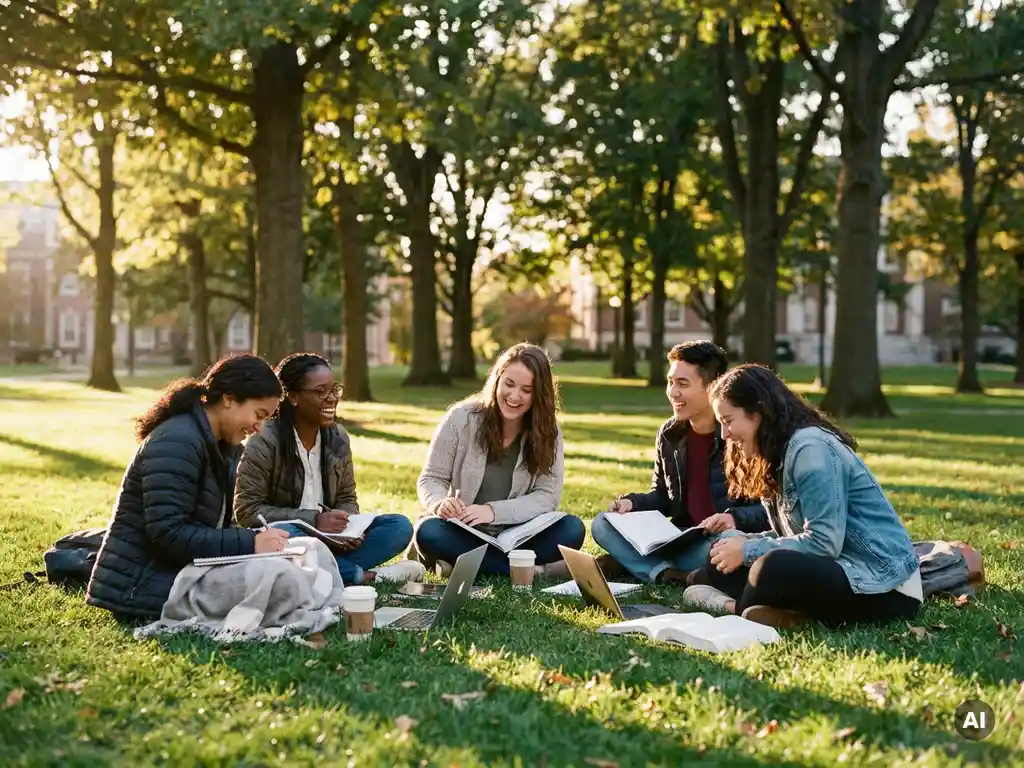
Campus community is important for academic success because it creates the social, emotional, and intellectual conditions students need to learn effectively. When students feel connected to the people and place around them, they engage more deeply with their studies, seek help sooner, and persist through challenges. The questions below unpack exactly how and why that connection translates into stronger outcomes.
How does belonging to a campus community affect grades?
Belonging to a campus community has a measurable positive effect on grades. Students who feel connected to their peers, faculty, and institution are more likely to attend class consistently, participate actively, and complete their degrees. That sense of belonging reduces the psychological friction that often leads to disengagement, which is one of the most common drivers of poor academic performance.
When students know their classmates and feel comfortable in their environment, they are more willing to ask questions, join study groups, and take intellectual risks in discussion. These behaviours directly support deeper learning. A student who sits in the back of a lecture hall feeling anonymous is far less likely to challenge an idea or seek clarification than one who feels genuinely part of the group.
Small-scale environments amplify this effect. In a college of around 500 to 550 students, every face becomes familiar quickly. Faculty know students by name, and students know each other across year groups and disciplines. That familiarity creates accountability and encouragement in equal measure, both of which support consistent academic effort.
What role do peer relationships play in learning?
Peer relationships are one of the most powerful drivers of learning in higher education. Students learn not only from their instructors but from the people sitting next to them, questioning the same texts, and working through the same problems. Peer dialogue challenges assumptions, exposes blind spots, and pushes thinking further than solo study typically can.
In an interdisciplinary setting, peer relationships carry even more weight. When students come from different academic backgrounds and cultural perspectives, the exchange of ideas becomes richer. A student studying environmental science who debates policy with a peer focused on government and society develops a more nuanced understanding of both fields than either could reach alone.
Peer relationships also create informal learning networks that extend well beyond the classroom. Study sessions, conversations over dinner, and spontaneous debates in shared spaces are all moments of genuine intellectual development. In a residential college setting, these moments happen naturally and frequently because students live, eat, and socialise in the same environment.
How does campus community support student mental health?
Campus community supports student mental health by reducing isolation, providing social support, and creating a sense of purpose. Students who feel embedded in a community are less likely to experience the loneliness and disconnection that frequently undermine wellbeing during the transition to higher education. A strong community provides both formal and informal support structures.
The first year of university is often the most psychologically demanding. Students are navigating a new academic environment while simultaneously building a social life from scratch. A close-knit campus community shortens that adjustment period significantly. When housing is guaranteed and shared, when common spaces bring students together daily, and when staff are genuinely accessible, students settle faster and feel safer.
Mental health and academic performance are deeply linked. A student managing significant anxiety or loneliness cannot give full attention to their studies. Conversely, a student who feels supported, seen, and connected is far better positioned to handle academic pressure, meet deadlines, and engage with challenging material. Campus community does not replace professional mental health support, but it creates the social foundation that makes everything else more manageable.
Does living on campus make a difference for academic outcomes?
Yes, living on campus makes a meaningful difference for academic outcomes. Residential students have more consistent access to academic resources, faculty, and peers, and they spend less time and energy on commuting and logistics. That proximity creates more opportunities for spontaneous collaboration, deeper social integration, and engagement with campus life in ways that directly support learning.
The benefits of on-campus living go beyond convenience. When students live alongside their classmates, the boundaries between social life and academic life become productively blurred. A conversation that starts over breakfast can continue into a study session. A debate that begins in a seminar room can carry on through the evening. These extended interactions deepen understanding in ways that a nine-to-five campus experience rarely allows.
Guaranteed housing removes a significant source of stress for students. Uncertainty about where you will live, how much it will cost, or whether you will find a suitable place takes real cognitive and emotional energy. When that uncertainty is eliminated from the start, students can direct their attention towards their studies and their community rather than logistics. This is particularly valuable for international students arriving in a new country.
What makes a campus community effective for academic growth?
An effective campus community for academic growth combines intellectual diversity, genuine accessibility, shared purpose, and opportunities to apply learning beyond the classroom. It is not simply about proximity or social activity. The most academically productive communities are ones where students are challenged by their peers, supported by their faculty, and connected to something larger than their individual degree.
Intellectual diversity and interdisciplinary exchange
When students come from different disciplines, nationalities, and backgrounds, the campus community becomes a learning environment in itself. Encountering genuinely different ways of thinking, different cultural reference points, and different academic frameworks develops the kind of intellectual flexibility that single-discipline programmes rarely produce. A community with over 70 nationalities and students working across six academic clusters creates that diversity naturally.
Accessible faculty and meaningful mentorship
The relationship between students and faculty shapes the quality of academic community more than almost any other factor. When class sizes are small and faculty live nearby or on campus, the mentorship relationship becomes genuine rather than transactional. Students receive faster feedback, more personalised guidance, and the kind of intellectual encouragement that builds confidence over time. That confidence translates directly into academic risk-taking and deeper engagement.
How can students get the most from their campus community?
Students get the most from their campus community by actively participating rather than observing, pursuing connections across disciplines and nationalities, and treating campus life as an extension of their academic development rather than a distraction from it. The students who thrive in community-centred environments are the ones who show up, contribute, and stay curious about the people around them.
Practically, this means joining student-led initiatives, engaging in community projects that connect the campus to the wider world, and taking advantage of the informal learning that happens outside the classroom. It also means being willing to have conversations that challenge your own thinking, whether that is in a seminar, a study group, or a shared kitchen.
Personal and professional development is also something students can actively shape. Courses and programmes that build transferable skills such as communication, teamwork, and adaptability are most effective when students approach them with intention. The same applies to language and cultural learning. International students who engage with the local community and language alongside their academic work develop a richer, more integrated experience.
Finally, students should take their peer relationships seriously as intellectual partnerships, not just social ones. The connections formed in a close-knit residential community often become long-term professional networks. Treating those relationships as meaningful from day one is one of the most valuable investments a student can make.
How UCR helps students build a community that supports success
University College Roosevelt is built around the belief that academic excellence and community are not separate goals. At UCR, the campus environment is designed to make both happen at once. Here is what that looks like in practice:
- Guaranteed housing for all students throughout their studies, creating a stable and connected residential environment from day one
- A small-scale community of around 500 to 550 students and 50 staff, where meaningful relationships with peers and faculty are the norm, not the exception
- Interdisciplinary learning across six academic clusters, so students engage with peers from genuinely different academic and cultural backgrounds every day
- Community Engaged Learning that connects students with local organisations, municipalities, and partners in Zeeland, extending the learning environment into the real world
- A mandatory Personal and Professional Development track that builds communication, teamwork, and adaptability alongside academic skills
- A vibrant inner-city campus in Middelburg, where daily life and academic life overlap naturally and frequently
If you are looking for a residential college experience where community and academic rigour reinforce each other, UCR offers exactly that. Discover what studying in a close-knit, internationally minded environment could mean for your development at ucr.nl.
Related Articles
- How do you write a motivation letter for a liberal arts college?
- What is it like to study in the Netherlands?
- How can students make the most of their extracurricular time at university?
- What is it like to study and live in the same place as your classmates?
- How does the Dutch directness affect international students socially?