


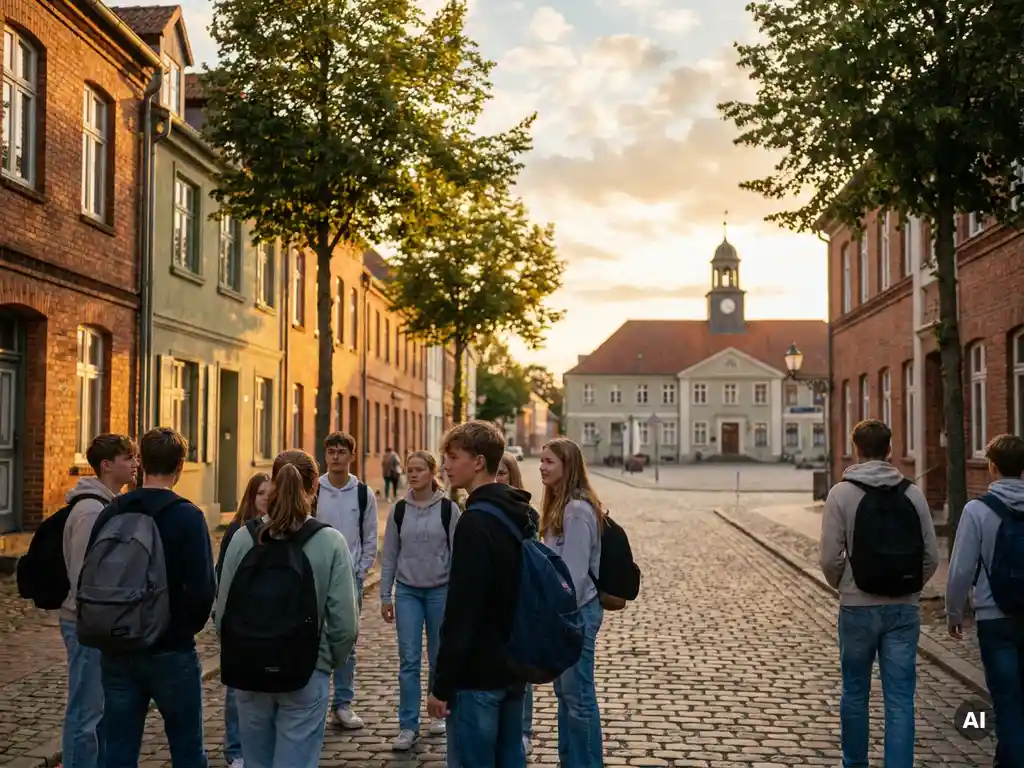
Studying in a small city as a university student is genuinely enjoyable for the right person. You get a tighter community, a calmer pace of life, and more direct access to the people and places that shape your education. The experience trades urban anonymity for real connection, and for students who want to be known rather than lost in the crowd, that is a meaningful difference. Below, this article answers the most common questions students ask before choosing a small-city university.
What are the real advantages of studying in a small city?
The real advantages of studying in a small city include a stronger sense of community, lower cost of living, easier navigation, and more direct relationships with faculty and local institutions. Unlike large university cities where students can disappear into the crowd, a small city forces proximity, and proximity builds connection.
In a compact urban environment, everything is within walking or cycling distance. You are not spending an hour on public transport to reach a lecture or a meeting. That recovered time adds up across a semester, and students consistently report feeling less stressed and more present in their daily lives.
Small cities also tend to offer more affordable housing, food, and social activities. The financial pressure that comes with living in a major metropolitan area is significantly reduced, which matters enormously for students managing a tight budget across three or four years of study.
Perhaps most importantly, small cities create conditions where students, faculty, and local organisations interact naturally and frequently. When a university is one of the most prominent institutions in a city, students are not invisible. They are participants in the life of the place, which opens doors that simply do not exist in cities where universities are just one institution among hundreds.
How does a small city shape your social life as a student?
A small city shapes your social life by concentrating it. Because the student population is smaller and the city itself is compact, you encounter the same people repeatedly, which builds deeper friendships faster than a large, dispersed campus environment typically allows. Social life in a small city is less about finding events and more about building relationships.
In a large city, social life can feel fragmented. Students scatter across neighbourhoods, commute from different areas, and socialise in ways that rarely overlap. In a small city, the opposite happens. The campus, the cafes, the parks, and the cultural spaces all sit close together, and the same community fills them.
At UCR in Middelburg, this dynamic is amplified by the residential campus model. With around 500 students all living on or near campus in the historic city centre, social life is embedded in the everyday. You do not need to plan to see people. You simply do. Friendships form in corridors, in courtyards, and over meals, not just at organised events.
That said, a small-city social scene does require some openness. There is no endless novelty of a major metropolis. Students who thrive here are those who invest in depth over breadth, who enjoy building a real community rather than sampling a city’s infinite options. For that kind of student, the social life in a small university city is genuinely rich.
Is it harder to find internships and career opportunities in a small city?
It can be more limited in volume, but not necessarily in quality. In a small city, the ratio of students to available opportunities is often more favourable than in a large city, where thousands of students compete for the same positions. Local organisations actively seek university students, and the relationships that lead to opportunities are easier to form.
In large cities, internship pipelines are competitive and often opaque. In a small city, a student who shows initiative can walk into a meaningful conversation with a local government office, a regional business, or a cultural institution within weeks of arriving. The access is more direct, even if the total number of organisations is smaller.
UCR’s location in Zeeland is a strong example of this. The college’s liberal arts programme is built around a living lab concept that connects students directly with municipalities, businesses, and community organisations. Students work on real projects addressing sustainability, public health, and social equity, not as an optional extra but as a core part of their education. That kind of hands-on experience is highly valued by employers and graduate programmes alike.
For students willing to complement their local experience with exchange programmes and digital networking, a small-city university can provide a career foundation that is both practical and distinctive. The depth of experience matters more to most employers than the size of the city it happened in.
What is daily student life actually like in a small university city?
Daily student life in a small university city is characterised by a slower, more intentional rhythm. Mornings are not rushed commutes. Afternoons are spent in small seminars, local fieldwork, or campus activities. Evenings happen within a community you actually know. It is a life that feels manageable, personal, and genuinely connected.
In Middelburg, UCR students live in a historic city centre with monumental buildings, a nearby coastline, and a pace of life that supports focus. The city is compact enough to walk everywhere, which means the boundary between campus life and city life is essentially nonexistent. Students study in the city and live in it simultaneously.
A typical week at a small-city university might include seminars with genuine discussion rather than lecture-hall passivity, project work with local partners, student-organised events on campus, and evenings spent with a close group of friends in a city that feels familiar. There is a comfort in knowing your environment and being known within it.
For international students in particular, this intimacy can ease the transition to a new country. UCR’s community of over 70 nationalities living in close proximity in Middelburg creates an environment where cultural exchange happens naturally, not in a forced or programmatic way. Student life at UCR reflects this: it is international in character but grounded in a specific, knowable place.
How does studying in a small city compare to a large university city?
Studying in a small city versus a large university city is fundamentally a trade-off between depth and breadth. Large cities offer more variety, more anonymity, and more external stimulation. Small cities offer more community, more focus, and more direct access to the people and institutions that shape your education. Neither is objectively better, but they produce very different experiences.
What large university cities offer
Large cities provide access to major cultural institutions, a wider range of internship employers, and a more diverse social scene. Students in Amsterdam, London, or Berlin can explore neighbourhoods, industries, and communities that simply do not exist in a city of 50,000 people. For students who want to be immersed in a metropolitan environment, that variety is genuinely valuable.
However, large-city universities often come with larger class sizes, more competition for academic attention, and a social environment that can feel isolating despite its apparent richness. It is entirely possible to spend three years at a large university and never feel truly known by your institution.
What small university cities offer
Small cities offer something different: the conditions for genuine belonging. When a university is a central part of a city’s identity, students are stakeholders in that place. Faculty are accessible. Local organisations are engaged. The campus community is tight enough that your contributions are visible and your relationships are real.
For students pursuing a liberal arts and sciences degree that emphasises interdisciplinary thinking, personal development, and real-world engagement, a small city is not a limitation. It is a feature. The proximity to community partners, the manageable scale, and the intensity of connection all reinforce exactly the kind of learning that a liberal arts education is designed to provide.
Who thrives most in a small-city university environment?
Students who thrive in a small-city university environment tend to be curious, socially confident, and genuinely interested in depth over novelty. They are not looking for a city to get lost in. They are looking for a community to grow within. If you want to be known, to build lasting relationships, and to engage meaningfully with your environment, a small-city university is likely a strong fit.
More specifically, the students who do best in small-city settings tend to share a few characteristics:
- Intellectual curiosity across disciplines: Without the distraction of a major city, academic engagement becomes a central part of daily life, which suits students who genuinely love learning.
- A preference for meaningful connection: Small communities reward people who invest in relationships. Students who value quality over quantity in their social lives find this environment deeply satisfying.
- An interest in real-world engagement: In a small city, the gap between the university and the community is narrow. Students who want to apply their knowledge beyond the classroom find more direct access here than in large, impersonal urban settings.
- Adaptability and openness: Small-city life requires you to create your own stimulation. Students who bring energy and initiative tend to shape the community around them rather than waiting for the city to entertain them.
- International or cross-cultural interest: Ironically, small international campuses can be more genuinely diverse than large urban universities, because the community is concentrated and interactions across cultures happen daily rather than occasionally.
Students who struggle in small-city environments are often those who need constant external novelty, who prefer anonymity, or who have a strong attachment to the specific cultural offerings of a major city. That is not a flaw. It simply means a different environment will serve them better.
How UCR helps you make the most of studying in a small city
University College Roosevelt is built around the specific advantages that Middelburg and Zeeland offer as a small-city setting. Rather than treating the location as a limitation, UCR has designed an entire educational model around it. Here is what that looks like in practice:
- Guaranteed housing for all students on a vibrant inner-city campus, so you are immediately embedded in the community from day one
- A living lab approach that connects every student with local government, businesses, and organisations in Zeeland for real-world project work
- Small seminar-based learning with a student body of around 500, meaning you are never anonymous in the classroom
- A flexible, interdisciplinary curriculum across six clusters that you design yourself, supported by a mandatory Personal and Professional Development track
- An international community of over 70 nationalities, creating genuine cross-cultural exchange within a compact, knowable campus
- Exchange opportunities through Utrecht University that allow you to extend your experience globally without sacrificing the depth of your home campus
If you are drawn to the idea of studying in a small city where your education is connected to a real community and your development is taken seriously as an individual, UCR may be exactly the environment you are looking for. Explore UCR’s admissions process to find out how to apply and what the programme involves.
Related Articles
- What is it like to be part of a multicultural student community?
- What activities help international students feel at home on campus?
- What is the cost of living in Middelburg compared to other Dutch cities?
- How do you find housing in Middelburg as an international student?
- How do you get around Middelburg without a car as a student?