


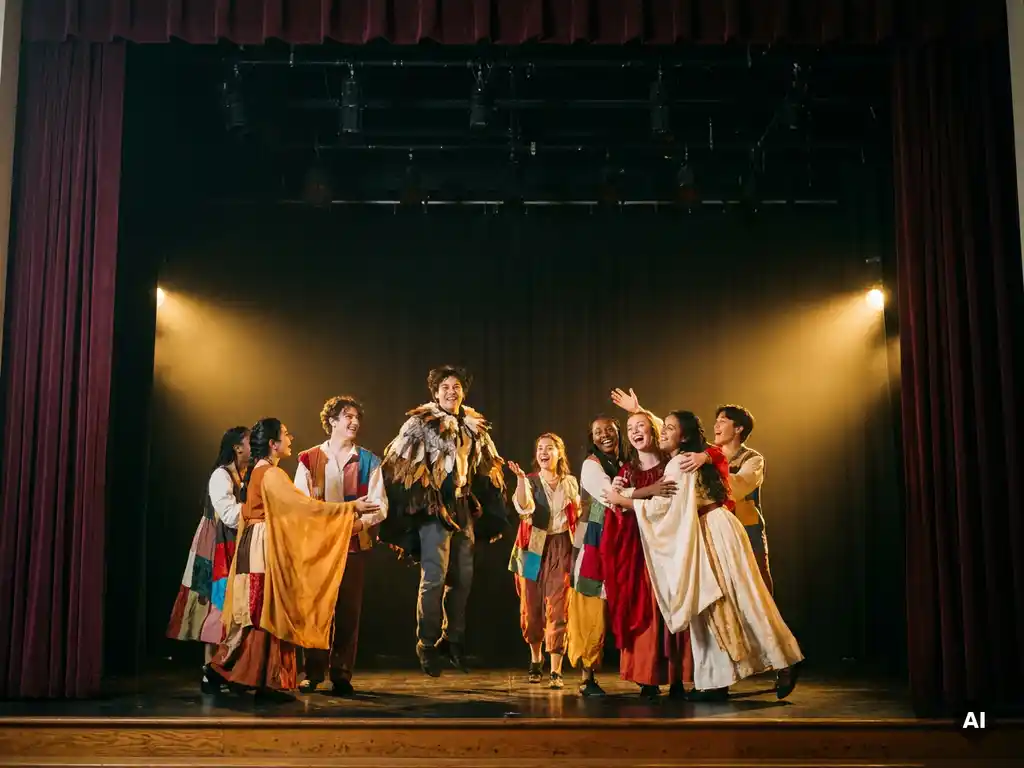
Participating in theater genuinely improves student skills across communication, collaboration, emotional intelligence, and critical thinking. These are not soft extras; they are core competencies that translate directly into academic performance and long-term career readiness. The sections below unpack the most common questions students and parents ask about the real benefits of drama and performing arts education.
What skills does theater actually build in students?
Theater builds a broad and transferable set of skills, including verbal communication, active listening, empathy, memorization, physical presence, and collaborative problem-solving. Unlike many classroom activities, performing arts education develops these skills simultaneously, under conditions that require students to apply them in real time, in front of an audience, without a safety net.
When a student rehearses a scene, they are not just learning lines. They are learning to read their scene partner, adjust their delivery based on feedback, manage nerves, and stay present under pressure. These are precisely the kinds of skills that matter in seminars, job interviews, and professional environments.
The core skill areas that theater arts education consistently develops include:
- Verbal and nonverbal communication: Projecting voice, controlling pace, and using body language purposefully
- Emotional intelligence: Interpreting and expressing emotion with nuance and authenticity
- Creative thinking: Approaching character, text, and staging as problems to solve imaginatively
- Discipline and time management: Meeting rehearsal deadlines and memorizing large volumes of material
- Resilience: Recovering from mistakes in real time, a skill with obvious applications far beyond the stage
How does theater improve communication and public speaking?
Theater improves communication and public speaking by giving students structured, repeated practice speaking in front of others in high-stakes conditions. Unlike a one-off class presentation, theater requires students to rehearse, receive directed feedback, and perform multiple times, building genuine fluency and confidence rather than just coping mechanisms for anxiety.
Public speaking is one of the most commonly cited fears among students. Theater addresses this not by eliminating discomfort, but by making it familiar. Students learn to breathe properly, modulate their voice, hold eye contact, and fill a room with presence. These skills carry over directly into academic contexts such as debates, seminars, and research presentations.
Theater also trains students to listen as much as they speak. A performance only works when actors respond authentically to one another. This active listening discipline is one of the less obvious but most valuable benefits of drama for students, and it makes a measurable difference in group discussions and professional meetings.
Can theater participation boost academic performance?
Yes, theater participation is associated with stronger academic performance, particularly in areas that require reading comprehension, analytical thinking, and oral communication. Engaging deeply with scripts, character motivations, and dramatic structure strengthens the same cognitive muscles used to analyze texts, construct arguments, and interpret complex ideas across disciplines.
Memorizing lines also builds working memory and concentration. Students who regularly learn and retain large amounts of text tend to develop stronger study habits and recall strategies that benefit them in examinations and research work.
Beyond cognitive benefits, the discipline required to balance rehearsal schedules with coursework teaches students to manage their time effectively. Many students who participate in theater report that the structure of production cycles, with firm deadlines and high accountability to a group, reinforces the kind of self-management that academic success demands.
For students pursuing interdisciplinary programmes that blend the arts, social sciences, and humanities, theater arts education can serve as a practical complement to theoretical study, grounding abstract ideas in human experience and storytelling.
How does being in a theater production develop teamwork?
Being in a theater production develops teamwork because a performance is entirely dependent on collective effort. No single actor can carry a production alone; every role, from lead to ensemble, from stage management to lighting, contributes to the outcome. This shared accountability builds a quality of collaboration that is difficult to replicate in conventional group assignments.
In a production, students must coordinate across roles and disciplines, negotiate creative differences, support one another through mistakes, and deliver a unified result under pressure. These are exactly the conditions under which real-world teamwork operates, and theater makes them routine rather than exceptional.
The performing arts also create unusual levels of trust between participants. Vulnerability is part of the process; students must commit to choices, take risks, and sometimes fail in front of their peers. Learning to do this in a supportive environment builds the kind of psychological safety that makes teams function well in any context.
Does theater help students manage stress and build confidence?
Theater helps students manage stress and build confidence by providing a structured, creative outlet for self-expression while gradually expanding their comfort zone in a supportive environment. The process of rehearsal, trying, failing, adjusting, and improving, normalizes imperfection and teaches students that growth comes from iteration rather than getting things right the first time.
Confidence built through theater is grounded in demonstrated capability. A student who has performed in front of an audience has evidence that they can handle exposure, recover from errors, and engage a room. This is qualitatively different from confidence built through reassurance alone.
Stress management benefits come partly from the physical demands of performance, breath control, movement, and vocal work all have documented calming effects, and partly from the community that theater creates. Students in productions often describe the cast and crew as one of the most supportive social environments they have experienced. That sense of belonging is itself a powerful buffer against academic and social stress.
How can theater experience benefit students beyond graduation?
Theater experience benefits students beyond graduation by equipping them with a set of transferable competencies that employers and graduate programmes consistently value: clear communication, adaptability, creative problem-solving, emotional intelligence, and the ability to perform under pressure. These are not incidental outcomes; they are the direct product of what theater training demands.
In professional contexts, the ability to present ideas persuasively, read a room, and adapt in real time gives theater-trained graduates a tangible edge. Industries from consulting and law to education, media, and public policy reward exactly the skills that drama and student development programmes cultivate.
Theater also develops a capacity for empathy that has lasting personal and professional value. Playing characters whose lives, beliefs, and circumstances differ from your own is an exercise in perspective-taking, a skill that underpins cross-cultural competency, ethical reasoning, and effective leadership.
For students considering careers that require communication across disciplines or cultures, the performing arts benefits extend well beyond what appears on a CV. The experience of making something collaboratively, under constraints, for a live audience, shapes how graduates approach complex challenges throughout their working lives.
How UCR helps students develop the skills theater builds
University College Roosevelt recognizes that the skills theater develops, communication, teamwork, resilience, and creative thinking, are exactly the skills students need to thrive in an interconnected world. UCR’s approach to student development is built around cultivating these same competencies through its educational model. Specifically:
- Personal and Professional Development track: Every student completes a mandatory trajectory focused on communication, teamwork, adaptability, and study skills, the same core areas that theater arts education strengthens
- Community Engaged Learning: Students collaborate with peers, local organizations, and community partners on real-world challenges, building the collective accountability and creative problem-solving that theater productions demand
- Interdisciplinary curriculum: The flexible curriculum across six clusters encourages students to combine disciplines, mirroring the cross-functional collaboration that defines both theater and professional life
- Small-scale community: With around 500 students on a residential campus, UCR creates the kind of close-knit, high-trust environment where students take creative risks and grow through shared experience
- Media, Culture and Communication cluster: Students with an interest in performance, storytelling, and public discourse can explore these themes academically alongside their broader liberal arts studies
If you are looking for a programme that develops you as a whole person, not just as a specialist, explore what studying at UCR looks like and discover how you can design a curriculum that reflects both your intellectual interests and your ambitions beyond the classroom.
Related Articles
- What are the benefits of studying Liberal Arts and Sciences in Europe?
- What is the orientation year visa for graduates in the Netherlands?
- Can you stay in the Netherlands after graduating from a Dutch university?
- How do you get involved in extracurricular activities at university?
- What is the cost of living in Middelburg compared to other Dutch cities?