


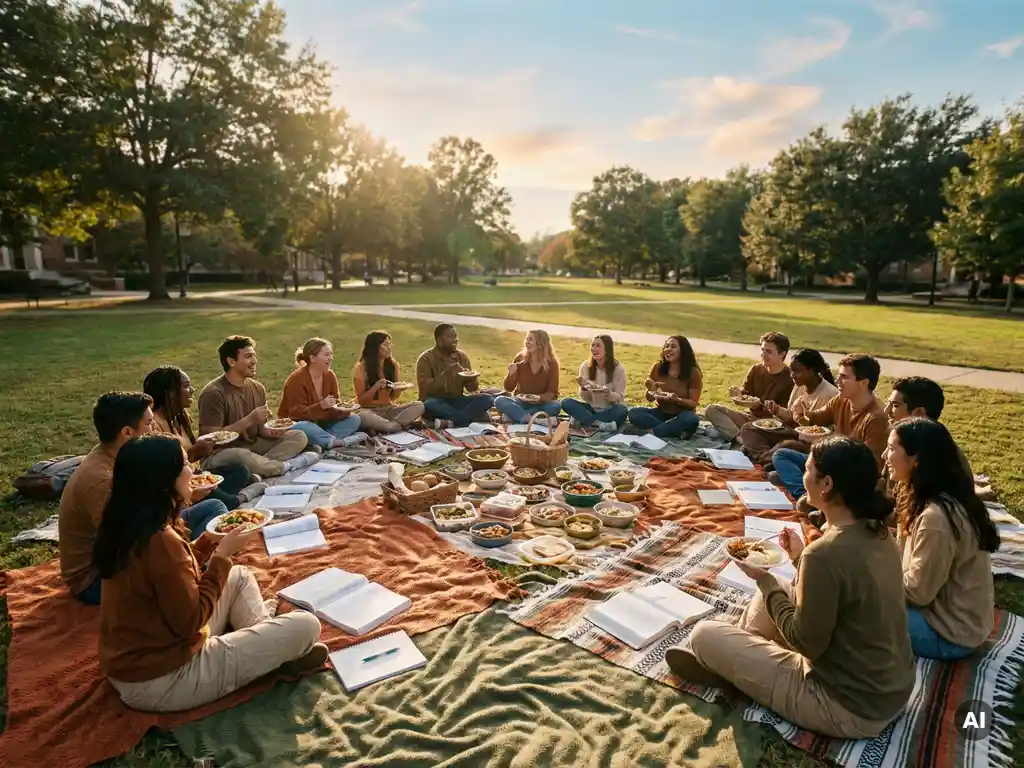
Being part of a multicultural student community means living and learning alongside people from genuinely different backgrounds, languages, and worldviews every single day. It challenges assumptions, builds empathy, and develops the kind of cross-cultural fluency that no textbook can replicate. The questions below unpack exactly what that experience looks and feels like, from the friendships you form to the skills you carry with you long after graduation.
How does living in a multicultural community change the way you think?
Living in a multicultural student community fundamentally reshapes how you interpret the world around you. When your classmates come from different countries, educational traditions, and cultural frameworks, you are constantly exposed to perspectives that challenge your default assumptions. Over time, this does not just make you more open-minded, it makes you a sharper, more critical thinker.
The shift happens gradually. Early on, you notice that people approach the same problem very differently depending on their background. A student from a collectivist culture may prioritise group consensus in a debate, while someone from a more individualist tradition pushes for decisive personal positions. Neither is wrong. Sitting with that tension, understanding both, and synthesising something better: that is where real intellectual growth begins.
Cultural diversity also forces you to interrogate your own assumptions. When your worldview is the only one in the room, it is easy to treat it as neutral or universal. In a genuinely international community, that illusion disappears quickly. You start to see your own perspective as one lens among many, which is one of the most valuable cognitive shifts a student can make.
What challenges do students face in a multicultural campus environment?
Students in a multicultural campus environment commonly face challenges around communication styles, cultural misunderstandings, and the discomfort of navigating unfamiliar social norms. These friction points are real, but they are also precisely what makes the experience formative. Growth rarely happens without some degree of productive difficulty.
Language is often the first hurdle. Even when everyone speaks English, there are significant differences in directness, humour, formality, and how disagreement is expressed. What reads as confident in one culture can come across as rude in another. Learning to read these signals, and to communicate across them, takes patience and genuine curiosity.
Homesickness and cultural adjustment are equally common, particularly in the first semester. Moving to a new country while simultaneously adapting to a new academic system and a new social environment is a lot to manage at once. Students who thrive are usually those who lean into the community rather than retreating from it, joining student-led activities, being open about their experience, and asking questions rather than making assumptions.
There is also the challenge of forming meaningful connections across difference. Surface-level interaction is easy. Deep friendship requires more effort when cultural references, communication styles, and even humour do not immediately align. But students who push through that initial awkwardness consistently report that the friendships they build across cultural lines are among the most rewarding of their lives.
How do friendships form across cultural and language differences?
Friendships in a multicultural student community form most naturally through shared experience rather than shared background. Living together, working on group projects, navigating a new city, and facing the same academic pressures creates a powerful common ground that cuts across cultural and language differences.
Residential campuses accelerate this process significantly. When you eat breakfast with the same people you studied with the night before, and those are the same people you see at a student event on Friday evening, relationships develop quickly and organically. Proximity and repetition do a lot of the work that intentional socialising might otherwise require.
Shared intellectual curiosity also plays a major role. Students drawn to interdisciplinary, internationally oriented programmes tend to be genuinely interested in other people’s ideas and experiences. That curiosity creates natural openings for connection: conversations that start as academic discussions often become the foundation for lasting friendships.
Language differences rarely prevent close friendships from forming, though they do shape them. Many students in international communities develop a kind of creative, hybrid communication style, mixing languages, using humour across barriers, and finding ways to express nuance even when vocabulary falls short. That creative negotiation of language is, in itself, a bonding experience.
What skills does a multicultural student community help you develop?
A multicultural student community helps you develop cross-cultural communication, adaptability, empathy, and collaborative problem-solving, skills that are consistently ranked among the most valued by employers and graduate programmes worldwide. These are not soft extras; they are core competencies for anyone who wants to work or lead in a globally connected world.
- Cross-cultural communication: You learn to adjust your communication style, listen more carefully, and navigate different norms around directness, hierarchy, and conflict.
- Adaptability: Constant exposure to new perspectives and unexpected situations builds genuine flexibility, the ability to shift approach when circumstances change.
- Empathy: Understanding how someone’s background shapes their worldview makes you a more thoughtful collaborator, leader, and human being.
- Collaborative problem-solving: Working in diverse teams teaches you to integrate different viewpoints into stronger, more creative solutions than any one perspective could produce alone.
- Self-awareness: Seeing your own culture reflected back through others’ eyes helps you understand your own assumptions, biases, and blind spots.
These skills develop through experience rather than instruction. You do not acquire them by reading about cultural difference, you acquire them by living it, making mistakes, reflecting, and trying again. That is why the residential, internationally diverse environment of a liberal arts college is such a powerful setting for this kind of development.
How does a multicultural environment affect academic learning?
A multicultural environment enriches academic learning by bringing genuinely diverse perspectives into every seminar, group project, and classroom discussion. When students from different countries and disciplines engage with the same question, the range of frameworks, references, and analytical approaches they bring produces richer, more complex understanding than a homogeneous group could achieve.
This is especially true in interdisciplinary programmes, where the subject matter itself, global challenges like sustainability, public health, social justice, and governance, is inherently cross-cultural. A student from Southeast Asia, one from West Africa, and one from Northern Europe will each bring different lived contexts to a discussion of climate policy or media influence. That diversity of experience does not just add colour to the conversation; it changes the quality of the analysis.
Research also benefits. When students work together across cultural and academic backgrounds, they are more likely to question assumptions, identify blind spots, and arrive at more nuanced conclusions. The liberal arts and sciences programme at UCR is built around exactly this kind of interdisciplinary, internationally oriented learning, where the diversity of the student body is treated as an academic asset, not just a social one.
There is also a motivational dimension. Learning alongside peers who have made significant sacrifices to pursue their education, some travelling thousands of kilometres from home, tends to raise everyone’s sense of purpose and commitment. The international student community becomes a source of academic inspiration as well as personal support.
What does daily life actually look like in a multicultural student community?
Daily life in a multicultural student community is more ordinary than people expect, and more extraordinary than they can fully anticipate before experiencing it. It means sharing meals with people from different continents, discussing weekend plans in a mix of accents, and casually learning about traditions, foods, and perspectives that were entirely unfamiliar a few months earlier.
On a residential campus, the multicultural dimension is woven into every part of the day. Mornings might start with a conversation in the dining hall that spans three countries and two languages. Afternoons involve seminars where a question about governance or media draws on perspectives from students who have lived under very different political systems. Evenings bring student-organised events that celebrate different cultural traditions: music, food, film, and storytelling from across the world.
The campus itself becomes a kind of living map of the world. With students from over 70 nationalities sharing the same small, close-knit space, cultural exchange happens continuously and informally. You do not need to travel to encounter the world, the world is already there, in the room next to yours.
There are quieter moments too. Study sessions in the library, walks through Middelburg’s historic streets, late-night conversations about identity, ambition, and what home means when you are far from it. These are the experiences that students consistently describe as the most formative, not the big events, but the accumulation of small, genuine human connections across difference.
How UCR helps you thrive in a multicultural student community
University College Roosevelt is built around the belief that a truly international, close-knit community is not just a nice feature of university life, it is central to the education itself. At UCR, the Bachelor of Liberal Arts and Sciences brings together students from over 70 nationalities in a small residential campus where multicultural learning happens every day, in and out of the classroom.
- Guaranteed housing for all students, creating a shared residential experience that accelerates genuine connection
- A fully English-taught programme that welcomes international students into a diverse, inclusive academic environment
- Interdisciplinary clusters that encourage collaboration across academic backgrounds and cultural perspectives
- A mandatory Personal and Professional Development track that builds cross-cultural communication and adaptability
- Community Engaged Learning and real-world projects that put diverse student teams to work on meaningful challenges
- Dutch language courses for international students to ease integration into Dutch culture and society
If you are ready to learn in a community where diversity is a genuine strength, explore what life at UCR looks like at ucr.nl.
Related Articles
- What is the difference between a university and a hogeschool in the Netherlands?
- How do you apply to a Dutch university as an international student?
- How hard is it to learn Dutch as an international student?
- How do you balance academics and extracurricular activities at college?
- What health insurance do international students need in the Netherlands?