


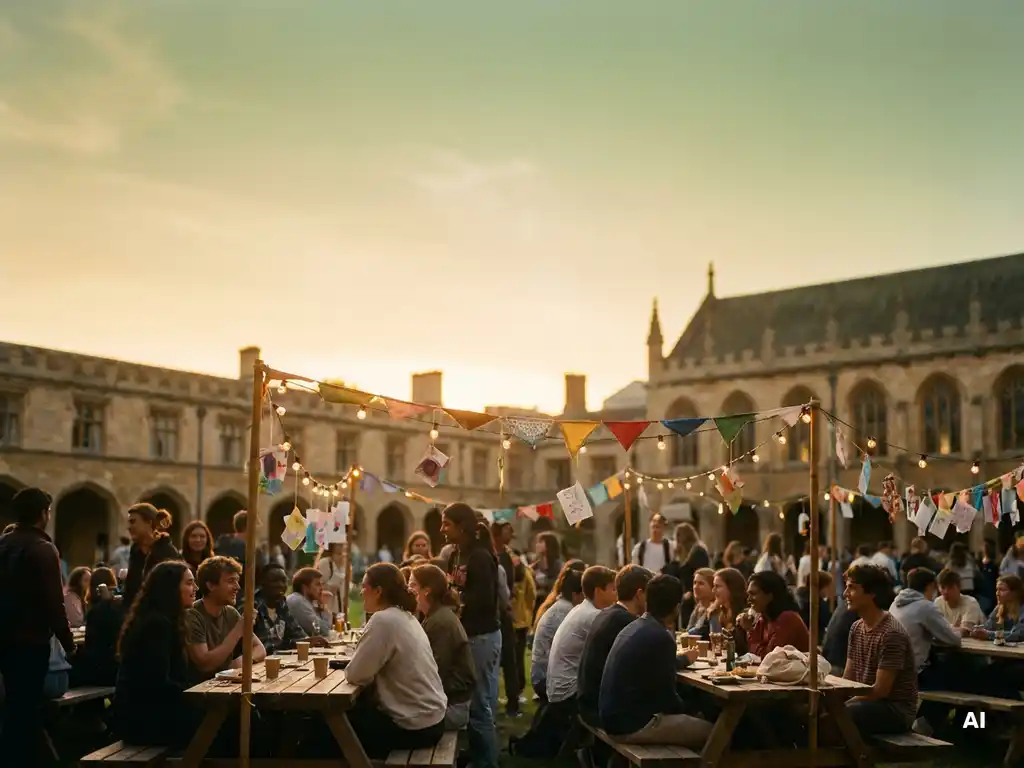
Student-run events contribute to campus life by creating the social fabric that holds a university community together. At University College Roosevelt, where around 500 students from more than 70 nationalities share a residential campus in Middelburg, student-organised activities are not a side feature, they are central to what makes the UCR experience distinctive. Below, you will find answers to the most common questions about student-led events and why they matter at a liberal arts college.
What kinds of events do students organise on campus?
Students at UCR organise a wide range of events, from cultural celebrations and debate evenings to sports tournaments, film screenings, charity drives, and themed social nights. Because the campus brings together students from over 70 nationalities, the variety of student-led activities reflects an equally broad range of interests, traditions, and creative ideas.
Student associations and informal groups form around shared passions, whether that is sustainability advocacy, entrepreneurship, music, or international cuisine. These groups take the lead in planning and executing events that reflect their members’ backgrounds and curiosities. A student from the Netherlands might co-organise a cultural exchange evening alongside peers from Southeast Asia or East Africa, resulting in events that genuinely reflect the international character of the campus community.
The residential setting makes spontaneous collaboration easier. When students live, study, and socialise in the same space, ideas for events emerge naturally from everyday conversations. This is one reason UCR campus culture feels alive and self-renewing, students are not waiting for an institution to schedule their social lives. They shape it themselves.
How do student-run events build a sense of community?
Student-run events build community by giving every person on campus a shared experience to rally around. When students organise and attend events together, they form connections that go beyond the classroom, connections built on trust, collaboration, and mutual enjoyment. At a small residential college like UCR, those connections accumulate quickly into a genuine sense of belonging.
The scale of the campus matters here. With roughly 500 students, UCR is small enough that a single well-organised event can bring together a meaningful proportion of the entire student body. A debate evening, a cultural festival, or a charity fundraiser is not a peripheral activity, it is something most students will hear about, talk about, and often attend. That shared participation strengthens the social bonds that define life on campus.
Student-led events also create visible opportunities for inclusion. When a new student arrives and sees peers actively running activities they care about, it signals that this is a community where participation is expected and welcomed. The message is clear: you are not just a member of this campus, you help build it.
What skills do students develop by organising campus events?
Organising campus events develops practical, transferable skills including project management, communication, teamwork, budgeting, and problem-solving. These are not abstract competencies, they are tested in real conditions, with real stakes, and with real people depending on the outcome.
When a student takes on the role of event coordinator, they quickly learn to manage competing priorities, negotiate with stakeholders, delegate tasks, and adapt when things do not go to plan. These are exactly the kinds of challenges that employers and graduate programmes value, and they are difficult to develop in a purely academic setting.
This connects directly to UCR’s broader educational philosophy. The college’s mandatory Personal and Professional Development trajectory is designed to cultivate transferable skills like communication, adaptability, and teamwork. Student-run events are an organic extension of that development, a live rehearsal for the collaborative, multi-stakeholder environments graduates will encounter in their careers.
Students who lead events also develop confidence in their own voice and judgment. Deciding on a theme, managing a budget, coordinating volunteers, and responding to feedback in real time builds a kind of self-assurance that coursework alone rarely produces.
How do student events complement academic learning at a liberal arts college?
At a liberal arts college, student-run events complement academic learning by putting interdisciplinary thinking into practice outside the classroom. A debate on climate policy, a panel on media ethics, or a community fundraiser for a local cause all require students to draw on knowledge from multiple fields, exactly the kind of integrative thinking that a liberal arts education is designed to develop.
UCR’s academic model encourages students to connect ideas across disciplines and engage with real-world challenges. Student-organised events extend that model into daily campus life. A student studying Environment and Sustainability might organise a zero-waste campus day. A student in Government and Society might convene a mock parliament. These events are not separate from academic growth, they are expressions of it.
The “living lab” concept that shapes UCR’s educational approach applies equally to campus life. The campus itself becomes a space for experimentation, civic engagement, and creative problem-solving. When students organise events that engage the wider Middelburg community, they are applying the same principles of community engagement and social responsibility that run through the academic curriculum.
There is also a reciprocal effect. Students who are actively engaged in campus life tend to bring more energy, perspective, and real-world grounding to their academic work. The skills and experiences gained through organising events feed back into seminar discussions, group projects, and research questions.
Who can get involved in running campus events?
Any UCR student can get involved in running campus events, regardless of their academic cluster, nationality, or year of study. Student-led activities at UCR are open and inclusive by design, the campus culture actively encourages participation rather than reserving leadership roles for a select few.
Students can join existing associations, propose new ones, or collaborate informally with peers who share a common interest. The small scale of the campus makes it straightforward to find like-minded people, pitch an idea, and move from concept to event relatively quickly. There is no lengthy approval process or institutional gatekeeping standing between a student with an idea and the opportunity to act on it.
First-year students are particularly encouraged to get involved early. Because UCR’s residential model places all students in the same living environment from day one, newcomers have immediate access to the social networks and informal structures through which events are planned. Joining a student-run initiative in the first semester is one of the fastest ways to feel at home on campus and to start building the kind of relationships that last well beyond graduation.
How UCR supports a thriving student-led campus culture
UCR is built to make student-led campus life possible and meaningful. Several features of the college work together to support an active, student-driven community:
- Guaranteed residential housing places all students in the same campus environment, making it easy to connect, collaborate, and co-organise events throughout the year
- A small, international community of around 500 students from over 70 nationalities creates a naturally diverse pool of ideas, traditions, and perspectives to draw on
- The Personal and Professional Development trajectory builds the communication, teamwork, and organisational skills that students put to use when running campus activities
- An interdisciplinary academic culture encourages students to think across boundaries, which translates into events that bring together students from different clusters and backgrounds
- Strong ties to the Middelburg community open up opportunities for student-organised events that extend beyond the campus and engage with the wider region
If you are looking for a university experience where you help shape the culture around you, UCR offers exactly that. You do not just attend events, you create them. Discover the UCR experience and see what life on campus looks like when students take the lead.