


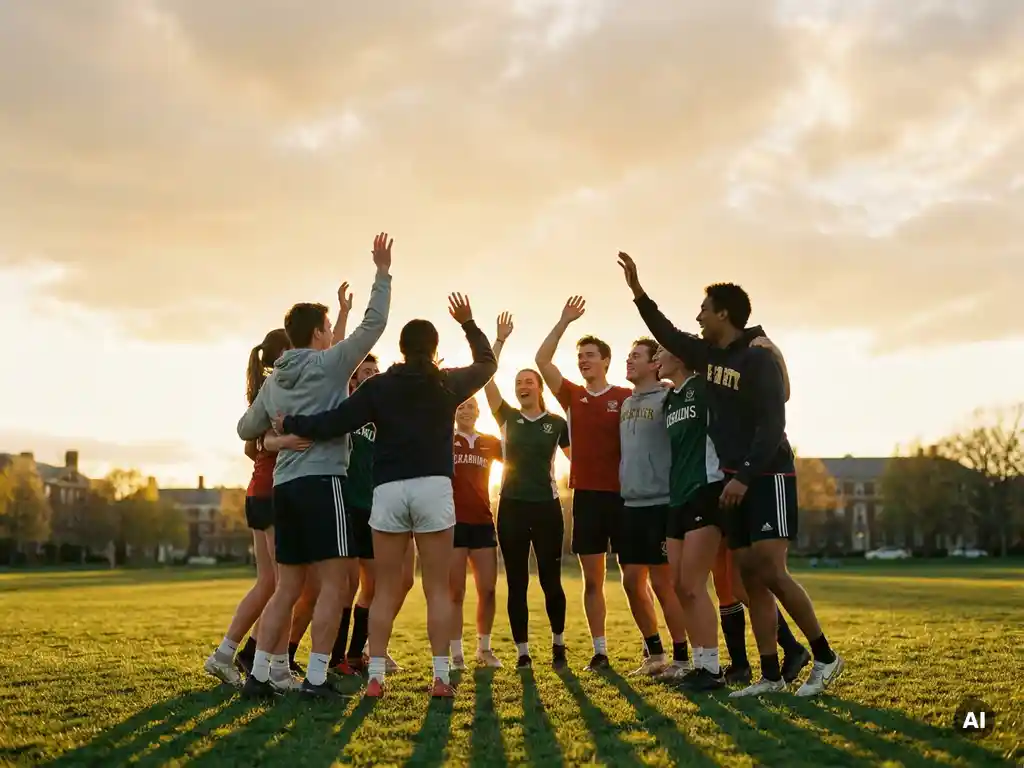
Sport plays a significant role in the social life of university students. It creates natural opportunities to meet people, build routines, and feel part of something larger than academic study. For many students, especially those arriving on campus for the first time, joining a sports team or fitness group is one of the fastest routes to genuine belonging. The questions below unpack exactly how sport shapes university life, from friendships and mental health to campus culture and student integration.
How does sport help university students make friends?
Sport helps university students make friends by creating structured, repeated social contact in a low-pressure environment. Unlike a classroom or social event, sport gives people a shared goal, a reason to show up regularly, and a natural conversation starter. These conditions are ideal for forming real friendships, not just acquaintances.
When students train together, compete together, or even just cheer each other on, they build a kind of trust that is hard to manufacture in other settings. There is a shared vulnerability in trying something physical in front of others, and that vulnerability tends to accelerate connection. Over time, training sessions become social rituals, and teammates become the people students turn to outside of sport as well.
The regularity of sport is a particularly important factor. Friendships deepen through repeated contact, and a weekly training schedule provides exactly that. Students who join a sports club in their first weeks on campus often find that it anchors their entire social network, giving them a ready-made group at a time when everything else feels new and uncertain.
What types of sport are most popular among university students?
The most popular sports among university students tend to be team-based, low-cost, and easy to join without prior competitive experience. Football, basketball, volleyball, and swimming consistently attract large numbers of student participants across campuses worldwide. Running clubs and yoga groups have also grown significantly in popularity, particularly among students who prefer individual or low-intensity activity.
Team sports remain dominant in university settings for a straightforward reason: they are inherently social. You cannot play football or volleyball alone, which means joining automatically places you within a group. This social structure is a major draw for students who want to meet people as much as they want to exercise.
Beyond traditional sports, many university campuses have seen a rise in recreational and lifestyle-based activities such as climbing, martial arts, ultimate frisbee, and dance. These activities appeal to students who may not have played competitive sport at school but are open to trying something new in a welcoming, non-elite environment. The key for many students is not the sport itself but the community it offers.
How does playing sport affect student mental health and wellbeing?
Playing sport has a well-established positive effect on student mental health and wellbeing. Regular physical activity reduces stress, improves mood, supports better sleep, and builds resilience. For university students navigating academic pressure, new environments, and major life transitions, sport provides a consistent outlet that supports emotional balance alongside physical fitness.
The mental health benefits of sport go beyond the physiological effects of exercise. Belonging to a team or sports community gives students a sense of identity and purpose outside academic performance. This matters because student wellbeing is closely tied to feeling connected and valued, not just to achieving good grades.
Sport also teaches students how to handle setbacks in a relatively safe context. Losing a match, missing a goal, or struggling to improve a skill are all manageable challenges that build the kind of emotional resilience students need throughout their studies and beyond. The Personal and Professional Development focus that institutions like UCR embed into student life reflects a similar understanding: that growth happens through challenge, reflection, and community, not just through academic content alone.
Students who exercise regularly also tend to report better concentration and energy levels during study. The relationship between physical activity and cognitive performance is well supported, making sport not just a social or emotional benefit but an academic one too.
Can sport help international students feel at home on campus?
Sport can be one of the most effective tools for helping international students feel at home on campus. It removes language barriers, creates immediate common ground, and gives students from different cultural backgrounds a shared experience to bond over. For students arriving in a new country, a sports team can provide a sense of belonging before they have fully settled into academic or social life.
International students often face a particular challenge in their first weeks: they are surrounded by people but may not yet feel connected to any of them. Sport addresses this directly. On a football pitch or in a swimming lane, what matters is showing up and participating. Cultural differences, language gaps, and social awkwardness become far less significant when everyone is focused on the same activity.
At a campus like UCR, where over 70 nationalities study together in a small, residential community, sport plays a natural role in bridging those differences. When students from the Netherlands, Germany, Nigeria, and South Korea are all on the same volleyball team, they are not just playing sport together. They are learning how to communicate, collaborate, and trust people who are different from themselves. These are precisely the cross-cultural competencies that a liberal arts and sciences education aims to develop.
Sport also gives international students a ready-made social calendar. Knowing that training happens every Tuesday and Thursday, and that there is a match on Saturday, provides structure and routine at a time when everything else is unfamiliar. That predictability is genuinely comforting.
How does sport participation shape campus culture at university?
Sport participation shapes campus culture by creating shared traditions, a sense of collective identity, and a social fabric that extends well beyond the playing field. Campuses where students actively engage in sport tend to have stronger community bonds, higher levels of peer interaction, and a more vibrant, energetic atmosphere overall.
When students watch each other compete, celebrate wins together, and support teammates through losses, they are building a culture of mutual investment. This kind of culture does not stay confined to sport. It spills into how students collaborate academically, how they treat one another in shared living spaces, and how they engage with campus life more broadly.
Sport also creates visible, student-led activity on campus. Teams organise events, tournaments, and social gatherings that give the wider student community something to rally around. In a residential college setting especially, where students live and study in close proximity, this kind of shared activity is essential for maintaining a positive and cohesive community atmosphere.
The values that sport reinforces, including teamwork, accountability, and perseverance, tend to become embedded in the broader campus culture when sport participation is high. Students carry those values into group projects, community engagement activities, and their personal relationships. In this way, sport is not just an extracurricular activity. It is a genuine contributor to the kind of campus culture that makes a university feel like a community rather than just an institution.
How UCR supports student wellbeing through community and campus life
UCR’s small, residential campus in Middelburg creates the ideal conditions for sport and social life to thrive alongside academic study. With around 500 students living and learning together, the community is close-knit enough for sport to genuinely shape how students connect, grow, and feel at home. Here is what makes the UCR environment particularly well suited to student wellbeing through sport and community:
- Guaranteed housing for all students, creating a stable residential community where social bonds, including those formed through sport, develop naturally
- A student-led campus culture with active clubs and activities that give students ownership over their social and recreational lives
- A diverse international community of over 70 nationalities, where sport serves as a universal language that bridges cultural differences
- A mandatory Personal and Professional Development track that builds the teamwork, communication, and resilience skills that sport also reinforces
- A small, intimate campus in the heart of Middelburg, where students, faculty, and staff interact daily in ways that make community feel real rather than institutional
If you are looking for a university experience where academic ambition and personal growth go hand in hand, UCR offers exactly that. Discover the UCR experience and find out how you can shape your own path in one of the Netherlands’ most unique higher education environments.
Related Articles
- How hard is it to learn Dutch as an international student?
- How early should you apply to study in the Netherlands?
- How do you start a new student club or society at university?
- What is the difference between student life at a Dutch university and a liberal arts college?
- How does the Dutch directness affect international students socially?