


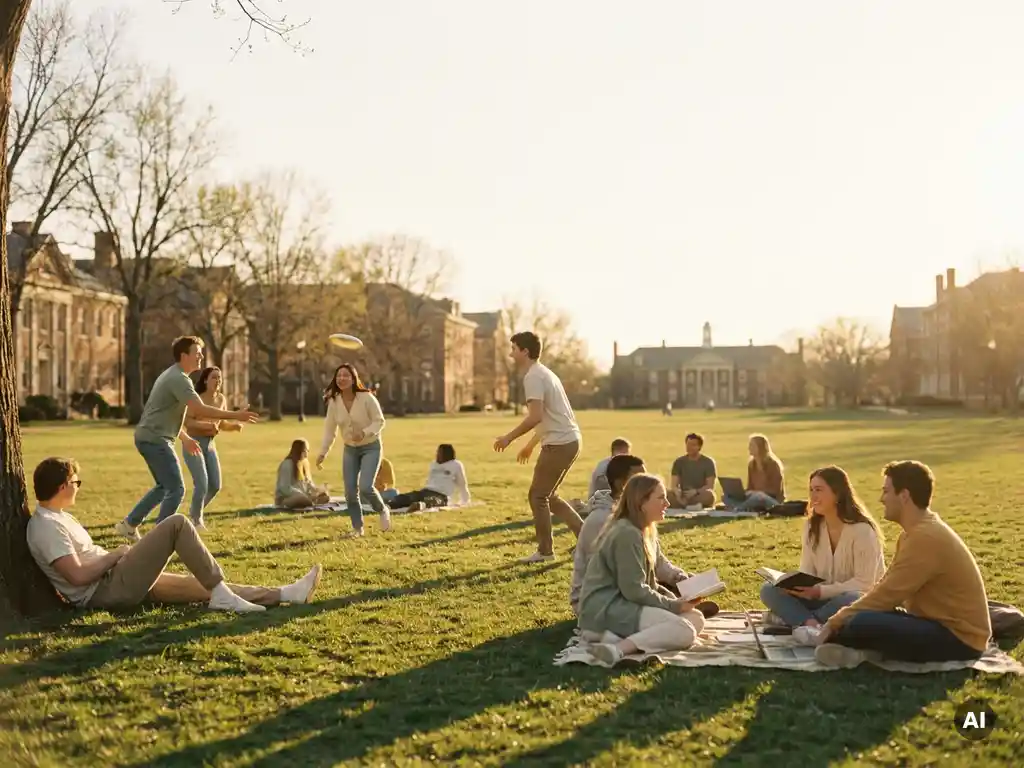
Residential college students spend their free time in a rich mix of social activities, student clubs, sports, creative pursuits, and exploration of the surrounding area. Because they live on campus alongside classmates and staff, the boundary between academic life and personal life is intentionally blurred in the best possible way. The sections below unpack exactly how that plays out across different dimensions of daily student life.
What activities are available to students living on a residential campus?
Students living on a residential campus have access to a wide range of extracurricular activities, from student-run clubs and sports teams to cultural events, debates, and community projects. At a small liberal arts college, these activities are largely student-initiated, which means the offering evolves year on year based on what students themselves want to create and lead.
At UCR, the campus community of around 500 students supports an active, student-led culture where individuals can launch new initiatives without navigating layers of bureaucracy. Because the campus is small and tight-knit, it is genuinely easy to get involved. Common categories of extracurricular activity at residential liberal arts colleges include:
- Student associations and clubs covering interests from debating and journalism to sustainability advocacy and entrepreneurship
- Sports and fitness, including team sports, individual training, and outdoor recreation
- Arts and performance, such as music, theatre, film screenings, and visual arts projects
- Community-engaged projects that connect students with local organisations, municipalities, and businesses
- Academic and intellectual events, including guest lectures, symposia, and student-run panels
The residential setting is key here. When you live where you study, the campus becomes more than a place to attend class. It becomes a living environment where ideas, friendships, and initiatives all grow in the same space.
How do residential college students typically socialise outside class?
Outside class, residential college students socialise primarily through shared living spaces, student events, campus traditions, and informal gatherings that emerge naturally from living in close proximity to peers. The residential model removes the commute that separates students at non-residential universities, making spontaneous connection the norm rather than the exception.
At a college like UCR, with over 70 nationalities represented in a community of roughly 500 students, socialising outside class takes on an international dimension. A conversation in the common room might involve students from five different countries. Shared meals, campus events, and student-organised activities all create regular touchpoints for connection.
Some of the most meaningful social experiences at residential liberal arts colleges happen through:
- Informal gatherings in shared housing spaces and communal areas
- Student-organised parties, cultural evenings, and themed events
- Sports matches and fitness activities with housemates and course mates
- Collaborative work on community projects that extends beyond the classroom
- Weekend trips and group outings to nearby towns, cities, or natural areas
The social fabric of a residential campus is built as much by these unplanned moments as by formal events. Living alongside people from different academic backgrounds and cultures accelerates the kind of social learning that simply takes longer in a commuter setting.
Do residential college students have time for hobbies and personal interests?
Yes, residential college students do have meaningful time for hobbies and personal interests, and a well-designed liberal arts programme actively encourages this. Pursuing personal passions outside the classroom is not treated as a distraction from academic work but as an integral part of becoming a well-rounded individual.
At UCR, this philosophy is embedded in the curriculum through a mandatory Personal and Professional Development trajectory, which recognises that skills like creativity, adaptability, and self-awareness grow as much through personal pursuits as through coursework. Students are encouraged to bring their whole selves to campus life, not just their academic selves.
In practice, students at residential liberal arts colleges pursue an impressive range of personal interests alongside their studies, including:
- Music, visual art, photography, and creative writing
- Cooking, language learning, and cultural exploration
- Volunteering and civic engagement in the local community
- Fitness, yoga, cycling, and outdoor adventure
- Entrepreneurial side projects and independent research
The flexibility of a liberal arts curriculum also means that in many cases, a personal hobby can find its way into coursework. A student passionate about environmental photography might channel that interest into a sustainability project. A musician might explore the sociology of sound in a media studies course. The programme is designed to be responsive to who students are, not just what they are studying.
What role does the surrounding town or region play in student life?
The surrounding town and region play a significant role in residential college student life, offering cultural, recreational, and professional opportunities that extend the campus experience into the wider world. At colleges embedded in a specific place, the local environment becomes part of the education itself.
UCR is located in Middelburg, the historic capital of Zeeland in the southwest of the Netherlands. The town is home to monumental buildings, a vibrant market culture, and a strong sense of local identity. For students, Middelburg is not just a backdrop. It is a place to explore, engage with, and contribute to.
Zeeland itself adds a distinctive dimension to campus life at UCR. The province offers:
- Kilometres of coastline and beaches within easy reach for weekend trips
- High levels of sunshine compared to much of the Netherlands, making outdoor activity genuinely appealing
- A delta landscape that connects directly to UCR’s academic work in sustainability and environmental science through the Delta Climate Center
- A close-knit local community where students can build real relationships with residents, businesses, and organisations
Because UCR emphasises Community Engaged Learning, students regularly work with local partners on real projects. This means free time and academic time can blend productively. A student might spend a Saturday afternoon cycling along the coast and then spend Monday working with a local municipality on a sustainability initiative. The region shapes how students learn and how they relax.
How do students balance free time with academic demands at a residential college?
Students at residential colleges balance free time with academic demands by benefiting from a structured yet flexible environment where support is close at hand and time management becomes a skill developed through daily practice. Living on campus means that academic resources, social opportunities, and personal space are all within walking distance, which makes managing the rhythm of study and rest easier than in a commuter setting.
At a selective liberal arts college, the academic workload is genuinely demanding. Weekly coursework at UCR incorporates guest lectures, student presentations, fieldwork, debates, and individual assignments. Students are expected to engage deeply and take ownership of their learning. That level of engagement requires intentional time management.
Several structural features of the residential college model support this balance:
- Small class sizes mean students receive more direct feedback and spend less time navigating large, impersonal systems
- Proximity to faculty and staff, many of whom live in or near Middelburg, makes it easier to ask questions and resolve problems quickly
- A mandatory Personal and Professional Development trajectory explicitly builds skills like study habits, adaptability, and self-organisation
- A flexible curriculum allows students to shape their schedule around their energy and interests, rather than following a rigid timetable
- Campus community norms that treat rest and recreation as legitimate parts of student life, not as guilty indulgences
The key insight is that balance at a residential college is not about keeping academic life and personal life strictly separate. It is about integrating them in a way that is sustainable and enriching. Students who thrive in this environment tend to be those who are genuinely curious, self-motivated, and open to learning from every part of their experience, inside and outside the lecture room.
How UCR shapes student life beyond the classroom
UCR is built around the idea that who you become at university matters as much as what you study. The residential campus in Middelburg creates the conditions for a student life that is socially rich, personally stretching, and academically serious all at once. Specifically, UCR supports students’ lives outside class through:
- Guaranteed housing for all students throughout their studies, creating a stable and connected living environment
- A student-led campus culture with over 70 nationalities and an active tradition of student-initiated clubs and events
- Community Engaged Learning that connects academic work with real projects in Zeeland and beyond
- A Personal and Professional Development trajectory that builds transferable life skills alongside academic ones
- A location in Zeeland that offers coastline, sunshine, and a close-knit regional community to explore
If you are curious about what daily life as a student in Middelburg actually looks like, discover student life at UCR and find out how academics and personal growth come together on one of the Netherlands’ most distinctive campuses.
Related Articles
- What are the best universities in the Netherlands for international students?
- What is it like to study in a small city as a university student?
- How does participating in theater improve your skills as a student?
- What is the difference between student life at a Dutch university and a liberal arts college?
- What happens during orientation week at a residential university?