


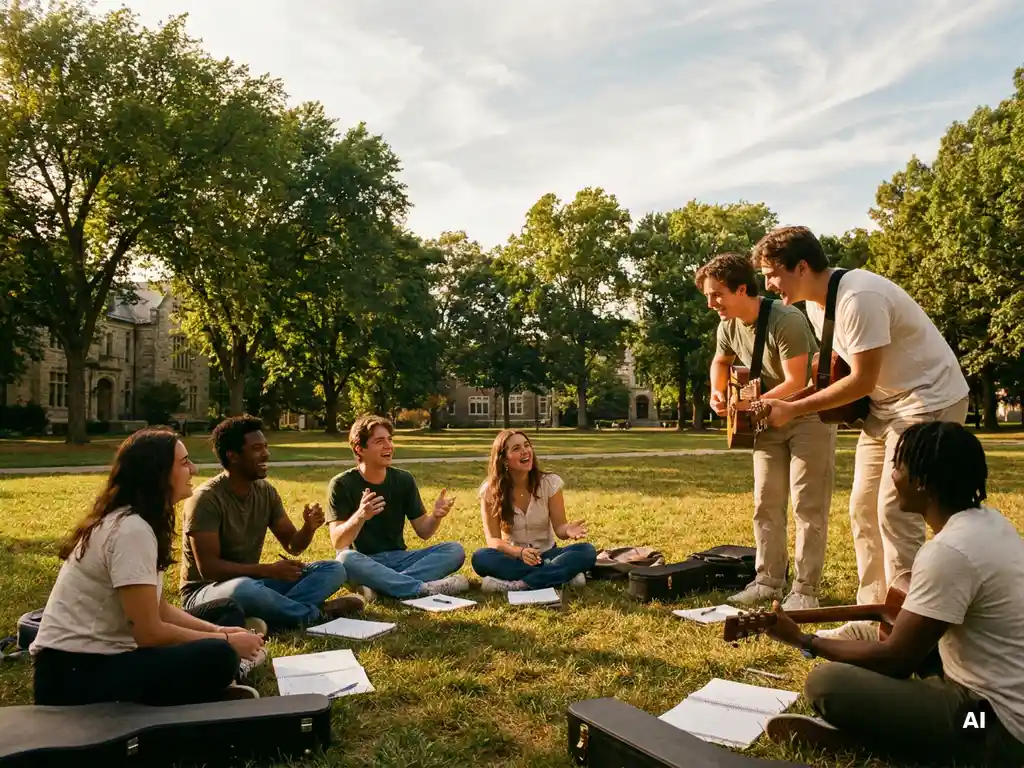
Student clubs at liberal arts colleges support personal growth by giving students hands-on opportunities to lead, collaborate, communicate, and take initiative outside the structured curriculum. These experiences complement academic learning in ways that lectures and seminars rarely can, helping students build self-awareness, resilience, and real-world competence. The questions below unpack exactly how that happens and what students can do to make the most of it.
What kinds of clubs are typically found at liberal arts colleges?
Liberal arts colleges typically host a wide range of student clubs spanning academic interest groups, cultural and identity organisations, performing arts ensembles, debate and public speaking societies, sustainability initiatives, entrepreneurship networks, sports and wellness groups, and community service organisations. Because liberal arts students study across disciplines, the club landscape tends to reflect that breadth and curiosity.
At a small residential college, student-run organisations often emerge directly from the interests of the current student body rather than from a fixed institutional catalogue. This means clubs form organically around what students genuinely care about, whether that is environmental advocacy, creative writing, a particular language or cultural tradition, or social entrepreneurship. The result is a campus culture that feels alive and responsive rather than static.
Student clubs at liberal arts colleges also tend to be more accessible than at large universities. With fewer students competing for the same roles, it is easier to take on meaningful responsibilities early, to shape the direction of an organisation, and to see the direct impact of your involvement. This accessibility is part of what makes extracurricular activities at liberal arts colleges so formative.
How do student clubs build skills that classroom learning doesn’t?
Student clubs build skills through unscripted, consequence-bearing experiences that classroom settings cannot fully replicate. When a student organises an event, manages a budget, resolves a conflict within a team, or pitches an idea to an audience of peers, they are practising communication, leadership, and problem-solving in real time, without a safety net or a grade attached.
Academic courses are designed to build knowledge and analytical ability, but they are structured environments with defined expectations. Clubs introduce ambiguity. A club treasurer learns financial responsibility not from a textbook exercise but from handling actual funds. A club president learns how to motivate a team not through a case study but through the messy reality of coordinating people with different priorities and schedules.
These experiences develop what employers and graduate schools often describe as transferable skills: the ability to communicate clearly under pressure, to adapt when plans change, to work constructively with people you did not choose, and to take ownership of outcomes. These are precisely the qualities that distinguish graduates who thrive in dynamic environments from those who struggle to apply their academic knowledge in practice.
Why are student clubs especially impactful at small residential colleges?
Student clubs have an outsized impact at small residential colleges because the close-knit campus environment amplifies every interaction. When students live, study, eat, and socialise in the same community, the relationships formed through clubs go deeper and last longer. The line between academic life and extracurricular life blurs in productive ways, creating a more integrated experience of personal development.
At a large university, a student can remain anonymous. At a small college, involvement is visible. When you run a campus event or lead a club initiative, your peers and faculty notice. This visibility creates accountability, but it also creates encouragement. Students are more likely to take creative risks when they feel genuinely supported by a community that knows them.
The residential dimension matters too. Living on campus means that club activity does not stop when a meeting ends. Conversations continue over dinner, collaborations form spontaneously in common spaces, and friendships built through shared projects become part of daily life. This continuity deepens the personal growth that extracurricular involvement initiates.
How do clubs at liberal arts colleges support intercultural competence?
Student clubs at liberal arts colleges support intercultural competence by bringing together students from different national, linguistic, and cultural backgrounds around shared interests. When a student joins a club and works closely with peers who see the world differently, they develop the empathy, adaptability, and cross-cultural communication skills that are essential in any internationally facing career or community.
At colleges with a highly international student body, this dynamic is particularly rich. Cultural clubs and international student organisations create spaces where traditions, perspectives, and experiences are actively shared rather than simply coexisting. Students who participate in these spaces do not just learn about other cultures in an abstract sense; they learn to navigate difference in practice, which is a fundamentally different and more durable kind of learning.
Intercultural competence also grows through the friction and negotiation that happen when a diverse group tries to accomplish something together. Deciding how to run a club, how to communicate a message to a mixed audience, or how to resolve a disagreement across cultural communication styles all require genuine intercultural skill. Clubs create these situations repeatedly, making them an informal but powerful training ground for global citizenship.
Can student club involvement strengthen a graduate’s career prospects?
Yes, student club involvement can meaningfully strengthen a graduate’s career prospects. Employers and admissions committees at graduate programmes look for evidence that candidates can lead, collaborate, and take initiative beyond their formal studies. Club experience provides concrete, story-driven examples of exactly those qualities, making a candidate more memorable and more credible in interviews and applications.
The specific skills developed through campus clubs, including project management, public communication, team leadership, financial stewardship, and event coordination, translate directly into workplace competencies. A student who founded a sustainability club, organised a campus-wide initiative, and managed a small team has a portfolio of real experience to draw on, not just a degree.
There is also a networking dimension. Clubs connect students with peers, alumni, faculty advisers, and sometimes external partners who can become professional contacts. At a residential college with strong ties to the surrounding community, club projects that engage with local organisations or industry partners can open doors that purely academic work would not.
It is worth noting that depth matters more than breadth. Sustained, meaningful involvement in one or two clubs demonstrates commitment and growth far more convincingly than a long list of superficial memberships. Recruiters and admissions readers are experienced at distinguishing genuine engagement from resume padding.
How can students make the most of club opportunities at a liberal arts college?
Students make the most of club opportunities at a liberal arts college by engaging early, taking on responsibility progressively, and connecting their club experience intentionally to their broader academic and personal goals. The students who gain the most from extracurricular life are those who treat it as a complementary learning environment rather than a separate social activity.
Practically, this means several things:
- Join in your first semester. The earlier you get involved, the more time you have to grow within an organisation and to take on leadership roles as you progress through your studies.
- Choose depth over breadth. It is better to be genuinely invested in one or two clubs than to spread yourself thin across many. Meaningful involvement requires time and energy.
- Seek out roles that stretch you. If public speaking makes you nervous, volunteer to present at a club event. If you have never managed a budget, offer to help with finances. Clubs are low-stakes environments to build skills you do not yet have.
- Reflect on what you are learning. Keep track of the skills, challenges, and achievements you accumulate through club involvement. This reflection makes it easier to articulate your growth in applications and interviews later.
- Connect across clubs. Some of the richest learning happens when students from different clubs collaborate on shared projects. Look for opportunities to bridge communities and create something that would not exist without that cross-pollination.
- Talk to your faculty advisers. At a small college, faculty are genuinely accessible. Many are enthusiastic about supporting student-led initiatives and can help connect club projects to academic resources or community partners.
The underlying principle is intentionality. Students who treat campus clubs as a deliberate part of their education, rather than an afterthought, consistently report that their extracurricular experiences were among the most formative parts of their time at college.
How UCR supports student personal growth inside and outside the classroom
At University College Roosevelt, personal growth is not left to chance. The college is designed, structurally and culturally, to give students every opportunity to develop as whole people alongside their academic work. Key features that support this include:
- A mandatory Personal and Professional Development track that builds transferable skills such as communication, teamwork, adaptability, and career readiness from the very first semester
- A close-knit residential campus of around 500 students representing over 70 nationalities, where an active student-led culture makes it easy to get involved and take on meaningful roles
- A “living lab” approach that connects academic learning to real-world challenges in partnership with local government, industry, and the community
- An interdisciplinary curriculum across six clusters that encourages students to think across boundaries, preparing them for complex, multifaceted careers
- Exchange partnerships with institutions including Bard College in New York and Glendon College in Toronto, broadening students’ global perspective beyond the campus
If you are looking for a college where liberal arts education and genuine personal development go hand in hand, UCR offers an environment built precisely for that. Explore the UCR programme and find out whether it is the right fit for you.
Related Articles
- How do you know if a residential university college is right for you?
- How do residential college students spend their free time outside class?
- How do student clubs at liberal arts colleges differ from those at large universities?
- How do students balance social life and academic pressure at a residential college?
- How do you build a social life in a small university town like Middelburg?