


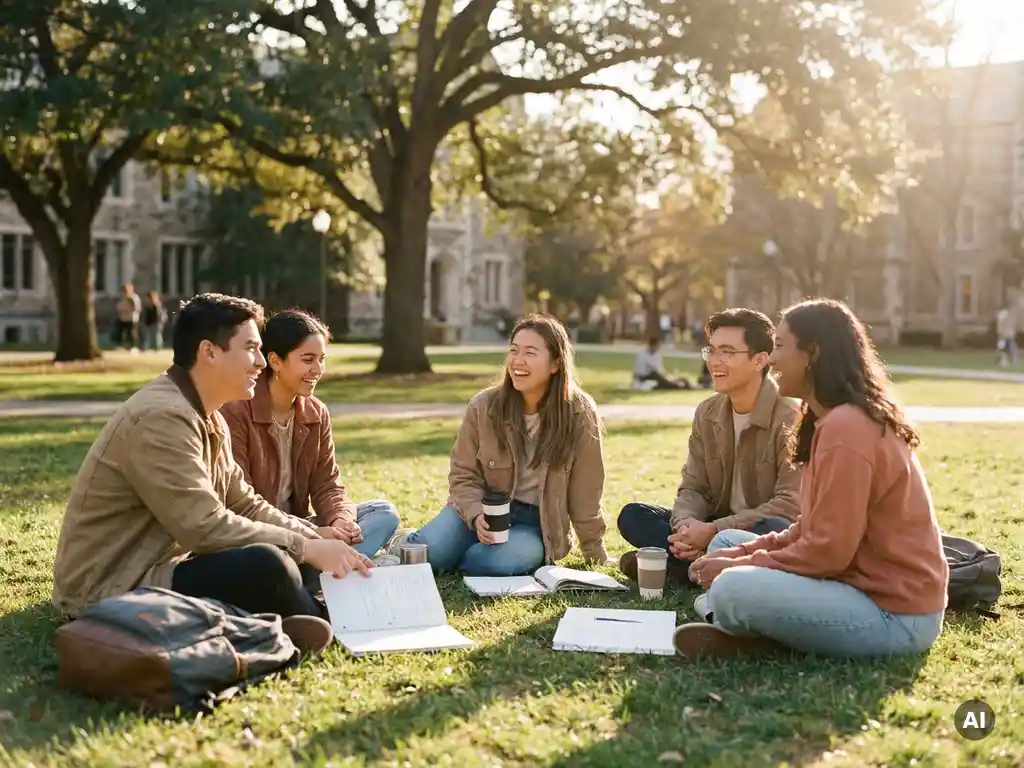
International students can absolutely build genuine, lasting friendships at a new university, and many do so faster than they expect. The key is that making friends abroad requires a little more intentionality than it might at home, simply because you are navigating a new culture, a new language environment, and a new social landscape all at once. The sections below answer the most common questions international students have about building friendships at university, from the first awkward week to the connections that last a lifetime.
Why is it harder to make friends at university as an international student?
Building friendships as an international student is harder because you are managing multiple adjustments simultaneously. You are adapting to a new academic system, a new country, and a new social culture, all while trying to present yourself confidently to strangers. This cognitive and emotional load leaves less mental space for the relaxed, spontaneous interactions that friendships typically grow from.
Unlike domestic students, international students often cannot rely on shared cultural references, familiar humour, or a pre-existing network of acquaintances from school. Small talk that feels effortless at home can feel effortful in a second language or an unfamiliar social register. There is also the pressure of feeling like you should be making friends quickly, which can make early social situations feel higher-stakes than they really are.
It is worth naming something that rarely gets said directly: loneliness in the first weeks of university is extremely common, even among students who appear socially confident. The difference between international students who go on to build strong friendships and those who struggle is usually not personality, it is opportunity and structure. Students who have regular, repeated contact with the same peers tend to form bonds naturally over time. The challenge is creating those conditions in a new environment.
What social activities help international students meet people quickly?
The social activities that help international students meet people quickly are ones that involve low-pressure, repeated contact with the same group of people. Orientation events, shared meals, student clubs, and collaborative academic projects all create the kind of consistent exposure that friendships need to take root. One-off events rarely produce lasting connections on their own.
The most effective early strategies tend to share a few common features:
- Structured group activities: Sports teams, music groups, debate clubs, and cultural associations give you a reason to show up regularly and something to talk about beyond introductions.
- Shared academic experiences: Study groups, group assignments, and discussion-based classes create natural collaboration and a sense of being in something together.
- Informal daily rituals: Eating together, grabbing coffee between classes, or walking to lectures with the same people builds familiarity faster than formal events.
- Student-led events: Parties, cultural evenings, and campus traditions organised by students tend to feel more relaxed and inclusive than institutional events.
- Volunteering and community projects: Working toward a shared goal with others accelerates trust and creates meaningful common ground quickly.
The underlying principle is simple: frequency beats intensity. You do not need a single deep conversation to make a friend. You need many ordinary interactions with the same person over time. Choose activities that bring you back to the same people week after week, and friendships will develop more naturally than you might expect.
How does living on campus affect friendship building for international students?
Living on campus dramatically accelerates friendship building for international students because it removes the single biggest barrier to social connection: distance. When you live near your classmates, friendships form through the accumulation of small, unplanned moments, a conversation in the hallway, a shared meal, a late-night study session, rather than requiring deliberate effort every time.
Residential campuses create what sociologists sometimes call “passive contact”, the kind of low-effort, repeated proximity that research consistently links to the development of close relationships. You do not have to schedule time with people; you simply run into them. For international students in particular, this matters enormously. It means that even on days when you feel too tired or uncertain to actively seek social interaction, connection still happens organically.
Guaranteed housing also removes a practical anxiety that can otherwise dominate the first weeks of university life. When you know where you will live and who your neighbours will be, you can focus your energy on settling in socially rather than managing logistics. At UCR, all students are guaranteed housing for the full duration of their studies on a vibrant inner-city campus in Middelburg, which means every student starts from the same residential foundation, living closely with peers, faculty, and staff in a community designed for daily connection.
How long does it take international students to build real friendships at university?
Most international students begin to feel a genuine sense of social belonging within the first three to six months of university life, though the timeline varies significantly depending on the individual and the environment. Acquaintances typically form within the first few weeks; friendships that feel real and reciprocal usually take longer, often developing fully over the course of the first academic year.
It is important to distinguish between different stages of social connection. The first weeks are typically about meeting people and identifying potential friends. The middle months are about deepening those connections through shared experiences, vulnerability, and time. By the end of the first year, most international students who engaged actively with campus life report having at least a small core group of people they genuinely trust.
What tends to slow the process is comparison. International students who measure their social progress against an idealised version of what university friendships should look like, instant, effortless, and abundant, often feel they are falling behind when they are actually right on track. Friendships built abroad tend to be particularly strong precisely because they were formed through shared challenge and genuine curiosity about one another, not just proximity and habit. Give yourself the full first year before drawing any conclusions about how your social life is developing.
What role does a small campus community play in international student friendships?
A small campus community plays a significant role in helping international students build friendships because it makes meaningful connection structurally easier. In a large university of tens of thousands of students, it is entirely possible to feel invisible. In a small, close-knit community, you see the same faces regularly, your name gets remembered, and relationships develop with a depth and pace that larger environments rarely support.
At a small college, the social landscape is navigable. You are not trying to find your people among an overwhelming crowd, you are getting to know a manageable group of individuals who share your intellectual curiosity and your willingness to be somewhere unfamiliar. That shared context creates an immediate and powerful bond.
UCR is home to around 500 students from over 70 nationalities, which means the community is genuinely international without being so large that individuals get lost in it. Students interact with the same peers across classes, meals, campus events, and residential life. Faculty and staff are also embedded in the same community, which flattens the hierarchy and makes the whole environment feel more human. For international students who might otherwise feel like outsiders in a large institution, a small campus like UCR offers something rare: a place where you are genuinely known.
How can international students maintain friendships across cultural differences?
International students can maintain friendships across cultural differences by approaching those differences with curiosity rather than discomfort. The friendships that last across cultural lines are built on a willingness to ask questions, to explain your own perspective without defensiveness, and to accept that your friend’s way of seeing the world is as valid as your own, even when it surprises you.
Cultural differences in friendship norms are real and worth acknowledging. Different cultures have different expectations around directness, emotional expression, physical affection, punctuality, and how conflict is handled. What reads as coldness in one culture might be respect in another. What feels like overfamiliarity to one person might be warmth to another. Naming these differences openly, rather than letting them quietly create distance, is one of the most effective ways to keep cross-cultural friendships strong.
A few practical approaches that help:
- Ask rather than assume: If a friend’s behaviour confuses you, ask about it with genuine curiosity. Most people appreciate being asked to explain their perspective.
- Share your own cultural context: Help your friends understand where you are coming from, too. Reciprocal transparency builds trust faster than either person trying to adapt silently.
- Find shared values beneath surface differences: Humour, ambition, care for others, and intellectual curiosity transcend cultural background. Focus on what connects you.
- Be patient with misunderstandings: Cross-cultural friendships sometimes require more repair work than friendships between people from similar backgrounds. That is not a sign of incompatibility, it is a sign that you are navigating something genuinely complex together.
Studying in an environment that actively values cultural diversity, and that gives you the academic vocabulary to think about it, makes this process considerably easier. Courses in social science, communication, and global studies give students frameworks for understanding cultural difference that they can apply directly to their friendships and daily interactions.
How UCR helps international students build friendships from day one
University College Roosevelt is designed, structurally and culturally, to help international students build genuine friendships quickly and sustain them throughout their studies. The combination of residential living, a small campus community, and an internationally oriented curriculum creates exactly the conditions that social connection requires.
- Guaranteed housing on a vibrant inner-city campus means all students live in close proximity from the start, enabling the daily informal contact that friendships grow from.
- A community of around 500 students from over 70 nationalities makes the campus genuinely international without being overwhelming, you will know your peers, and they will know you.
- The Personal and Professional Development trajectory builds communication, teamwork, and adaptability skills that make navigating cross-cultural friendships easier and more rewarding.
- Interdisciplinary courses and collaborative projects bring students from different backgrounds together around shared intellectual challenges, creating natural common ground.
- An active student-led campus culture with clubs, events, and community engagement activities gives you multiple entry points into the social life of the college from your very first week.
- Dutch language courses for international students help you settle into the local culture and feel at home in Middelburg, extending your social world beyond the campus itself.
If you are looking for a university where building friendships is not something you have to figure out alone, UCR offers a community where connection is built into the experience. Explore student life at UCR and discover what it means to live, learn, and grow in a close-knit international community.
Related Articles
- What scholarships are available for international bachelor students in the Netherlands?
- What should international students arrange before arriving in the Netherlands?
- Can you combine data science and sustainability at university?
- How do you find student accommodation in the Netherlands?
- What extracurricular activities look best on a graduate school application?