


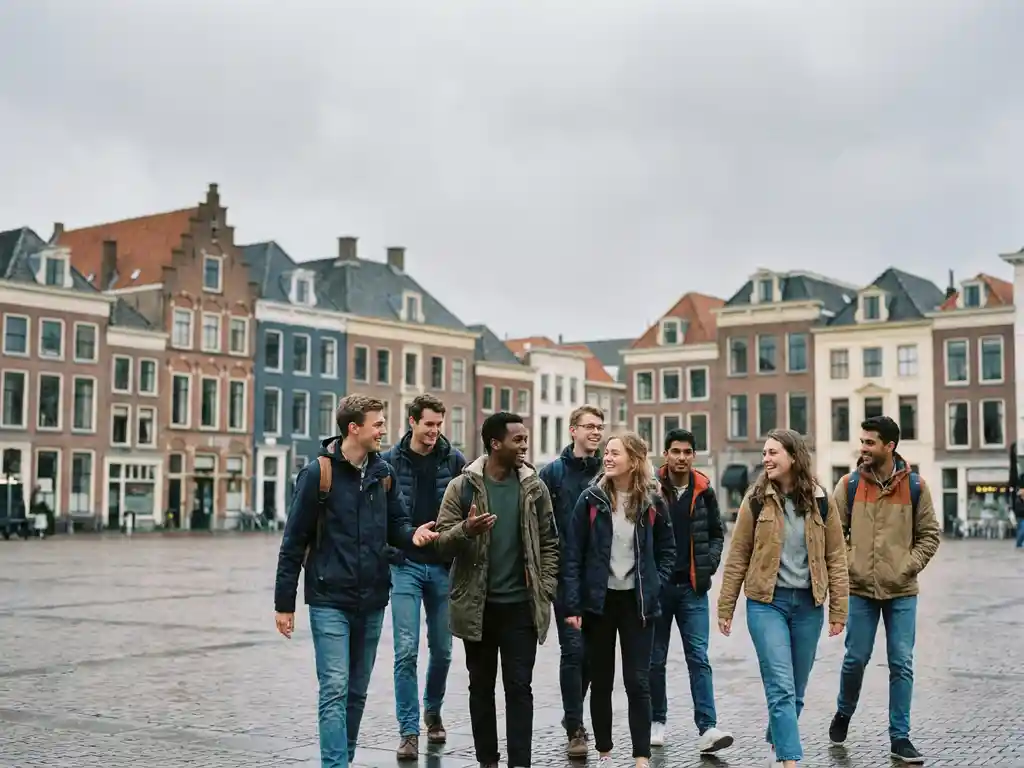
International students in the Netherlands consistently notice the same cultural differences: Dutch people are unusually direct, highly egalitarian, and extremely punctual. These traits shape everything from classroom dynamics to friendships and daily social life. For students arriving from more hierarchical or indirect communication cultures, the adjustment can feel sharp at first but ultimately rewarding. The sections below unpack each of the most commonly noticed cultural differences, so you know what to expect before you arrive.
How do Dutch people communicate differently from other cultures?
Dutch communication is strikingly direct compared to most other cultures. Where many societies rely on hints, polite softening, or reading between the lines, Dutch people tend to say exactly what they mean, without apology and without expecting offence. If your idea is weak, a Dutch colleague or classmate will tell you so plainly. If your haircut looks odd, they may mention that too.
This directness is not rudeness in the Dutch cultural framework. It is considered a form of respect, a signal that the other person is worth honest engagement. International students from East Asian, Middle Eastern, Latin American, or Southern European backgrounds often find this bluntness jarring at first, because in their home cultures, maintaining harmony and avoiding face loss takes priority over blunt honesty.
The adjustment usually runs in both directions. Dutch peers may initially read international students as evasive or overly formal, while international students may read Dutch peers as harsh or arrogant. Once both sides understand the cultural logic behind each style, communication tends to open up considerably. Learning to receive direct feedback as a neutral act, not a personal attack, is one of the most useful cultural skills you will develop during your time studying in the Netherlands.
What does Dutch egalitarianism mean for campus life?
Dutch egalitarianism means that hierarchy is actively minimized in Dutch society, and this flattens the relationship between students, professors, and administrators in ways that surprise many international students. In the Netherlands, it is entirely normal to address a professor by their first name, push back on their argument in class, or knock on a dean’s door without a formal appointment. Status does not command the same deference it does in many other cultures.
On campus, this shows up in small but meaningful ways. Faculty at a liberal arts college in the Netherlands tend to eat in the same spaces as students, engage in casual conversation outside lectures, and genuinely expect students to challenge ideas in class. This is not informality for its own sake. It reflects a deep cultural belief that every person’s opinion deserves a fair hearing regardless of their title or seniority.
For students from cultures where academic hierarchy is rigid, this can feel disorienting. You may worry that using a professor’s first name is disrespectful, or that disagreeing in a seminar is inappropriate. In the Dutch context, the opposite is true. Staying silent or overly deferential may actually be read as disengagement. Participating actively, including respectful disagreement, signals that you are taking the work seriously.
Why do international students find Dutch social life hard to break into?
Many international students find Dutch social life difficult to penetrate because Dutch people tend to maintain a clear distinction between acquaintances and close friends. While Dutch people are typically open and friendly in conversation, that friendliness does not automatically translate into an invitation into their social circle. Friendships in the Netherlands often develop slowly, through repeated contact over time, rather than quickly through shared enthusiasm.
Part of this comes down to how Dutch social life is structured. Dutch people tend to maintain long-standing friend groups that were formed during secondary school, and they may not feel the need to actively expand those circles. For an international student arriving without an existing network, this can feel like hitting an invisible wall. People are pleasant but not particularly eager to integrate you into their weekend plans.
The good news is that a residential campus environment significantly changes this dynamic. When you live, study, and eat alongside the same group of international and Dutch students every day, the repeated contact that Dutch friendships typically require happens naturally and quickly. Students living in the Netherlands as part of a close residential community tend to build genuine cross-cultural friendships far faster than those commuting to a large urban university.
It also helps to take initiative. Joining student committees, attending campus events, or simply being consistent about showing up to shared spaces accelerates the process. Dutch people respond well to reliability and follow-through. If you say you will be somewhere, be there.
How does the Dutch approach to time and planning differ from other cultures?
Dutch culture treats time as a resource to be managed carefully, which means punctuality and advance planning are not just preferences but genuine social expectations. Arriving late to a meeting, a class, or even a casual get-together is noticed and considered disrespectful. Similarly, Dutch people tend to plan their social calendars weeks in advance, which can feel rigid or cold to students from cultures where spontaneity is the norm.
The practice of scheduling even informal visits, sometimes called “agenda culture,” surprises many international students. In some cultures, dropping by a friend’s home unannounced is a sign of closeness. In the Netherlands, it is more likely to be received as an imposition. Sending a message to check availability before visiting is standard practice, even among close friends.
For students studying in the Netherlands, this planning orientation has real academic benefits. Deadlines are taken seriously, group project timelines are followed, and meetings start on time. Once you adapt to this rhythm, you may find that the predictability reduces stress rather than adding it. Knowing exactly when things will happen and that others will reliably show up creates a kind of structural trust that supports academic collaboration.
What cultural norms around money surprise international students in the Netherlands?
The Dutch approach to money is famously pragmatic and transparent, and the norm of splitting bills equally, known internationally as “going Dutch,” is genuinely practiced in everyday life. Expecting someone else to pay for your meal or drink, even on a first meeting, is unusual in Dutch social culture. Each person pays their own share, and this is not considered stingy. It reflects a cultural value of fairness and financial independence.
International students from cultures where treating others generously is a social gesture of warmth or status can find this jarring. In some cultures, insisting on paying for a friend signals care and closeness. In the Dutch context, the same gesture might be read as patronizing or as implying the other person cannot afford their share.
Dutch people also tend to talk about money more openly than people from many other cultures. Asking what someone pays in rent, how much a salary is, or whether something was expensive is not inherently taboo. This transparency is part of the same egalitarian logic: financial information is practical, not shameful. Students arriving from cultures where money is a sensitive or private topic may need time to adjust to this openness without reading it as intrusive.
How can international students adapt to Dutch culture without losing their identity?
Adapting to Dutch culture does not mean abandoning your own. The most effective approach is to develop cultural fluency, the ability to understand and operate within Dutch norms while retaining the values, communication styles, and traditions that are central to who you are. This is a skill, and like any skill, it improves with practice and reflection.
A few practical strategies that international students in the Netherlands find genuinely useful:
- Interpret before reacting. When a Dutch person says something that feels blunt or cold, pause and ask yourself whether the same words would land differently if you applied Dutch cultural logic. Most of the time, the intent is neutral or even positive.
- Take initiative socially. Dutch social circles do not expand automatically. Showing up consistently, following through on plans, and being specific about invitations (“Are you free Thursday at 7?”) works far better than open-ended suggestions.
- Use available language support. Learning basic Dutch, even a handful of phrases, signals genuine effort and opens doors. Many programmes for international students include Dutch language courses specifically to ease this transition.
- Share your own culture actively. Dutch people are genuinely curious about the world. Cooking a dish from home, explaining a tradition, or offering a different perspective in class is valued, not sidelined.
- Give yourself time. Culture shock follows a fairly predictable arc. The initial disorientation tends to ease significantly after the first few months, once routines are established and friendships begin to form.
Living in the Netherlands as a student is ultimately an exercise in perspective-taking. Every cultural difference you navigate builds exactly the kind of cross-cultural intelligence that employers, graduate schools, and global citizens need.
How UCR helps international students navigate Dutch culture
University College Roosevelt is designed from the ground up to support international students through this kind of cultural transition, without asking them to leave their identity at the door. The residential campus in Middelburg places students from over 70 nationalities in daily contact with each other and with Dutch peers, creating the repeated interaction that cross-cultural understanding requires.
- Dutch language courses are available to all international students to ease integration into Dutch culture and society
- The mandatory Personal and Professional Development programme builds communication, adaptability, and intercultural skills from day one
- A close-knit community of around 500 students and 50 staff means no one gets lost in the crowd
- Guaranteed housing on campus removes one of the biggest logistical stressors of living in the Netherlands as a student
- Community Engaged Learning connects students with local government, organisations, and residents in Zeeland, accelerating genuine cultural immersion
If you are curious about what life as an international student at a liberal arts college in the Netherlands actually looks like, the best next step is to speak with someone who can answer your specific questions. Connect with the UCR admissions team to learn more about campus life, the application process, and how UCR supports students from every cultural background.
Related Articles
- How do you write a motivation letter for a liberal arts college?
- How does the Dutch grading system work for university students?
- What is it like to live in Amsterdam as a student?
- What is the role of a student board in campus governance?
- What social activities are available for university students in 2026?