


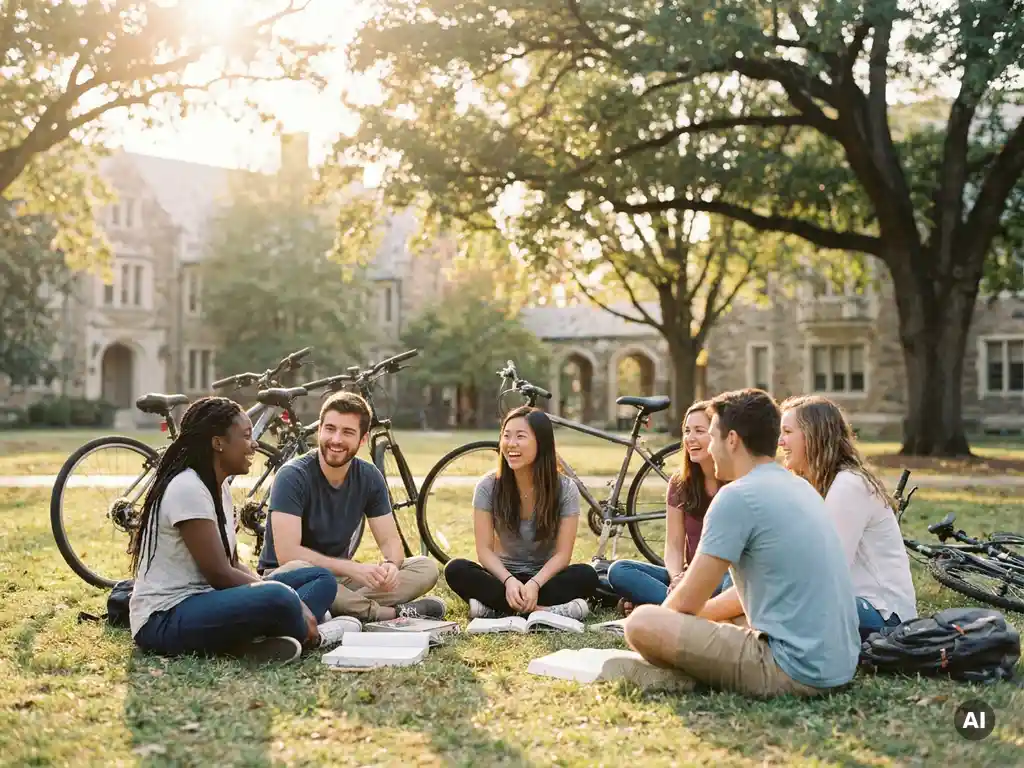
Students say campus community changed their university experience because it transformed studying from a solitary pursuit into a shared journey. When you live, learn, and grow alongside the same people every day, the connections you form shape not just your social life but your academic mindset, your confidence, and your sense of purpose. The questions below unpack exactly why that happens and what it means for your future.
What makes a campus community different from just attending university?
A campus community is different from simply attending university because it integrates your academic life with your social and personal life in a single, continuous environment. Rather than arriving for lectures and leaving, you share meals, study spaces, extracurricular activities, and daily routines with the same group of people. That constant proximity creates a depth of connection that commuter or lecture-only settings rarely produce.
At a traditional large university, it is entirely possible to complete a degree without forming a single meaningful relationship with a peer or a lecturer. You attend, you sit, you leave. A campus community works differently. When your classmates are also your neighbours, your study partners, and the people you run into at breakfast, the boundaries between learning and living dissolve in the best possible way.
This matters most at smaller residential colleges, where the scale is deliberately kept intimate. With around 500 to 550 students, a college like University College Roosevelt creates an environment where you are genuinely known. Faculty and staff often live nearby, making academic support feel personal rather than bureaucratic. The result is a student life that feels coherent rather than fragmented across different parts of a city.
How does living on campus affect academic performance?
Living on campus supports academic performance by reducing friction between students and their learning environment. When your accommodation, your classrooms, your library, and your peers are all within walking distance, the practical barriers to studying, collaborating, and seeking help drop significantly. Proximity to academic resources and to motivated peers creates conditions where consistent engagement becomes the norm rather than the exception.
Guaranteed housing, as UCR offers to all students for the full duration of their studies, removes one of the most significant stressors that undermine student focus: housing insecurity. When you are not worrying about rent negotiations, long commutes, or whether your lease will be renewed, you have more cognitive and emotional bandwidth to invest in your studies.
There is also a peer-effect dimension worth considering. When you are surrounded by intellectually curious, motivated students around the clock, academic effort becomes a shared culture rather than a solitary discipline. Study groups form organically. Conversations at dinner extend into debates about course material. Ideas from one discipline cross-pollinate with another. This kind of informal, continuous intellectual exchange is one of the less visible but most powerful advantages of residential college life.
What role does campus community play in personal development?
Campus community plays a central role in personal development by placing you in daily contact with people who challenge your assumptions, broaden your perspective, and hold you accountable to your own growth. Academic skills can be developed in isolation, but qualities like empathy, communication, leadership, and resilience are built through sustained, real human interaction.
At a close-knit residential college, personal development is not left to chance. At UCR, every student follows a mandatory Personal and Professional Development trajectory alongside their academic coursework. This structured programme builds transferable skills including effective communication, teamwork, adaptability, and study strategies. But the formal programme only reinforces what the campus community is already doing informally every single day.
Living in close proximity to peers from more than 70 nationalities means that navigating difference becomes a daily practice. You learn to listen across cultural boundaries, to articulate your ideas clearly to someone with a very different frame of reference, and to find common ground with people whose backgrounds look nothing like your own. These are not soft skills in the dismissive sense of the phrase. They are the precise capabilities that employers, graduate schools, and the wider world consistently identify as hardest to develop and most valuable to have.
Why do students feel more supported at small residential colleges?
Students feel more supported at small residential colleges because the scale makes genuine relationships possible. When a college has 500 to 550 students rather than 20,000, every individual is visible. Faculty know your name, your academic interests, and your progress. Support services are not queues you join; they are conversations you have with people who already know your context.
The contrast with large universities is stark. At a big institution, pastoral care and academic support are often delivered through systems: ticketing platforms, appointment slots weeks in advance, generic guidance designed for the average student. At a small residential college, the short communication lines mean that a concern raised on Monday can be addressed by Wednesday, not next semester.
There is also something important about the physical environment. When your college occupies a vibrant inner-city campus where students, faculty, and staff all move through the same spaces, support becomes embedded in everyday life rather than siloed into a welfare office. You encounter your tutor at the campus cafe. Your academic advisor lives ten minutes from campus. That proximity makes asking for help feel natural rather than formal, and it means that early signs of struggle are noticed before they become crises.
For prospective students weighing their options, the student life at UCR reflects exactly this model: a community small enough to know you, structured enough to support you, and open enough to let you lead your own experience.
How does an international campus community prepare students for global careers?
An international campus community prepares students for global careers by making cross-cultural competence a lived experience rather than a line on a curriculum. When you study, live, and collaborate daily with peers from dozens of different countries, you develop the cultural intelligence, communication flexibility, and global awareness that international employers consistently look for.
At UCR, with over 70 nationalities represented in a student body of around 500 to 550, internationalisation is not a marketing claim. It is the texture of daily life. Group projects bring together students from different academic clusters and different cultural backgrounds. Debates and seminars surface genuinely different worldviews. The campus itself becomes a microcosm of the interconnected world graduates will enter.
Real-world engagement beyond the campus
International community is reinforced by UCR’s living lab approach, which connects students with local government, businesses, and organisations in Zeeland and beyond. Working on real challenges alongside community partners means that students practise applying knowledge across contexts, not just within the familiar boundaries of their own academic cluster. This kind of applied, outward-facing learning builds the adaptability that global careers demand.
Exchange partnerships and global networks
UCR also offers exchange opportunities with partner institutions including the University of Nebraska at Kearney, Bard College in New York, and Glendon College in Toronto. These partnerships extend the international dimension of the UCR experience beyond Middelburg, giving students the chance to immerse themselves in different academic cultures while maintaining the foundation of their liberal arts and sciences degree.
How UCR helps you experience the benefits of a close-knit campus community
University College Roosevelt is built around the principles this article has explored. If you are looking for a university experience where community, academic rigour, and personal growth reinforce each other, UCR offers a distinctive environment designed to deliver exactly that.
- Guaranteed housing for all students for the full duration of their studies, creating stability and a genuine sense of belonging from day one
- A small, international community of around 500 to 550 students from over 70 nationalities, where meaningful connections are the norm
- A flexible, interdisciplinary curriculum through the Bachelor of Liberal Arts and Sciences, letting you design a degree that reflects your interests and ambitions
- A mandatory Personal and Professional Development trajectory that builds the transferable skills you will use long after graduation
- A living lab approach that connects academic learning to real challenges in collaboration with local and global partners
- Exchange partnerships with institutions in the United States and Canada for students who want to extend their international experience
Ready to experience what a truly close-knit campus community feels like? Discover the UCR experience and start shaping your future.
Related Articles
- How do you get a student visa for the Netherlands?
- Is studying in the Netherlands worth it for international students?
- Can you stay in the Netherlands after graduating from a Dutch university?
- What is BSN and why do international students in the Netherlands need it?
- What is it like living in Middelburg as an international student in 2026?