


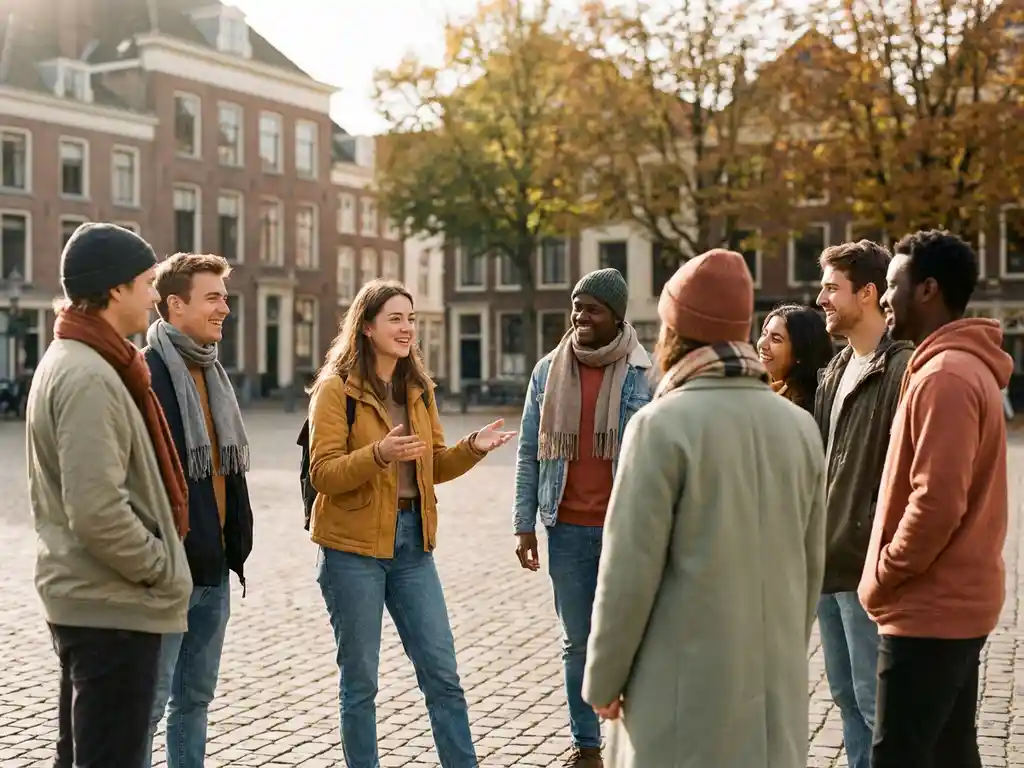
Learning Dutch helps international students feel at home faster because it removes the invisible barrier between campus life and everyday life in the Netherlands. Even a basic command of the language signals to local people that you are making an effort to integrate, which opens doors to friendships, smoother daily interactions, and a genuine sense of belonging that English alone rarely provides. The questions below unpack exactly how and why that process works.
How quickly can international students pick up basic Dutch?
Most international students with a background in English, German, or another Germanic language can pick up functional, everyday Dutch within a few months of consistent practice. Reaching a level where you can handle greetings, shopping, and simple conversations typically takes around six to twelve weeks of regular exposure, while more confident spoken fluency develops over the course of a full academic year.
Dutch is widely considered one of the more accessible languages for English speakers. Its grammar follows recognizable patterns, a large share of its vocabulary overlaps with English, and pronunciation, while distinctive, is not unusually difficult to approximate. This means the learning curve for basic communication is gentler than it might first appear.
The speed at which you progress depends heavily on how much you step outside the English bubble that naturally forms in an international student community. Students who make a conscious effort to use Dutch in shops, at local markets, or with neighbors typically advance noticeably faster than those who limit practice to formal lessons. Immersion, even partial immersion, accelerates everything.
What everyday situations become easier when you speak some Dutch?
Speaking even basic Dutch makes a meaningful difference in routine situations such as shopping at a local market, reading official letters from the municipality, using public transport, visiting a doctor or pharmacy, and navigating bureaucratic processes like registering at the town hall. These are precisely the moments where not understanding the language creates friction and stress for international students settling in the Netherlands.
In Middelburg specifically, a smaller city where the international student population is relatively modest compared to Amsterdam or Utrecht, daily life brings you into regular contact with Dutch-speaking locals. Supermarket staff, landlords, local government offices, and neighborhood residents will often default to Dutch, and knowing enough to follow the conversation, or at least to signal that you are trying, changes the tone of those interactions entirely.
There is also a practical confidence effect. Once you can handle one or two routine Dutch interactions successfully, the anxiety around others drops. Students who cross that threshold tend to explore the city and the wider Zeeland region more freely, which in turn deepens their connection to the place they are living.
Does speaking Dutch actually help international students make local friends?
Yes, speaking some Dutch genuinely increases the likelihood of forming friendships with Dutch locals, because it demonstrates a willingness to meet people on their own terms rather than expecting them to adapt entirely to you. While most Dutch people speak excellent English, the gesture of attempting their language creates a warmth and reciprocity that English-only interactions rarely produce.
This matters more in smaller cities like Middelburg than in major international hubs. In a city of this scale, social life is more rooted in local networks, neighborhood relationships, and community events. International students who engage with those networks, even imperfectly, tend to build a richer social life beyond the university campus.
It is also worth noting that friendships with Dutch students and locals give international students access to a different kind of cultural knowledge: recommendations for places that do not appear in tourist guides, invitations to local events, and an understanding of Dutch social norms that makes the whole experience feel more authentic. Language is the key that unlocks that layer of belonging.
What are the best free or low-cost ways to learn Dutch as a student?
The most effective free and low-cost options for learning Dutch as an international student include language exchange partnerships, free online platforms, public library resources, and structured Dutch courses offered directly by your university. Combining at least two of these approaches tends to produce faster and more durable results than relying on any single method.
- University Dutch courses: UCR includes Dutch language courses within its curriculum specifically to help international students settle into Dutch culture and society. These structured lessons are designed with the student’s daily life in mind and are among the most practical starting points available.
- Language exchange (tandem learning): Pairing with a Dutch student who wants to practice English creates a free, mutually beneficial arrangement. Both parties improve, and the social connection itself becomes part of the learning process.
- Free apps and platforms: Tools like Duolingo, Language Transfer, and the Dutch public broadcaster’s free online Dutch course (NT2) offer solid foundations at no cost. These work best as daily supplements to real-world practice rather than standalone solutions.
- Local community events: Many Dutch municipalities and libraries run free conversation groups or cultural events where newcomers can practice in a relaxed setting. In Middelburg, the local community is small enough that these events are easy to find and genuinely welcoming.
- Simply using Dutch daily: Ordering in Dutch at a café, reading Dutch packaging, or listening to Dutch radio for ten minutes a day costs nothing and builds familiarity faster than most people expect.
How does learning Dutch affect life outside the university campus?
Learning Dutch significantly expands the range of experiences available to international students beyond the campus, from exploring Zeeland’s smaller towns and coastal areas to participating in local cultural life, volunteering, and part-time work. Without some Dutch, life outside the university can feel limited to spaces where English is reliably spoken, which narrows the experience considerably.
Zeeland is a region with a strong local identity, a rich history, and a landscape that rewards exploration. Students who can read a local information board, follow a guided tour, or chat with a market vendor gain access to a dimension of the region that purely English-language engagement misses. The same applies to cultural events, local festivals, and community initiatives where Dutch is the default.
There is also a longer-term dimension. Many international students who study in the Netherlands go on to build careers or lives there after graduation. The Dutch job market, even in internationally oriented sectors, values candidates who have made the effort to learn the language. Starting that process as a student is an investment that compounds well beyond the years spent at university.
Learning Dutch also reinforces one of the core skills that a liberal arts and sciences education develops: the ability to step outside your own frame of reference and engage seriously with a different perspective. Language learning is, in that sense, both a practical tool and an intellectual exercise that aligns naturally with the broader goals of studying abroad.
How UCR helps international students settle into Dutch life
UCR directly supports international students in their journey to feel at home in the Netherlands through several structured and community-based initiatives:
- Dutch language courses are embedded in the curriculum, giving students a structured, low-pressure way to build language skills from their first semester.
- Guaranteed on-campus housing in the heart of Middelburg places students within walking distance of local shops, markets, and community spaces, making daily Dutch practice a natural part of life.
- A close-knit campus community of around 500 students from over 70 nationalities means that cultural exchange, including with Dutch peers and local staff, is built into everyday campus life.
- Community Engaged Learning connects students with local organizations, municipalities, and businesses in Zeeland, creating real-world contexts in which Dutch language and cultural understanding become genuinely useful.
- Personal and Professional Development courses build the adaptability and communication skills that make navigating a new country and a new language far less daunting.
If you are curious about how UCR supports international students from day one, connect with the UCR admissions team to learn more about campus life, the curriculum, and how to make the most of studying in the Netherlands.
Related Articles
- How do you choose the right English-taught bachelor's degree in the Netherlands?
- Which Dutch student cities are most affordable for international students?
- How do you apply to a Dutch university as an international student?
- What are the mental health benefits of campus community involvement?
- How do students from different countries adapt to life in the Netherlands?