


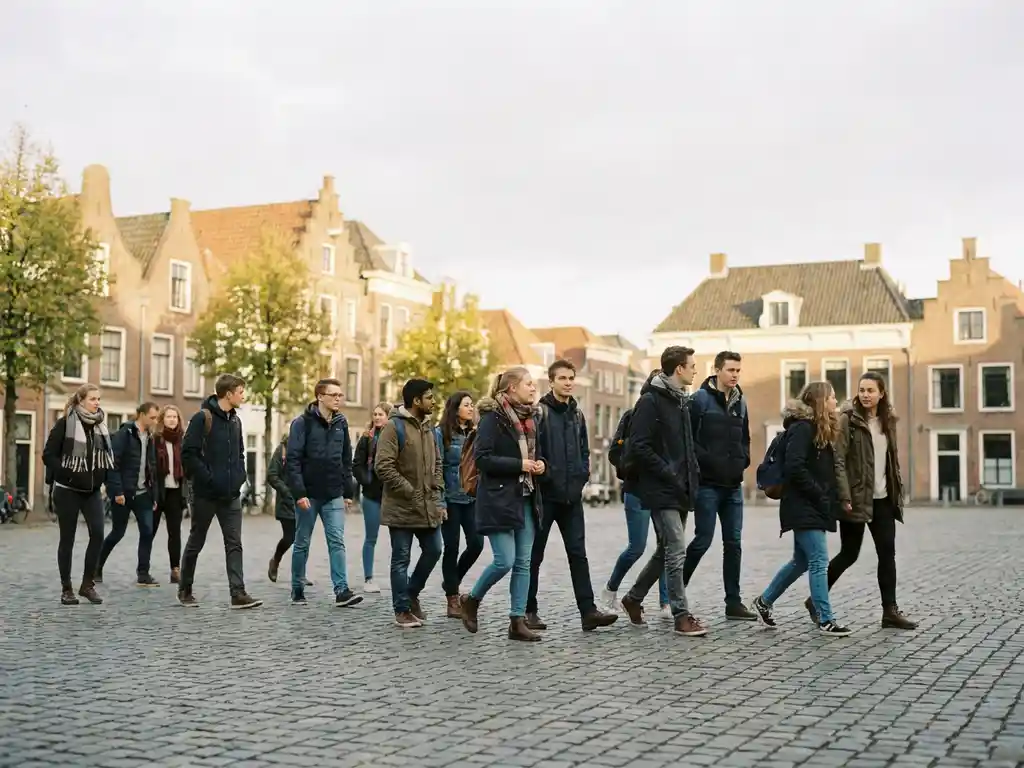
Most international students moving to the Netherlands say the same thing in hindsight: the practical realities of daily life caught them off guard far more than the academic challenges did. Housing costs, cycling culture, Dutch directness, and the rhythm of a small city are all things that take adjustment. Whether you are planning to study at a liberal arts college in the Netherlands or weighing up your options across Europe, the honest experiences shared by students who have already made the move reveal patterns worth knowing before you pack your bags.
What is daily life actually like for international students in the Netherlands?
Daily life for international students in the Netherlands is active, social, and surprisingly structured around cycling, cooking, and campus community. Most students find that life quickly settles into a rhythm of classes, shared meals, campus events, and exploring the surrounding area. The Netherlands is compact, well-connected, and genuinely welcoming to international newcomers.
The Dutch lifestyle rewards independence. Grocery shopping, cooking for yourself, managing your own schedule, and navigating public transport are all expected from day one. Students who thrive tend to embrace this early. Those who struggle often underestimate how much energy self-sufficiency requires, especially in the first few weeks when everything is unfamiliar.
One thing international students consistently mention is how quickly a small campus community becomes home. When your university, housing, classmates, and social life are all located within walking distance of each other, integration happens faster than it would in a large city. The trade-off is that you are in close quarters with the same group of people, which makes genuine connection easier but also means there is less anonymity than you might expect.
The Netherlands also has a strong outdoor culture. Rain or shine, Dutch students cycle everywhere, and international students are expected to follow suit. Buying a secondhand bike in the first week is practically a rite of passage, and it genuinely transforms how you experience living in the country.
How does the Dutch housing market affect international students?
The Dutch housing market is one of the most competitive in Europe, and international students who rely on finding private accommodation after arrival often face serious difficulties. Rental prices in major cities are high, availability is limited, and many landlords require Dutch guarantors or proof of income. For students without guaranteed housing, this is one of the biggest practical stressors of studying in the Netherlands.
This is precisely why guaranteed housing arrangements matter so much for international students. At a residential college like UCR, all students are guaranteed housing for the full duration of their studies, which removes one of the most anxiety-inducing variables from the experience entirely. Living on campus in Middelburg means students never have to navigate the private rental market while simultaneously adjusting to a new country, a new academic system, and a new language.
Students at larger Dutch universities in cities like Amsterdam, Utrecht, or Rotterdam often spend weeks or months searching for a room before arrival, sometimes resorting to temporary Airbnb stays or commuting from outside the city. International students should factor housing security into their decision-making when comparing institutions, not treat it as an afterthought.
What does a liberal arts curriculum look like in a Dutch university context?
A liberal arts curriculum in a Dutch university context means designing your own interdisciplinary degree rather than following a fixed programme. Instead of declaring a single major from day one, students choose courses across multiple academic fields and build a personalised path that reflects their intellectual interests and career goals. In the Netherlands, this model is still relatively rare, which makes liberal arts colleges distinct from most Dutch universities.
At UCR, for example, students can draw courses from six interdisciplinary clusters spanning areas such as Data Science and Intelligent Systems, Environment and Sustainability, Health, Cognition and Behaviour, and Media, Culture and Communication. A student might combine courses in environmental policy, data analysis, and philosophy of science within a single degree. The result is a Bachelor of Arts or Bachelor of Science from Utrecht University, depending on the academic direction chosen.
What surprises many incoming students is how much responsibility the curriculum places on them. You are not handed a timetable. You build one, with guidance from faculty advisors. This requires genuine self-knowledge about what you want to study and why. Students who arrive with intellectual curiosity but without a clear sense of direction often find this liberating. Those who expected a more prescribed structure sometimes find it disorienting at first.
The Dutch academic environment also emphasises critical thinking and debate in ways that feel different from many national school systems. Participation in seminars, student presentations, and peer discussion is expected and assessed. Passive attendance is not enough. For international students coming from more lecture-heavy educational traditions, this shift in classroom culture is one of the most significant adjustments to make. You can explore UCR’s academic programme to get a clearer sense of how this curriculum is structured in practice.
How do international students manage the cost of studying in the Netherlands?
Managing the cost of studying in the Netherlands requires careful budgeting across tuition, housing, food, transport, and health insurance. The Netherlands is not the cheapest country in Europe, but it is far from the most expensive, and international students who plan ahead find it entirely manageable. Institutional scholarships, part-time work rights for EU students, and lower costs in smaller cities all help reduce financial pressure.
Tuition fees in the Netherlands are structured differently for EU and non-EU students. EU students typically pay the statutory tuition fee, which is significantly lower than the fees charged to non-EU students. Non-EU students pay an institutional fee that varies by programme. Prospective students should research the exact fee structure for their chosen institution and check what financial support options are available.
Several factors help international students keep costs manageable:
- Location matters: Studying in a smaller city like Middelburg costs considerably less than studying in Amsterdam or Rotterdam. Rent, food, and leisure expenses are all lower.
- Guaranteed housing removes uncertainty: Knowing your housing cost upfront makes budgeting far more straightforward than navigating the private market.
- Dutch language skills help: Students who pick up basic Dutch can access cheaper local shops, services, and social opportunities that are less accessible in English only.
- Student discounts are widely available: Public transport, museums, cultural events, and many shops offer student rates with a valid student card.
- Health insurance is mandatory: International students should factor in the cost of Dutch health insurance or check whether their home country coverage applies.
Part-time work is another option many international students explore. EU students can work without restriction. Non-EU students on a student visa are permitted to work a limited number of hours per week, typically with some conditions attached. Checking the current rules before arrival is essential.
What do students find hardest about adapting to life in the Netherlands?
The hardest parts of adapting to life in the Netherlands for international students are typically the Dutch directness in communication, the grey winter weather, and the initial challenge of building social connections in a new country. These are not insurmountable, but students who are not prepared for them often find the first semester harder than expected.
Dutch directness and communication style
Dutch culture values honesty and efficiency in communication in a way that can feel blunt or even rude to students from cultures where more indirect communication is the norm. A Dutch professor will tell you plainly if your work is not up to standard. A Dutch classmate will disagree with you openly in a seminar without softening the critique. This is not hostility; it is a cultural norm. Students who understand this early tend to adapt much faster than those who interpret directness as personal criticism.
Winter weather and seasonal adjustment
The Netherlands has a maritime climate, which means mild temperatures but a lot of overcast skies, wind, and rain, particularly between October and March. Students from sunnier countries often underestimate how much the grey winters affect their mood and energy. Building habits around exercise, social connection, and getting outside even on cloudy days helps significantly. Zeeland, where UCR is located, actually receives more hours of sunshine per year than most of the Netherlands, which makes a meaningful difference during the colder months.
How can international students make the most of studying in a small Dutch city?
International students can make the most of studying in a small Dutch city by leaning into the proximity and access that smaller cities offer rather than treating them as a limitation. In a city like Middelburg, the distance between your classroom, your housing, local government, cultural institutions, and the surrounding natural environment is short. That closeness creates opportunities that simply do not exist in a large urban campus.
Students in smaller Dutch cities often find it easier to build genuine relationships with faculty, local organisations, and community partners. When a university has close ties to local government and industry, students can engage with real-world projects in ways that would take years to access in a larger city. This kind of community-engaged learning builds practical skills alongside academic knowledge.
Middelburg itself is one of the best-preserved medieval cities in the Netherlands, with a historic centre, monumental buildings, and easy access to the Zeeland coastline. Students who explore the region, take day trips to nearby cities, and engage with the local community consistently report richer experiences than those who stay within the campus bubble.
A few practical ways to get the most out of a small city experience:
- Get involved in student-led campus culture from the first week, not the second semester
- Use the short lines to local organisations to pursue internship or research opportunities early
- Explore the surrounding region by bike or train; Zeeland has coastline, nature, and neighbouring Belgium within easy reach
- Take Dutch language classes if they are available; even basic Dutch transforms how locals respond to you
- Attend local events in Middelburg rather than always defaulting to campus social life
How UCR helps international students navigate life in the Netherlands
UCR is designed specifically to support international students through the transition to studying and living in the Netherlands. As a fully residential liberal arts college, it removes many of the practical and social barriers that make moving abroad difficult. Key features that directly address the challenges described in this article include:
- Guaranteed housing for all students for the full duration of their studies, eliminating the need to navigate the Dutch rental market independently
- A mandatory Personal and Professional Development track that builds communication, adaptability, and self-management skills from the first semester
- Dutch language courses offered to international students to support cultural integration
- A close-knit international community of around 500 students from over 70 countries, making it easier to build genuine connections quickly
- Community Engaged Learning that connects students to Middelburg and Zeeland through real-world projects with local partners
- A flexible, interdisciplinary curriculum that gives students the academic freedom to explore their interests across multiple fields
If you are considering studying at an international university in the Netherlands and want to understand whether UCR is the right fit for you, the admissions team is the best starting point. Connect with UCR to ask your questions directly and find out what life as a student in Middelburg actually looks like.
Related Articles
- How do you open a bank account as a student in the Netherlands?
- How do you deal with homesickness as an international student in the Netherlands?
- How hard is it to learn Dutch as an international student?
- How do you learn Dutch as an international university student?
- What groceries and everyday items should you bring from home to the Netherlands?