


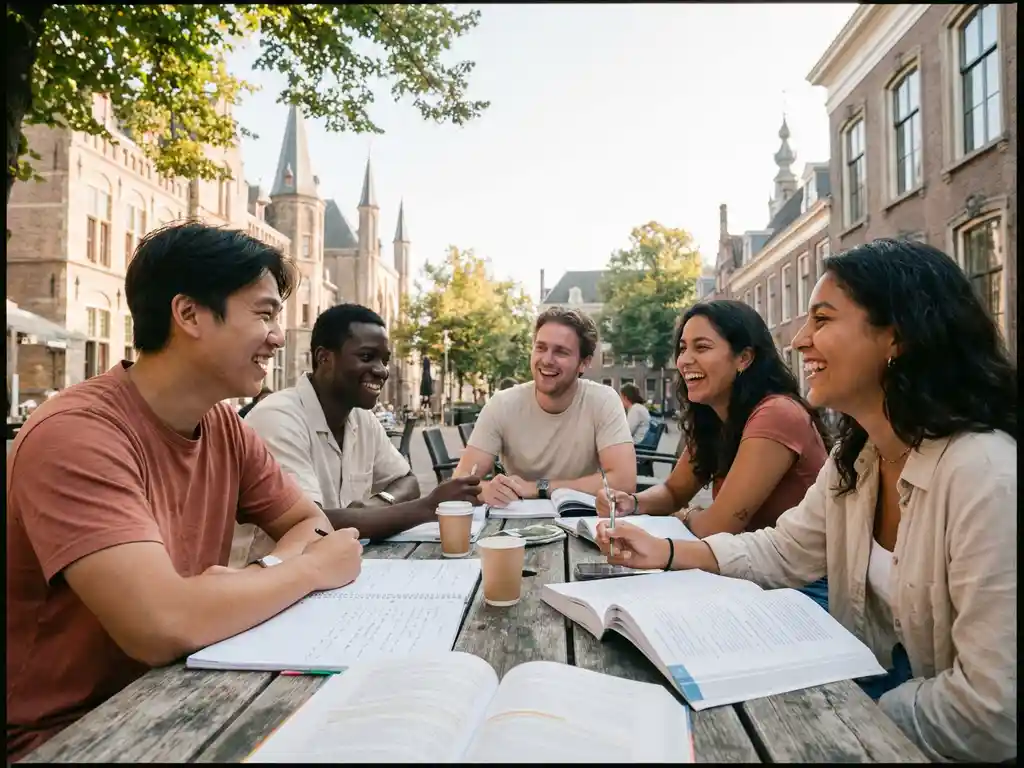
Learning Dutch as an international university student is entirely achievable, and most students reach a conversational level within one to two years of consistent study and practice. Dutch is considered one of the more accessible languages for English speakers, sharing significant vocabulary and grammatical roots with English and German. This article walks through the most common questions international students have about picking up Dutch during their studies in the Netherlands.
Is Dutch hard to learn for English speakers?
Dutch is widely considered one of the easiest languages for English speakers to learn. The two languages share a large number of cognates, similar sentence structures, and a common Germanic root, which means many Dutch words are immediately recognizable to anyone fluent in English. Language learners who already speak German will find the transition even smoother.
That said, Dutch does present some genuine challenges. The pronunciation takes adjustment, particularly the guttural “g” sound and vowel combinations that do not exist in English. Dutch also has grammatical gender, with words classified as either common or neuter, which affects how articles and adjectives are used. Verb conjugation follows patterns that are logical once learned but unfamiliar at first.
On balance, most language institutes and linguists rank Dutch among the top five most learnable languages for native English speakers. Students who commit to regular practice typically notice real progress within a few months, especially when they are living in the Netherlands and surrounded by the language daily.
Do international students in the Netherlands need to learn Dutch?
International students studying in English-taught programs in the Netherlands are not required to learn Dutch. The academic program itself will be delivered entirely in English, and most Dutch people, particularly in university cities, speak English confidently. You can navigate daily life, form friendships, and complete your degree without ever becoming fluent in Dutch.
However, choosing not to engage with the language at all means missing out on a richer experience. Learning even basic Dutch opens doors to deeper connections with local communities, a better understanding of Dutch culture, and a greater sense of belonging in your host country. Employers in the Netherlands and across Europe also view Dutch language skills as a genuine asset on a graduate’s CV.
For students in smaller cities or towns, the case for learning Dutch becomes even stronger. In places like Middelburg, where daily life is more closely intertwined with the local Dutch community than in a large metropolitan area, having some Dutch language ability makes everyday interactions, from visiting local markets to joining community events, significantly more rewarding.
What Dutch language resources are available at Dutch universities?
Most Dutch universities and international colleges offer Dutch language courses specifically designed for international students, typically ranging from beginner to intermediate level. These courses are usually structured around practical, everyday communication rather than formal academic Dutch, making them highly accessible to students with no prior knowledge of the language.
At University College Roosevelt, Dutch language courses are available as part of the curriculum and are designed to help international students settle into Dutch culture and society with greater ease. These courses sit within the broader framework of the liberal arts and sciences program, which emphasizes personal development alongside academic learning. Students can take Dutch alongside their chosen courses from across disciplines, making language learning a natural extension of their broader education.
Beyond formal courses, universities typically provide access to:
- Language exchange programs pairing international students with Dutch-speaking peers
- Online platforms and self-study tools recommended by language departments
- Conversation groups and informal language meetups organized by student associations
- Library resources including Dutch grammar guides, workbooks, and audio materials
It is worth checking what your specific institution offers early in your studies, as some language courses fill up quickly and may require advance registration.
How can you practise Dutch outside the classroom?
Practising Dutch outside the classroom is where real fluency develops. The most effective approach is to integrate Dutch into your daily routines rather than treating it as a separate study activity. Living in the Netherlands gives you a constant, immersive environment that few language learners elsewhere have access to.
Everyday interactions
Start small by greeting shopkeepers, ordering food, or asking for directions in Dutch. Most Dutch people will appreciate the effort, even if they switch to English to help you along. These brief, low-stakes exchanges build confidence faster than any textbook exercise. Over time, push yourself to sustain the conversation in Dutch a little longer each time before accepting the switch to English.
Digital and media immersion
Changing your phone language to Dutch, following Dutch social media accounts, and watching Dutch television with subtitles are all effective ways to absorb vocabulary passively. Dutch radio and podcasts designed for language learners are also excellent for training your ear to the rhythm and pronunciation of the language during commutes or while exercising.
Language exchange apps that connect you with native Dutch speakers looking to practise English are particularly valuable. These one-to-one conversations give you structured speaking practice in a low-pressure setting, and you can schedule them around your academic timetable.
Community engagement
Joining local clubs, sports teams, or volunteer organisations where Dutch is the primary language of communication is one of the most effective immersion strategies available. In a residential campus setting in a city like Middelburg, the local community is genuinely accessible, and participating in local life gives your Dutch practice real purpose and context.
How long does it take to become conversational in Dutch?
Most English-speaking students reach a conversational level in Dutch within six to twelve months of consistent, daily practice in an immersive environment. Reaching the B1 level on the Common European Framework of Reference for Languages, which represents genuine conversational ability, typically requires around 600 hours of combined study and exposure, though this varies significantly depending on individual effort and immersion.
Students who take formal Dutch language courses while living in the Netherlands tend to progress faster than those studying Dutch outside the country, simply because they can immediately apply what they learn in real-life situations. The combination of structured classroom instruction and daily informal exposure accelerates the learning curve considerably.
A realistic timeline for most international university students looks something like this:
- Months one to three: Basic greetings, numbers, everyday phrases, and simple conversations in familiar contexts
- Months four to six: Ability to handle routine transactions, follow simple conversations, and understand common signs and instructions
- Months seven to twelve: Growing confidence in spontaneous conversations, ability to discuss familiar topics at a reasonable pace
- Year two and beyond: Increasing fluency, ability to engage with more complex topics, and growing comfort with regional accents and informal speech
Consistency matters more than intensity. Short, daily practice sessions are more effective than occasional long study blocks, particularly in the early stages of learning.
Does learning Dutch improve your experience as an international student?
Learning Dutch meaningfully improves the experience of studying in the Netherlands. Students who engage with the local language consistently report feeling more connected to their host country, more integrated into the local community, and more confident navigating daily life beyond the campus. Language is one of the most direct pathways to genuine cultural understanding.
Beyond the personal benefits, Dutch language skills have practical value. They open up internship and part-time work opportunities that might otherwise be inaccessible, allow you to engage more fully with local organisations and community projects, and strengthen your CV for careers in the Netherlands or other Dutch-speaking regions such as Belgium and Suriname.
For students on a residential campus, learning Dutch also enriches the social experience in ways that go beyond the international student bubble. Being able to communicate with local residents, understand local media, and participate in community life gives your time in the Netherlands a depth that purely English-language engagement cannot replicate. It transforms your study abroad experience from something you observe into something you genuinely inhabit.
How UCR helps international students learn Dutch
University College Roosevelt actively supports international students in learning Dutch as part of a broader commitment to personal development and cultural integration. Key features of this support include:
- Dutch language courses available within the curriculum, designed specifically to help international students engage with Dutch culture and society
- A residential campus in Middelburg, a historic Dutch city where daily life naturally creates opportunities to practise the language outside the classroom
- Community Engaged Learning that connects students with local organisations, municipalities, and community partners, providing real-world contexts for Dutch language use
- A close-knit international community of around 500 students and 50 staff, where language exchange and cross-cultural connection are part of everyday campus life
- A Personal and Professional Development track that builds the communication and adaptability skills that underpin successful language learning
If you are considering studying in the Netherlands and want to make the most of the experience, including learning Dutch in a genuinely immersive environment, UCR offers a unique combination of academic rigour and real-world engagement. Connect with the UCR admissions team to find out more about the program and what life on campus in Middelburg looks like.
Related Articles
- What is student life like in the Netherlands?
- What are the benefits of living on a residential college campus?
- How do international students build friendships at a new university?
- How do you get around Middelburg without a car as a student?
- How do you manage homesickness during your first semester abroad?