


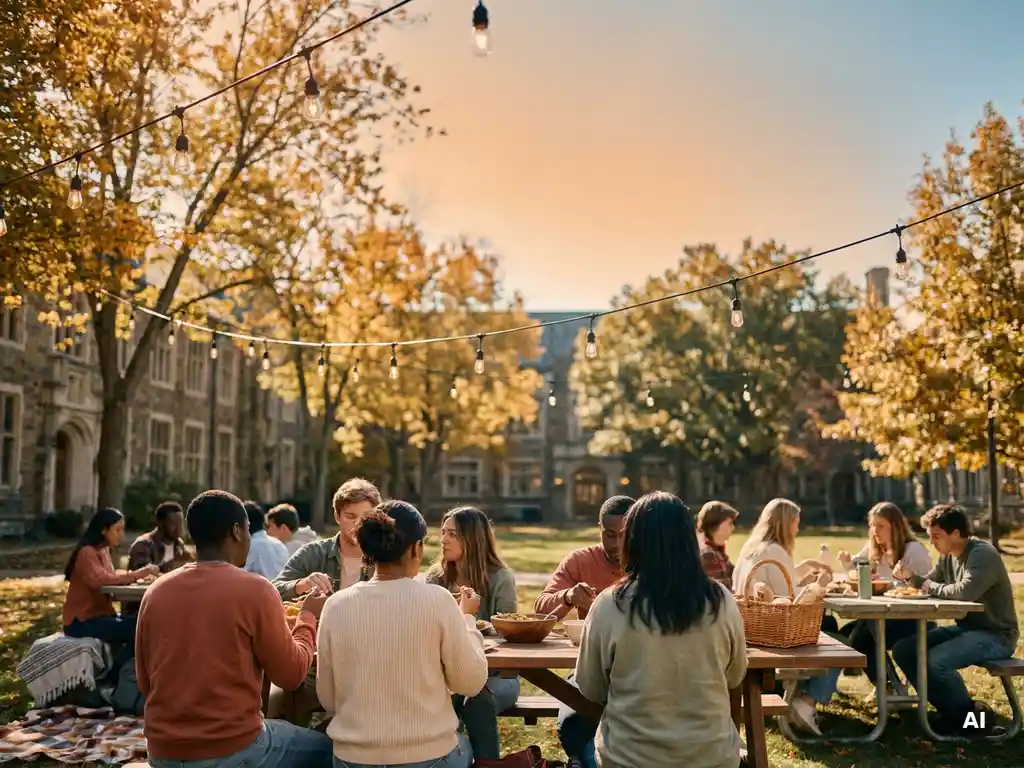
Campus traditions help new students feel a sense of belonging by creating shared experiences that signal inclusion, build familiarity, and establish a collective identity before academic pressure sets in. When students participate in rituals together, they form emotional bonds with peers, staff, and the institution itself. The questions below explore exactly how this works and what makes certain traditions more effective than others.
What role do shared rituals play in building student community?
Shared rituals build student community by giving everyone a common reference point. When a group of strangers goes through the same experience at the same time, it creates an immediate sense of “us.” That feeling of mutual participation is the foundation of social bonding, and campus traditions are one of the most reliable ways to generate it.
Rituals work because they are repeatable and recognizable. A welcome week ceremony, an annual campus run, or even a weekly communal dinner carries meaning precisely because it has happened before and will happen again. Returning students become the keepers of that meaning, and new students are invited into it. This transfer of shared knowledge across year groups is what turns a group of individuals into a genuine community.
Beyond the practical social function, rituals also give students a story to tell. The moment a new student can say “we all did this together,” they have already started to identify with their campus. That identification matters far beyond the event itself. It shapes how students relate to their institution, to each other, and to the years ahead.
How do campus traditions reduce the anxiety of starting university?
Campus traditions reduce starting anxiety by replacing uncertainty with structure. The first weeks of university are disorienting for almost every new student. Traditions give those weeks a clear shape: here is what happens first, here is who you will meet, here is what you can expect. That predictability lowers the emotional cost of transition.
Anxiety at the start of university is often rooted in the fear of not fitting in. Traditions directly address that fear by making participation the default. When everyone is new to a ritual, no one is behind. A student who has never attended a particular campus event before is in exactly the same position as every other first-year student, which levels the social playing field and removes the pressure of needing prior knowledge or existing friendships to join in.
There is also a practical comfort in having something to do. Unstructured free time in an unfamiliar environment can amplify loneliness. Traditions fill that space with purposeful activity and ready-made conversation. Students who might otherwise spend their first evenings alone in their rooms instead find themselves part of something, which is often the first step toward building lasting friendships.
What types of campus traditions are most effective at fostering belonging?
The most effective campus traditions for fostering belonging are those that are participatory, low-barrier, and repeated consistently over time. Traditions that require active involvement rather than passive observation create stronger bonds, because doing something together is more connecting than watching something together.
Several characteristics mark the most effective traditions:
- Inclusivity: Traditions that anyone can join, regardless of background, academic interest, or social confidence, reach the widest range of students and leave no one on the outside.
- Repetition: Annual or regular events build anticipation and give students something to look forward to across their entire time at university.
- Informal social contact: Traditions that create relaxed, unstructured time alongside structured activity allow friendships to form naturally rather than forcing interaction.
- Storytelling and memory-making: Events that are vivid, unusual, or emotionally resonant become shared memories that students return to long after they graduate.
- Student ownership: Traditions that students help organize and lead tend to carry more meaning than those imposed from above, because they reflect what the student body actually values.
Orientation weeks, campus-wide sports days, cultural festivals, and collaborative community projects all tend to score well on these criteria. The specific content matters less than the quality of the shared experience it generates.
Why does belonging matter for academic performance and wellbeing?
Belonging matters for academic performance and wellbeing because students who feel connected to their campus are more motivated, more resilient under pressure, and more likely to seek help when they need it. A student who feels like an outsider is more likely to disengage, struggle in silence, and ultimately underperform relative to their potential.
The relationship between social connection and academic outcomes is well established in educational research. Students who report feeling part of a community attend more classes, participate more actively in discussions, and persist through difficulty rather than withdrawing. This is not simply about morale. Belonging provides a sense of psychological safety that allows students to take intellectual risks, ask questions, and engage honestly with challenging material.
Wellbeing follows a similar pattern. Loneliness and social isolation are among the most significant contributors to poor mental health in young adults, and university transitions are a known risk period. Campus traditions that foster connection serve as a protective factor. They give students a social network to draw on during difficult periods, a sense of purpose beyond their coursework, and the grounding that comes from knowing they are genuinely part of something.
How does a small campus environment shape the impact of traditions?
A small campus environment amplifies the impact of traditions because every student is visible, participation is personal rather than anonymous, and the community is small enough for shared experiences to genuinely connect people rather than simply occur near them.
On a large campus, a student can attend hundreds of events and still feel invisible. With thousands of peers, it is easy to remain on the periphery of any tradition without anyone noticing or reaching out. On a small campus, the dynamic is fundamentally different. When the entire student body numbers in the hundreds rather than the thousands, attending a shared event means actually encountering your community. You recognize faces, you are recognized in return, and the ritual accumulates personal meaning because it connects you to specific people you will continue to see.
This is one of the reasons that residential colleges with compact communities tend to produce particularly strong senses of belonging. At a college like UCR, where around 550 students live and learn together on a single campus in Middelburg, traditions carry weight precisely because they are experienced by the whole community at once. A welcome event, a communal meal, or a collaborative project is not lost in scale. It lands.
Small campuses also make it easier for students to take ownership of traditions. When the student body is small enough to know each other, student-led initiatives gain traction quickly and the feedback loop between student culture and institutional practice is short. Traditions evolve in response to who the students actually are, which keeps them relevant and meaningful across successive year groups.
How can international students connect with traditions in an unfamiliar culture?
International students connect with traditions in an unfamiliar culture most effectively when those traditions are designed to be entered from any starting point. Traditions that assume shared cultural knowledge risk excluding students who arrive from different backgrounds. Those built around universal human experiences, shared activity, and genuine curiosity about difference include everyone from the outset.
For international students, the first challenge is often not the tradition itself but the social confidence to participate in something unfamiliar. Campuses that pair strong traditions with intentional welcome structures, such as orientation programs, peer mentoring, and mixed-nationality housing, give international students the relational foundation they need to step into shared rituals without feeling like outsiders observing from a distance.
Traditions that celebrate rather than flatten cultural difference are particularly effective in international communities. When students are invited to bring their own backgrounds into shared campus life, rather than simply adopting a pre-existing local culture, belonging becomes a two-way process. The international student is not asked to assimilate. They are asked to contribute, which is a meaningfully different invitation.
Language can also be a quiet barrier. Campuses where the primary language of instruction and social life is accessible to all students, and where additional language support is available for those navigating a new cultural context, make it easier for international students to participate fully in both formal traditions and the informal social life that surrounds them. Feeling linguistically at home is often the precondition for feeling socially at home.
How UCR helps new students build a genuine sense of belonging
At University College Roosevelt, the conditions that make campus traditions meaningful are built into the structure of student life from day one. For prospective students wondering whether they will truly belong, UCR’s approach offers several concrete answers:
- Guaranteed housing for all students means the entire community lives together on a vibrant inner-city campus in Middelburg, creating the daily proximity that turns shared rituals into genuine relationships.
- A close-knit community of around 550 students from over 70 nationalities ensures that campus traditions are experienced personally rather than anonymously, and that international students are the norm rather than the exception.
- A mandatory Personal and Professional Development track gives every student a shared developmental journey from their first semester, building the communication skills and social confidence that help students engage fully with campus life.
- Student-led campus culture means traditions evolve with the community, staying relevant and inclusive across year groups.
- Dutch language courses for international students help those navigating a new cultural context feel more at home on both the campus and in the broader Middelburg community.
If you are looking for a university where belonging is not an afterthought but a structural commitment, explore the UCR campus experience and find out how life at UCR is designed to help you thrive from the moment you arrive.
Related Articles
- How does community-engaged learning work at university?
- Do you need health insurance to study in the Netherlands?
- Can being part of a student club help you find your career direction?
- What documents do non-EU students need before arriving in the Netherlands?
- How do international students budget their monthly expenses in the Netherlands?