


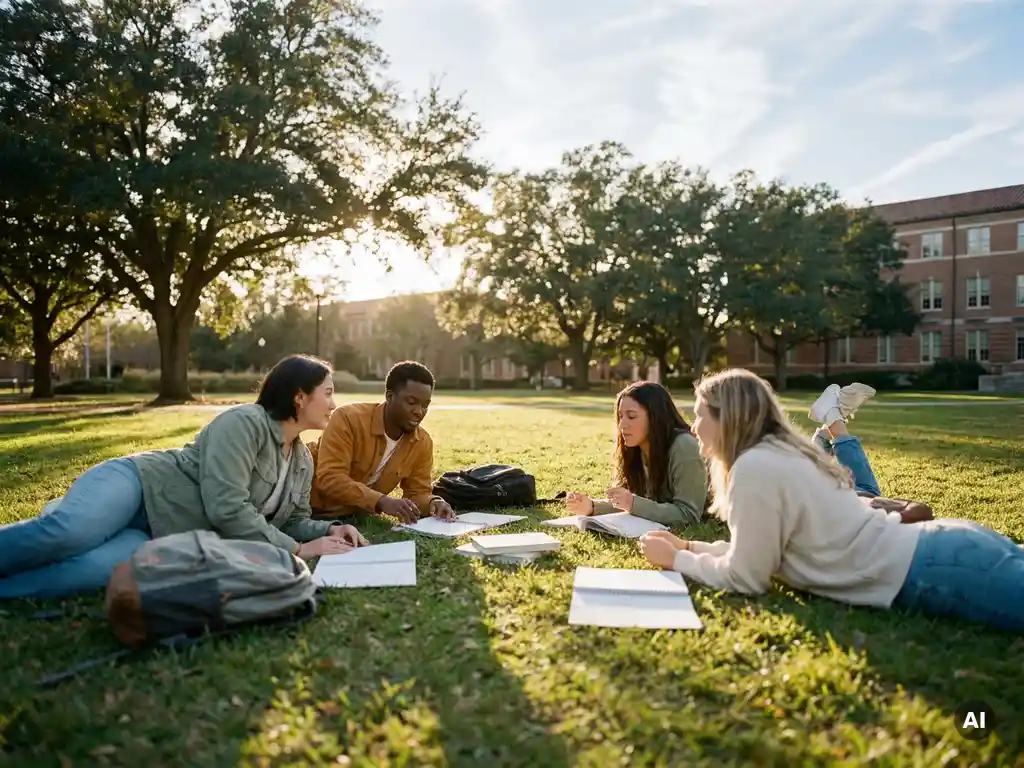
A typical day for a residential college student is structured but flexible, blending academic classes, collaborative projects, meals with peers, and self-directed study with a full evening of campus social life. Unlike commuter universities where students arrive, attend lectures, and leave, residential college students live where they learn, which means their daily rhythm integrates academic and personal growth from morning to night.
At a place like University College Roosevelt, where around 500 students share a compact inner-city campus in Middelburg, that integration is especially pronounced. Every part of the day, from breakfast conversations to late-night study sessions, becomes part of the educational experience. The sections below walk through each part of that day in detail.
What makes a residential college schedule different from a regular university?
A residential college schedule differs from a traditional university schedule because learning does not stop when class ends. Students live, eat, study, and socialise within the same community, which means academic conversations continue over dinner, study groups form spontaneously, and faculty are genuinely accessible outside office hours. The boundaries between academic life and personal life are intentionally blurred.
At most large universities, students commute to campus for scheduled lectures and then disperse. The residential college model removes that separation entirely. When your classmates are also your neighbours, collaboration happens constantly and organically. A debate started in a seminar room often continues in the common room that evening.
This structure also tends to produce smaller, more discussion-based classes rather than large lecture halls. At UCR, for example, courses are deliberately small-scale, with teaching methods that include guest lectures, student presentations, debates, and fieldwork rather than passive note-taking. The schedule reflects this: it is varied by design, not uniform by default.
What do residential college students do in the morning?
Most residential college students begin their mornings with breakfast in or near campus housing, often alongside classmates, before heading to their first class or a study block. Because housing is guaranteed and located on or near campus, there is no commute, which gives students more control over how they start their day and more time to prepare thoughtfully for what lies ahead.
Morning routines vary significantly depending on the day’s schedule. A student might have a 9 am seminar in environmental science followed by a free block used for reading, or they might start later with a collaborative project meeting before an afternoon class. The liberal arts and sciences curriculum at UCR is built around flexibility, so no two students have identical timetables.
Many students use morning hours for independent study, especially when working on research assignments. UCR introduces students to undergraduate research from their very first semester, so mornings often involve reading academic papers, preparing presentations, or drafting coursework. The Personal and Professional Development trajectory, which all students complete, also builds the study skills and time management habits that make these self-directed morning blocks genuinely productive.
What types of classes and activities fill a residential college day?
A residential college student’s daytime schedule typically includes a mix of seminars, workshops, group projects, and hands-on learning activities rather than a series of identical lecture slots. At UCR, a single week might include a debate in a Government and Society course, a lab session connected to the Delta Climate Center, a guest lecture from a local entrepreneur, and a community-engaged learning project in Middelburg.
Academic classes and seminars
Classes at UCR are small and discussion-driven. Students choose courses across six interdisciplinary clusters: Business and Entrepreneurship, Data Science and Intelligent Systems, Environment and Sustainability, Government and Society, Health, Cognition and Behavior, and Media, Culture and Communication. Because the Bachelor of Liberal Arts and Sciences allows students to design their own curriculum, each student’s class schedule reflects their personal academic interests and goals.
Courses fall into three types: qualifying courses that build foundational knowledge, core courses that develop disciplinary competencies, and responsive courses that adapt to emerging global challenges and student interests. This structure means the academic day feels purposeful rather than prescriptive.
Real-world and community-engaged learning
Beyond the classroom, UCR’s living lab approach means students regularly engage with the wider community of Zeeland. Afternoons might involve fieldwork with local government partners, sustainability projects connected to regional challenges, or collaborative work with businesses and organisations in Middelburg. This community-engaged learning is not supplementary; it is a core part of how UCR delivers its curriculum. Students build critical thinking, creativity, and problem-solving skills precisely because they are applying them to real problems, not hypothetical ones.
How do residential college students spend their evenings?
Residential college students typically spend their evenings in a combination of self-directed study, social activities, and campus events. Because everyone lives on or near campus, evenings are naturally social without being distracting. Students might attend a student-organised cultural event, join a sports activity, participate in a club, or simply gather with friends from a mix of nationalities and academic backgrounds.
UCR’s student-led campus culture means evenings are shaped by students themselves. With over 70 nationalities represented in a community of around 500 students, informal evening gatherings become genuinely cross-cultural experiences. Conversations over dinner or in common spaces often bridge academic topics and personal perspectives in ways that would be impossible in a commuter setting.
Study also continues into the evening, but the residential setting makes group study more accessible. When your study partner lives two doors away, organising a session takes minutes rather than requiring logistics. The Personal and Professional Development trajectory actively builds the teamwork and communication skills that make these collaborative study habits effective from early in the first year.
How does campus living affect academic performance and personal growth?
Campus living tends to improve both academic performance and personal development because it removes logistical barriers to learning and surrounds students with a constant, supportive peer community. When students live where they study, they have more time for deep work, more access to peers and faculty, and more opportunities to develop the interpersonal skills that matter beyond graduation.
At UCR, guaranteed housing for all students for the full duration of their studies is not just a practical benefit. It is a deliberate educational choice. Knowing that every student shares the same campus creates a foundation of equality and belonging. Faculty and staff also live in or near Middelburg, which means the lines of communication between students and their teachers are genuinely short.
Personal growth happens continuously in this environment. Students learn to navigate a diverse international community, manage their own time and academic choices, and take on leadership roles in student organisations. The mandatory Personal and Professional Development trajectory formalises this growth by building transferable skills such as effective communication, adaptability, and career preparation into the curriculum itself. By the time students graduate, they have not only an academic degree but also a demonstrated record of self-directed learning and real-world engagement.
What should prospective students expect from their first week on campus?
Prospective students arriving at a residential college for the first time should expect a structured but welcoming orientation week that introduces them to campus life, academic expectations, fellow students, and the surrounding community. At UCR, the first week is designed to ease the transition into both the academic programme and the residential community, giving new students a strong foundation before formal classes begin.
During orientation, students typically meet their academic advisors, learn how to navigate the curriculum and course selection process, and begin forming the peer connections that will define their UCR experience. Because the campus is small and everyone is new at the same time, friendships form quickly and naturally.
New students can expect the following during their first week:
- Introduction to the liberal arts and sciences curriculum and how to design a personalised course plan
- Orientation sessions covering campus facilities, student services, and life in Middelburg
- Social events organised by student associations that help break the ice across nationalities and academic backgrounds
- Early introductions to the Personal and Professional Development trajectory and research expectations
- Guided exploration of Middelburg, including the local community connections that underpin UCR’s living lab approach
The first week sets the tone for everything that follows. Students quickly learn that UCR’s residential college experience is active rather than passive. They are not waiting to be told what to do; they are already making choices, building relationships, and beginning to shape the academic journey that will be uniquely their own.
How UCR shapes the residential college student experience
University College Roosevelt is built around the belief that where and how you live directly shapes how and what you learn. For prospective students considering a residential college, UCR offers a distinctive combination of academic flexibility and genuine community.
- Guaranteed housing for all students throughout their studies, on a vibrant inner-city campus in Middelburg
- A personalised curriculum across six interdisciplinary clusters, leading to a Bachelor of Arts or Bachelor of Science from Utrecht University
- Small-scale, discussion-based classes with a mix of seminars, fieldwork, guest lectures, and community-engaged learning
- A mandatory Personal and Professional Development trajectory that builds transferable skills alongside academic knowledge
- A close international community of around 500 students from over 70 nationalities, with a student-led campus culture
- Real-world learning through the living lab approach, connecting students with local government, businesses, and organisations in Zeeland
If the residential college student life described here sounds like the environment where you would thrive, explore UCR’s admissions process and take the first step toward designing your own academic journey.
Related Articles
- What is the social scene like for students in Middelburg?
- What social activities are available for university students in 2026?
- What is Dutch culture shock and how do students cope with it?
- How do international students budget their monthly expenses in the Netherlands?
- How do you manage homesickness during your first semester abroad?