


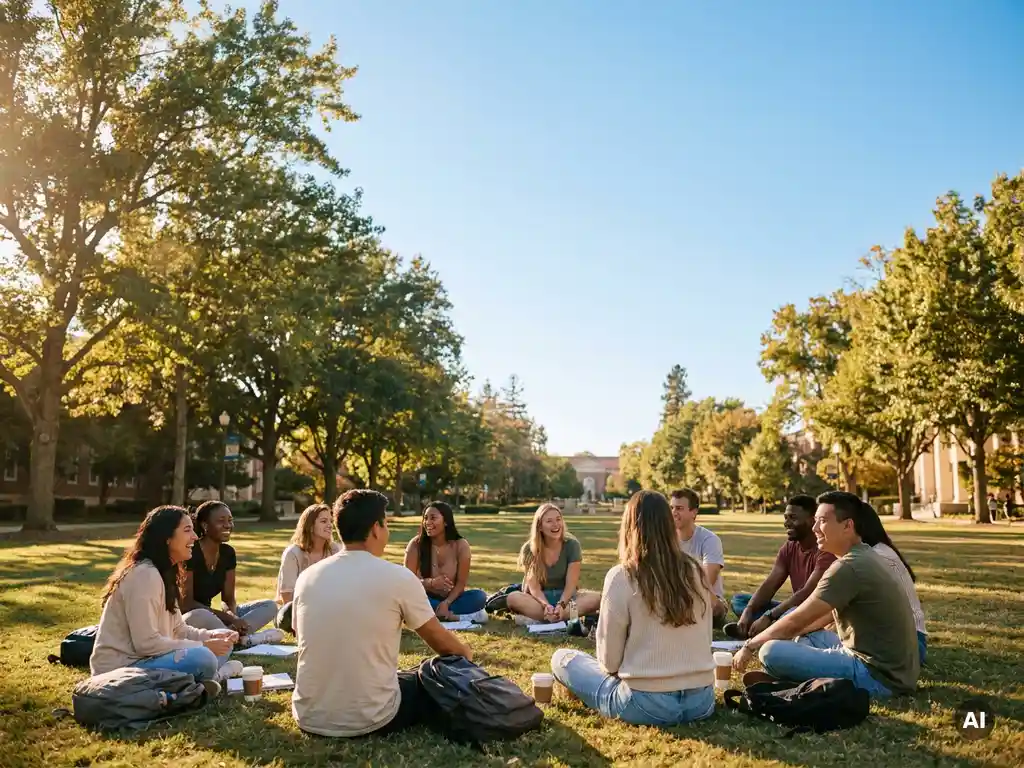
Small campus communities support first-year students by creating an environment where connection happens naturally and help is genuinely close at hand. With fewer students, shorter distances between people, and structures designed around belonging, the transition from secondary school to university feels less overwhelming. This article unpacks the specific ways a small campus makes that difference, from housing and faculty access to international inclusion and honest trade-offs.
What makes a small campus community different from a large university?
A small campus community differs from a large university primarily in scale and access. With a few hundred students rather than tens of thousands, every student is visible, relationships form more easily, and institutional support reaches individuals rather than crowds. At a small liberal arts college, you are a known person, not an enrollment number.
At large universities, first-year students often navigate enormous lecture halls, compete for office hours, and find their social footing within a population so large that meaningful connection can take months or years to establish. The sheer size creates distance, not just physically but socially and academically.
Small campuses invert that dynamic. When a college has around 500 students, you encounter the same people in class, in the dining hall, and on campus within days of arriving. Faculty know students by name. Peer networks form quickly because the community is compact enough to be navigable. The undergraduate experience at a small residential college is built around proximity, and that proximity is what makes early support so effective.
The academic model also tends to differ. Liberal arts colleges typically offer interdisciplinary programs where students move across subject areas rather than committing to a single department from day one. This flexibility means first-year students explore rather than specialize, which reduces the pressure of having to choose a fixed path immediately.
How do small campuses ease the transition into university life?
Small campuses ease the transition into university life by reducing anonymity and increasing structured touchpoints between students, staff, and peers. When the environment is intimate by design, first-year students spend less time figuring out where to go for help and more time actually getting it.
The first weeks at university are often the hardest. Students are adjusting to new academic expectations, a new social environment, and in many cases a new country. On a large campus, that adjustment happens largely in private. On a small campus, it happens in community.
Several features of small campus life make the transition more manageable:
- Smaller class sizes mean students engage actively from the start rather than sitting passively in lectures
- Mandatory development programs that build communication, teamwork, and study skills give first-year students a practical foundation alongside academic coursework
- Peer proximity means support networks form organically, often within the first week
- Staff accessibility reduces the gap between having a question and getting an answer
- A structured campus culture, often student-led, gives new arrivals immediate ways to participate and belong
At University College Roosevelt, for example, every student takes part in a Personal and Professional Development trajectory from their first semester. This mandatory program focuses on transferable skills including effective communication, adaptability, and study strategies, giving first-year students tools that serve them both inside and outside the classroom from day one.
What role does guaranteed student housing play in first-year wellbeing?
Guaranteed student housing plays a central role in first-year wellbeing by removing one of the most stressful uncertainties of starting university. When students know they have a secure, affordable place to live before they arrive, they can focus their energy on settling in academically and socially rather than navigating a competitive rental market.
Housing insecurity is a genuine barrier to academic performance and personal wellbeing. Students who spend their first weeks worrying about where they will live, or commuting long distances from off-campus accommodation, start at a disadvantage compared to those who are already embedded in campus life.
Residential colleges that guarantee housing for all students create a different kind of campus dynamic. When students live together, community forms continuously, not just during scheduled activities. Conversations happen in shared spaces. Friendships develop between people from different academic backgrounds and nationalities. The campus becomes a living environment rather than a place students visit for classes.
This matters especially for international students, who often arrive without an existing local network. Guaranteed housing means they step into a ready-made community from the moment they arrive, with peers nearby and staff accessible. For a residential college like UCR, guaranteed housing for all students throughout their studies is not simply a logistical convenience. It is a structural commitment to belonging.
How do close student-faculty relationships benefit new undergraduates?
Close student-faculty relationships benefit new undergraduates by making academic support personal, timely, and consistent. When faculty know their students individually, they can identify when someone is struggling, offer targeted feedback, and engage with each student’s specific intellectual interests rather than delivering generic instruction to a crowd.
At large institutions, faculty contact for first-year students is often limited to lectures and brief office hours. The relationship is transactional. At a small liberal arts college, the dynamic is different. With small class sizes and a compact campus, faculty and students interact regularly, both in formal academic settings and in everyday campus life.
This closeness produces several concrete benefits for new undergraduates:
- Students receive more detailed and personalized academic feedback
- Faculty can guide students toward research opportunities, elective choices, and academic paths that match their interests
- Students feel more confident asking questions, challenging ideas, and taking intellectual risks
- Mentorship relationships develop naturally, often extending beyond a single course
- First-year students are introduced to undergraduate research earlier, because faculty have the capacity to involve small groups meaningfully
At UCR, students engage with research projects from their first semester, supported by faculty who are close enough to guide that process in a hands-on way. The small scale of the institution makes that kind of early research involvement possible in a way that larger universities, with their competing demands on faculty time, typically cannot replicate for first-year students.
Do small campus communities help international students feel included?
Yes, small campus communities actively support international student inclusion by creating conditions where integration happens through daily interaction rather than deliberate effort. When a campus has a few hundred students from dozens of nationalities living and learning together in a compact space, cross-cultural connection is built into the ordinary rhythm of campus life.
International students at large universities can find themselves gravitating toward communities of students from their home country, simply because the campus is large enough to sustain those separate groups. Integration requires active choice. On a small campus, the community is too interconnected for that kind of separation to take hold easily.
Several factors make small campuses particularly welcoming for international first-year students:
- Guaranteed housing places international students immediately within the campus community rather than leaving them to find accommodation independently
- Small class sizes mean international students participate actively from day one rather than being absorbed into a large anonymous cohort
- Diverse peer groups are the norm rather than the exception, so no single nationality dominates social life
- Language support, such as Dutch language courses for international students at UCR, helps newcomers engage with the local culture and society beyond campus
- Staff proximity means international students can access practical support quickly when they need it
UCR brings together students from over 70 nationalities within a community of around 500 students. At that scale, international diversity is not a statistic; it is the texture of daily life. Students from different countries share classrooms, housing, and campus activities in a setting small enough that everyone’s presence is felt.
When does a small campus community become a drawback for students?
A small campus community becomes a drawback when a student needs variety, anonymity, or a wider range of specialist resources than a compact institution can provide. The same closeness that supports first-year students can feel limiting for those who thrive in larger, more anonymous environments or who want access to a broader set of facilities, clubs, or course options.
It is worth being honest about the trade-offs. Small campuses offer depth of community but not breadth of scale. A student who wants dozens of student societies, a large sports complex, or highly specialized postgraduate-level courses within their undergraduate institution may find that a small liberal arts college does not meet those expectations.
The social intensity of a small campus can also be challenging. When everyone knows everyone, there is less room to reinvent yourself quietly or to step back from social life without it being noticed. For students who value privacy or who need time to find their footing before engaging socially, the closeness of a small campus can feel like pressure rather than support.
There is also the question of urban life. A small residential college located in a smaller city offers a different lifestyle from a large university in a major metropolitan area. Students who want the cultural variety, nightlife, and anonymity of a big city may find that a campus in a quieter setting does not match their vision of student life, regardless of how strong the academic program is.
The right fit depends on what a student genuinely needs. For those who value personal connection, academic flexibility, and a community where they are known, a small campus is a strength. For those who need scale, variety, or distance, it may not be the best environment.
How UCR supports first-year students through small campus life
University College Roosevelt is built around the principles that make small campus communities work for first-year students. As a residential liberal arts and sciences college with around 500 students in Middelburg, UCR combines the structural advantages of small-scale learning with a genuinely international community and a curriculum designed to support personal growth from day one.
- Guaranteed housing for all students throughout their studies, removing uncertainty and embedding students in community immediately
- A mandatory Personal and Professional Development trajectory that builds communication, teamwork, and study skills in the first year
- Small class sizes with active learning formats including debates, fieldwork, guest lectures, and student presentations
- Close student-faculty relationships supported by staff who live in or near Middelburg
- Undergraduate research from the first semester, giving new students early access to meaningful academic work
- A diverse community of over 70 nationalities within a campus small enough for genuine cross-cultural connection
- Dutch language courses to help international students settle into life in the Netherlands
If you are looking for an undergraduate experience that combines academic rigor with genuine community, UCR offers a distinctive path. Explore what student life and the liberal arts and sciences program look like at ucr.nl.
Related Articles
- What are the best universities in the Netherlands for international students?
- What part-time jobs can international students do in the Netherlands?
- What is the difference between a student association and a student club?
- What is Dutch culture shock and how do students cope with it?
- Why is cycling culture in the Netherlands so important to understand before you arrive?