


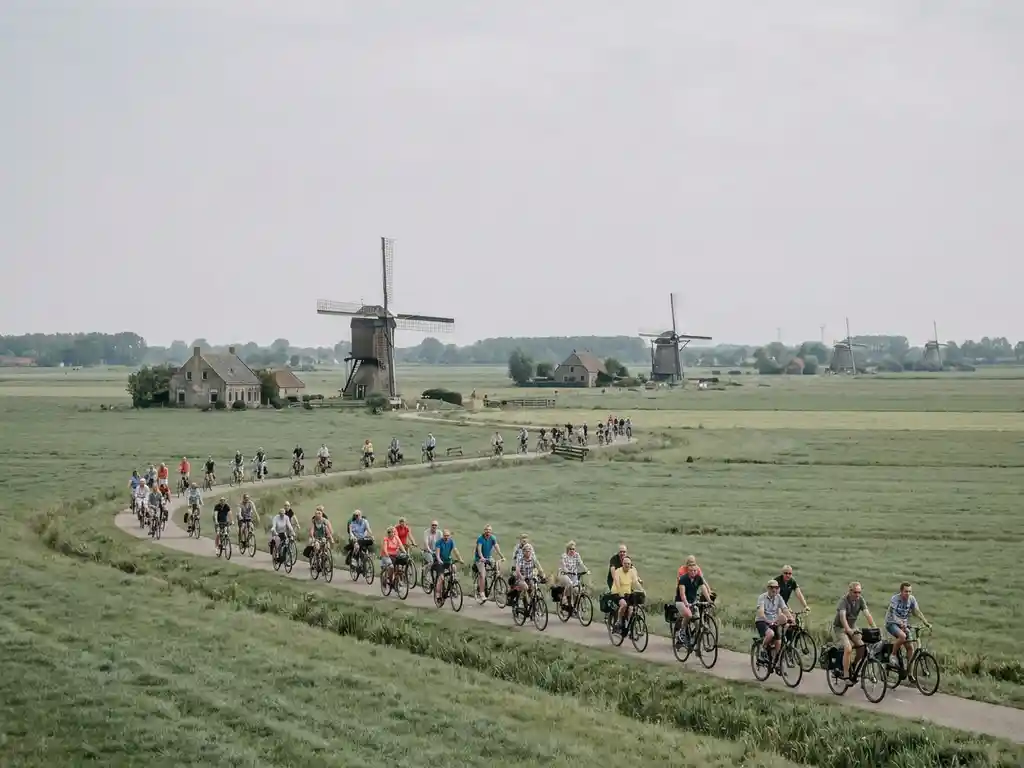
Cycling culture in the Netherlands is essential to understand before you arrive because it is not simply a leisure activity; it is the primary mode of daily transport for millions of Dutch people, and Middelburg is no exception. The Netherlands has built its entire urban infrastructure around the bicycle, meaning roads, traffic signals, and social norms all assume you know how to participate. Whether you are commuting to class, picking up groceries, or meeting friends across town, the bike is how life moves here. This article walks through everything international students need to know, from road rules and etiquette to finding the right bike in Middelburg.
How does cycling actually work as daily transport in the Netherlands?
Cycling in the Netherlands functions as a fully integrated transport system, not a recreational add-on. Dutch cities and towns are built around an extensive network of dedicated cycle paths, called fietspaden, that run parallel to roads, through parks, and across intersections with their own traffic signals. Most journeys under five kilometres are completed by bike as a matter of course, regardless of age, weather, or occasion.
Unlike countries where cycling requires athletic gear or special equipment, biking in the Netherlands is treated as ordinary movement. People cycle in work clothes, carrying shopping bags, holding an umbrella, or balancing a passenger on the back rack. The infrastructure supports this completely: smooth, well-maintained paths, abundant bike parking at train stations and shops, and traffic laws that actively protect cyclists over motor vehicles.
For international students arriving in Middelburg, this means the bicycle is not optional; it is the fastest, cheapest, and most practical way to move around the city. Middelburg is compact and flat, making it ideal for cycling, and students quickly discover that owning a bike transforms daily life from logistically complicated to effortlessly simple.
What are the unwritten rules of Dutch cycling etiquette?
Dutch cycling etiquette revolves around predictability, efficiency, and mutual respect. The most important unwritten rule is to keep moving and signal your intentions clearly. Hesitating, stopping suddenly, or swerving unexpectedly is considered dangerous and frustrating to the cyclists around you. The cycle path is treated like a road lane, and the same logic applies: maintain your speed, stay to the right, and overtake on the left.
Here are the key unwritten rules to follow from day one:
- Signal with your arm before turning, even if no one appears to be behind you. Dutch cyclists do this automatically, and failing to signal marks you immediately as a newcomer.
- Ring your bell when approaching pedestrians who have wandered onto the cycle path. A single ring is a polite warning, not an aggressive gesture.
- Do not walk on the fietspad. The red-surfaced cycle paths are for bikes only. Walking on them is one of the fastest ways to irritate locals.
- Avoid your phone. Using a handheld phone while cycling is both illegal and deeply frowned upon. If you need to check directions, pull over to the side.
- Lock your bike properly. Leaving a bike with only a wheel lock is an invitation for theft. Dutch cyclists use a frame lock combined with a chain lock attached to a fixed object.
- Give way at priority intersections. Triangular markings on the cycle path surface indicate you must yield. These appear frequently and are easy to miss if you are not looking for them.
The broader social expectation is that you integrate smoothly into the flow of traffic. Dutch cyclists are not aggressive, but they are efficient, and they expect the same from everyone sharing the path.
What type of bike do most Dutch people actually ride?
Most Dutch people ride an omafiets, which translates literally as “grandmother’s bike” but simply refers to the classic Dutch upright city bicycle. These bikes are heavy, durable, and designed for comfort rather than speed. They feature an upright riding position, a chain guard to protect clothing, wide tyres, mudguards, and built-in dynamo lighting powered by the wheel. They are not fast, but they are practical, low-maintenance, and built to last for decades.
You will also see cargo bikes (bakfietsen) used by families to transport children or large loads, and increasingly, e-bikes among commuters covering longer distances. Racing bikes and mountain bikes exist but are far less common for everyday transport; they are used for sport, not for cycling to the supermarket.
For students, a second-hand city bike is the standard choice. It does not need to be new, beautiful, or fast. It needs to have working brakes, functioning lights, and a solid lock. A modest, slightly worn-looking bike is actually preferable in student cities because it attracts less attention from thieves.
Where can international students buy or rent a bike in Middelburg?
International students in Middelburg can buy a second-hand bike from local bike shops, online marketplaces, or student notice boards. The most reliable options for affordable second-hand bikes include local cycle dealers in the city centre, the Facebook Marketplace listings for the Zeeland region, and Marktplaats, which is the Dutch equivalent of Craigslist and the most widely used platform for second-hand goods in the Netherlands.
Expect to pay roughly 50 to 150 euros for a decent second-hand city bike that will serve you well throughout your studies. Avoid anything priced suspiciously low, as stolen bikes do circulate on informal markets. Buying from a registered shop gives you more security and often includes basic repairs.
For students who arrive before they have had time to search, short-term bike rental is available through some local shops and occasionally through student housing arrangements. However, most students find that purchasing a bike within the first week is the more cost-effective approach given how central cycling is to daily life in Middelburg.
A few practical tips when buying:
- Test the brakes, lights, and gears before paying.
- Ask for a receipt or written confirmation of sale to prove ownership if stopped by police.
- Budget an additional 20 to 30 euros for a quality chain lock on top of the frame lock most Dutch bikes already have.
- Check whether your student housing provides a secure bike storage area, which most residential campuses in the Netherlands do.
What are the legal rules cyclists must follow in the Netherlands?
Cyclists in the Netherlands are subject to the Dutch traffic code and can be fined for violations. The most important legal rules are that cyclists must use the designated cycle path where one is available, must have working front and rear lights after dark, and must not use a handheld mobile phone while riding. Alcohol limits apply to cyclists as well as drivers, and cycling under the influence can result in a fine.
Key legal requirements to know include:
- Lights are mandatory after dark. A white or yellow light at the front and a red light at the rear are required by law. Dynamo lights built into the bike satisfy this requirement, but battery-powered clip-on lights are also widely used and accepted.
- Helmets are not legally required for regular cyclists in the Netherlands. This surprises many international students, but it reflects the safety design of the infrastructure itself. Helmets are recommended for children and for high-speed cycling, but wearing one is a personal choice for adults on city bikes.
- Cycle paths must be used when they are available. Riding on the main road when a fietspad runs alongside it is not permitted.
- Traffic signals apply to cyclists. Dedicated cycle traffic lights are present at most major intersections, and running a red light is both illegal and dangerous.
- Carrying passengers on the back rack is legal for adults, provided the bike has a proper carrier rack. Child seats must meet safety standards.
Fines for cycling violations in the Netherlands are enforced and can be substantial, so understanding the rules before you ride is genuinely important, not just advisable.
How does cycling shape student life at UCR in Zeeland?
Cycling shapes student life at UCR in Zeeland by making the entire region accessible, affordable, and social. Middelburg is a compact historic city where most destinations — lecture buildings, supermarkets, cafes, the train station — are reachable by bike within ten minutes. Students who embrace cycling quickly find that it removes friction from daily life and opens up the surrounding landscape of Zeeland in a way that no other transport mode can match.
Zeeland is one of the most scenic provinces in the Netherlands, with extensive coastline, polders, and small towns connected by well-maintained cycle routes. Weekend bike trips to the beach, nearby villages, or along the waterways become a natural part of student culture. The flat terrain makes these trips accessible regardless of fitness level, and the region’s cycling infrastructure is excellent even outside urban areas.
On a social level, cycling is a shared experience that connects students. Riding together to class, locking bikes outside a cafe, or spontaneously cycling somewhere new after lectures are all part of the informal rhythm of campus life. Because all UCR students live on the residential campus in Middelburg, the bike becomes a connector between the campus community and the wider city, encouraging students to engage with local life rather than stay within the university bubble.
The broader lesson for incoming students is that cycling is not just a transport decision; it is a cultural orientation. Adopting it quickly signals a willingness to integrate into Dutch life, and it genuinely makes your time in Zeeland richer, more independent, and more connected to the place you are living in.
How UCR helps students settle into life in the Netherlands
Arriving in a new country with a new transport culture, a new language, and a new academic system can feel overwhelming. UCR is designed to ease that transition and help international students build confidence and belonging from the very first week.
- All students receive guaranteed housing on the residential campus in Middelburg, placing you immediately within cycling distance of everything you need.
- The Personal and Professional Development programme helps students build practical life skills alongside academic ones, including how to navigate Dutch culture and society.
- International students can take Dutch language courses to ease integration into daily life, from reading street signs to chatting with locals at the market.
- The close-knit campus community of around 500 students means you are never navigating new experiences alone; peers, staff, and faculty are all nearby and genuinely accessible.
- UCR’s interdisciplinary academic programme is designed for curious, motivated students who want to engage with the world around them, including the community and region they study in.
If you are ready to explore what studying at UCR in Zeeland could look like for you, connect with the UCR admissions team and start the conversation today.
Related Articles
- Can you study in the Netherlands without speaking Dutch?
- How does a student association umbrella organization work at a university?
- How do residential college students spend their free time outside class?
- How do you apply for a Dutch student visa in 2026?
- What documents do non-EU students need before arriving in the Netherlands?