


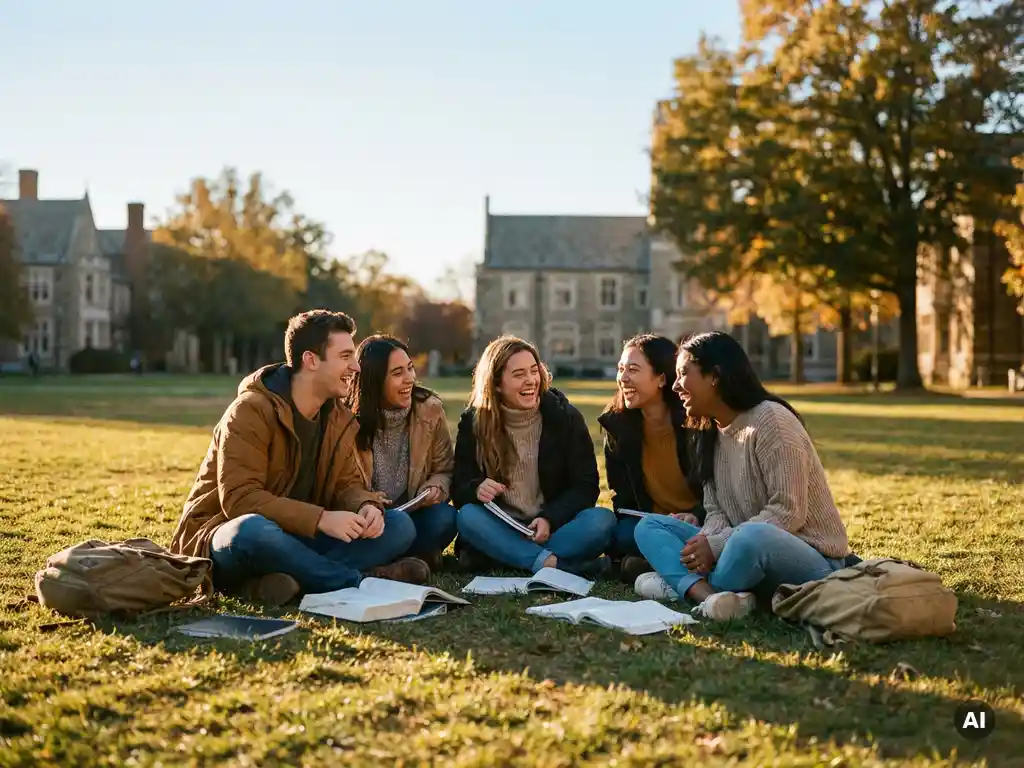
A shared residential experience builds lifelong friendships because it creates continuous, unplanned contact between students who eat, study, sleep, and socialise in the same space every day. Proximity alone does not explain it: what matters is that residential students share meaningful moments repeatedly, across different contexts, which is exactly what psychological research on friendship formation identifies as the foundation of deep connection. The questions below unpack why this happens, how campus life accelerates bonding, and why those bonds so often survive long after graduation.
Why do residential college students form stronger friendships than commuters?
Residential college students form stronger friendships than commuters because they encounter each other constantly, across contexts that go far beyond the classroom. Shared meals, late-night study sessions, spontaneous conversations in hallways, and communal spaces all create repeated, low-stakes interactions that accumulate into genuine closeness over time. Commuter students, by contrast, experience campus life in defined windows before returning to separate home environments.
Psychologists refer to this dynamic as the mere exposure effect: the more often people encounter each other in relaxed, natural settings, the more positively they tend to feel toward one another. In a residential college, that exposure happens organically every single day, without anyone needing to plan it. You do not schedule a friendship; you build one across dozens of small moments that add up.
There is also a depth dimension that commuter life makes harder to achieve. When students live together, they inevitably see each other at their best and their most vulnerable: stressed before exams, homesick in the first weeks, elated after a breakthrough. That emotional range creates a kind of intimacy that surface-level classroom acquaintance rarely reaches. Living-on-campus friendships are forged in real life, not just in academic settings.
What daily shared experiences bond residential students most deeply?
The daily shared experiences that bond residential students most deeply are the informal, unscripted ones: shared meals, communal study spaces, late evenings in common rooms, and the rituals that develop naturally within a close community. These moments feel ordinary at the time, but they are precisely the building blocks of lasting connection because they are consistent, repeated, and emotionally real.
In a residential liberal arts community like UCR, the range of shared experiences extends well beyond dormitory life. Students collaborate on interdisciplinary projects, attend guest lectures together, participate in Community Engaged Learning initiatives in the surrounding city, and take part in student-led campus activities. Each of these creates a shared reference point: a story, an inside joke, a challenge overcome together, that deepens the bond.
Shared meals deserve particular attention. Eating together is one of the oldest social rituals humans have, and in a campus setting where students gather in the same dining spaces daily, those meals become a reliable anchor for conversation and connection. Over three years, the cumulative effect of thousands of shared breakfasts, lunches, and dinners is a social fabric that is genuinely difficult to replicate outside a residential setting.
Student-led culture amplifies this further. When students organise their own events, clubs, and activities, they invest ownership in the community they are building. That sense of co-creation turns a place to live into a place that belongs to them, which makes the friendships formed there feel more meaningful and more personal.
How does a small campus community affect the depth of friendships formed?
A small campus community produces deeper friendships because students encounter the same people repeatedly across many different situations, which accelerates the process of genuinely knowing someone. In a community of around 500 students, you cannot remain a stranger for long. You will see your peers in class, at dinner, at events, and in the spaces between, and that sustained familiarity creates the conditions for real friendship rather than polite acquaintance.
Scale matters enormously here. At a large university with tens of thousands of students, it is entirely possible to spend three years surrounded by people without forming a single deep connection. The sheer size of the environment makes it easy to remain anonymous. In a small residential college, anonymity is almost impossible, and that is a feature rather than a limitation.
Small communities also tend to develop stronger norms of mutual support. When everyone knows everyone, there is a natural incentive to look out for each other. Students notice when a peer is struggling, when someone is sitting alone, when a friend has gone quiet. That attentiveness builds trust, and trust is the foundation of any friendship that lasts.
The presence of faculty and staff who live nearby or on campus reinforces this effect. When the boundaries between academic and personal life are more porous, students feel embedded in a genuine community rather than a transactional institution. The result is a campus community bond that feels more like belonging than enrolment.
How do shared academic challenges strengthen social bonds in residential colleges?
Shared academic challenges strengthen social bonds in residential colleges because working through difficulty together is one of the most reliable ways humans form trust and loyalty. When students collaborate on demanding coursework, navigate unfamiliar disciplines, or push through a research project that is not going smoothly, they experience a kind of collective effort that creates lasting emotional connection.
In a liberal arts and sciences programme, this effect is amplified by the interdisciplinary nature of the work itself. Students from different academic backgrounds are regularly brought together to tackle problems that no single discipline can solve alone. A student focused on environmental science might work alongside someone studying government and society, or a data science student might collaborate with a peer from media and communication. That intellectual diversity means students are constantly learning from each other as well as alongside each other.
The mandatory Personal and Professional Development trajectory at UCR adds another layer. Because every student participates in this programme, they share a common experience of developing skills like communication, teamwork, and adaptability. That common ground gives students a shared language and a shared set of challenges, which makes it easier to connect authentically across different academic interests.
Research projects, which UCR students engage with from their very first semester, are particularly effective at building bonds. Research is uncertain, iterative, and often frustrating, and navigating that uncertainty with peers creates the kind of shared vulnerability that turns colleagues into friends. University college friendships formed through genuine intellectual collaboration tend to carry a depth that social friendships alone do not always reach.
Why do residential college friendships tend to last beyond graduation?
Residential college friendships last beyond graduation because they were built on a foundation of shared identity, not just shared circumstance. Students who live, learn, and grow together for several years develop a sense of who they are partly through each other. That shared formation of identity creates a bond that does not dissolve when the physical environment changes.
There is also a practical dimension. Students who have lived together know each other’s habits, values, and ways of seeing the world at a level of depth that takes years to build in adult life. After graduation, when building new friendships becomes harder and time becomes scarcer, those pre-existing deep connections are genuinely valuable, and people tend to invest in protecting them.
The shared reference point of a distinctive college experience matters too. Graduates of a small, international residential college carry a very specific set of memories: a particular campus, a particular city, a particular way of learning. When two people share that specific experience, they share a shorthand that keeps the relationship alive even across distance and time. Liberal arts residential community alumni often describe their college friendships as the ones that require the least maintenance because the foundation is already so solid.
Exchange programmes and an international student body extend this network globally. When your university college friendships span dozens of nationalities and multiple continents, the chances of those connections remaining active and relevant throughout a career are significantly higher than if everyone graduated and moved to the same city.
How UCR helps you build friendships that last a lifetime
University College Roosevelt is designed from the ground up to create the conditions for deep, lasting friendship. The residential experience at UCR is not incidental to the academic programme: it is central to it. Here is what makes the UCR environment particularly effective at building lifelong connections:
- Guaranteed housing for all students throughout their studies, ensuring everyone shares the same campus life from day one
- A community of around 500 students from more than 70 nationalities, small enough for genuine familiarity, diverse enough for genuinely broadening friendships
- Interdisciplinary collaboration built into the curriculum, regularly bringing students from different academic clusters together to work on shared challenges
- A mandatory Personal and Professional Development trajectory that gives every student a common set of experiences and skills to build on
- A vibrant inner-city campus in Middelburg with a student-led culture that makes the community feel like it belongs to the students who live in it
- Exchange partnerships with institutions in the US and Canada that extend the UCR network internationally
If you are ready to experience a shared residential experience that builds friendships as lasting as the education itself, explore what life at UCR looks like and take the first step towards applying.
Related Articles
- Can you study in the Netherlands in English?
- How do student traditions shape campus culture over time?
- What is the difference between a student association and a student club?
- How does participating in theater improve your skills as a student?
- How do students balance social life and academic pressure at a residential college?