


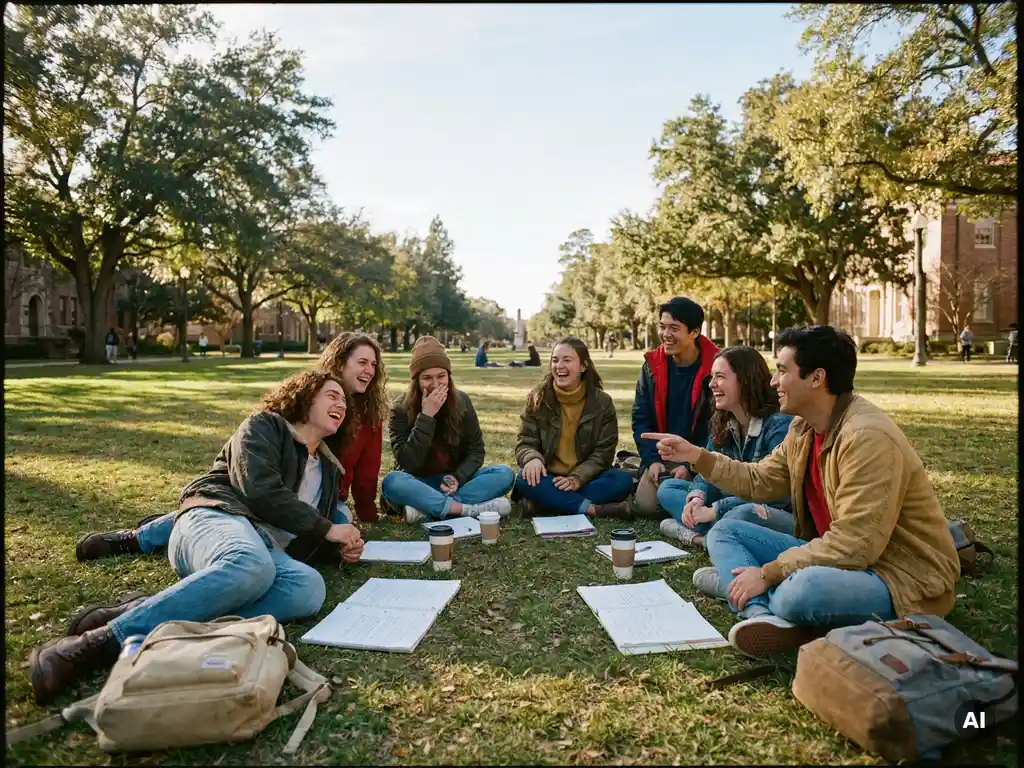
Your first year of campus social life moves faster than most people expect. Within days of arriving, you will likely find yourself in conversations with students from a dozen different countries, sharing meals, and joining events you never planned for. The residential campus setting is the single biggest driver of this: when you live, study, and socialise in the same place, friendships form naturally and quickly. The sections below unpack what that experience actually looks like, from the first week through to the moment it all starts to feel like home.
How quickly do students make friends in a residential campus setting?
Most students on a residential campus make their first genuine connections within the first week, often within the first few days. The combination of shared housing, communal dining, and structured orientation activities removes the usual barriers to meeting people. You are surrounded by peers who are equally new, equally curious, and equally open to connection, which creates an unusually fertile environment for friendship.
On a small campus like UCR, where around 500 students live and study together in Middelburg, the pace of connection is even faster. You will see the same faces at breakfast, in class, at the library, and at evening events. Repetition builds familiarity, and familiarity builds trust. Many students report that the friendships they form in the first two weeks become some of their closest relationships throughout their degree.
The key is to stay open and say yes early. Join the table with strangers at dinner. Attend the event you are not sure about. Ask the person next to you in class where they are from. The environment is designed to make these moments easy, but you still have to step into them.
What kinds of social events happen in the first semester?
The first semester of university social life is packed with events designed to help new students settle in, connect, and explore the campus community. At UCR, the first semester typically includes a structured orientation week, welcome events organised by the student association, themed parties, cultural evenings, sports activities, and community engagement projects that mix academic and social elements.
Student-led organisations play a central role in shaping the social calendar. Because UCR has an active student-led campus culture, much of what happens socially is driven by students themselves. You can expect:
- Orientation and welcome week activities that introduce you to campus life and fellow students
- Social mixers and informal gatherings in shared spaces
- Cultural exchange events that celebrate the diversity of over 70 nationalities on campus
- Sports, music, and creative clubs that meet regularly throughout the semester
- Community-Engaged Learning projects that bring students together around shared real-world challenges
- Guest lectures and debate evenings that double as social occasions
The variety matters. Not every student is drawn to the same kind of social activity, and the breadth of events means you can find your people through whatever interests you most, whether that is a football match, a film screening, or a sustainability project.
How does living on campus shape your social experience?
Living on campus transforms your social experience by making connection a constant, rather than something you have to schedule. When your home and your university are the same place, the boundary between academic life and social life dissolves. Conversations that start in the corridor continue in the classroom. Study sessions become social events. Friendships deepen through everyday proximity.
At UCR, guaranteed housing for all students throughout their degree means that everyone shares this experience. No student is commuting from outside the city or living in isolation from the campus community. This creates a level of social equity that is rare in higher education: everyone is equally present, equally available, and equally embedded in the same environment.
The inner-city campus in Middelburg adds another layer to this. The city itself becomes part of your social world. You will walk to local cafes, explore historic streets, and engage with the broader community of Zeeland, all of which gives your social life a sense of place and rootedness that purely academic settings rarely offer. Living on campus does not just give you a place to sleep; it gives you a community to belong to.
What social challenges should first-year students expect?
First-year students should expect a period of adjustment, even in the most welcoming campus environments. Social challenges in the first year of university are normal and do not signal that something has gone wrong. The most common difficulties include homesickness, the pressure to find your social group quickly, navigating a new cultural environment, and managing the energy demands of constant social proximity.
On a small residential campus, the closeness that makes community-building easy can also feel intense at times. When you live, study, and socialise with the same group of people, interpersonal dynamics become more visible. Minor conflicts or social missteps can feel amplified in a tight-knit setting.
A few things worth knowing before you arrive:
- Not everyone finds their people immediately. Some students click with their first group; others take a full semester to find where they belong. Both are valid.
- Homesickness is common and temporary. Most students report that it peaks in the first few weeks and fades as routines and friendships develop.
- Social fatigue is real. Living in a community of 500 people means you are rarely truly alone. Learning to protect your own downtime is an important skill.
- Academic pressure and social life compete for energy. Finding a rhythm that honours both takes time and conscious effort.
UCR’s mandatory Personal and Professional Development track supports students through exactly these kinds of transitions, building skills like adaptability and communication that are as useful socially as they are academically.
How does an international student community affect social life?
An international student community enriches campus social life by exposing you to perspectives, traditions, and ways of thinking that you would not encounter in a homogeneous environment. At UCR, with students from over 70 nationalities living and studying together, your social world is genuinely global from day one. This shapes not just who you meet, but how you think, communicate, and relate to others.
The practical effect is that everyday social interactions become cross-cultural exchanges. You will celebrate festivals you have never heard of, debate topics from angles you had not considered, and build friendships with people whose life experiences are radically different from your own. This is not just enriching; it is formative. The skills you develop navigating an international social environment, empathy, adaptability, cultural awareness, are among the most valuable you will take into your career and your life.
There is also a levelling effect. When everyone is navigating a new environment together, the usual social hierarchies that form in more homogeneous settings tend to dissolve. Nobody has the home advantage. That shared vulnerability creates a particular kind of openness that makes genuine connection easier and faster.
For students considering UCR student life, this international dimension is one of the most consistently cited highlights by current and former students.
When does campus social life start to feel normal and comfortable?
For most students, campus social life starts to feel genuinely comfortable around six to eight weeks into the first semester. By that point, routines have formed, faces have become familiar, and the initial anxiety of being new has largely settled. You know where to go, who to call, and how the rhythms of campus life work. It no longer feels like a performance; it feels like home.
That said, the timeline varies. Some students find their footing in two weeks; others take a full semester. Factors that influence the pace include how far from home you have moved, how much prior experience you have with new social environments, and how actively you engage with the events and opportunities around you.
A few markers that signal you are settling in:
- You have at least one person you would call if something went wrong
- You feel comfortable eating alone in a shared space without anxiety
- You have a regular social activity, a club, a study group, a weekly dinner, that you look forward to
- The campus feels like your space, not a place you are visiting
The residential structure at UCR accelerates this process significantly. When your social life and your home life occupy the same space, the transition from “new student” to “part of the community” happens organically, through shared meals, late-night conversations, and the accumulated weight of ordinary days spent together.
How UCR supports your first-year social experience
University College Roosevelt is built around the conditions that make a strong campus social life possible. If you are weighing up your first-year university experience, here is what UCR specifically offers:
- Guaranteed housing for all students throughout their degree, placing you at the heart of a close-knit residential community in Middelburg
- A small campus of around 500 students, where meaningful connections are the norm rather than the exception
- An active student-led culture with a full calendar of social, cultural, and community events from the first week
- Over 70 nationalities represented on campus, creating a genuinely international social environment
- A Personal and Professional Development track that builds the communication and adaptability skills that make social integration easier
- Community-Engaged Learning that connects your academic work to real-world projects, giving you shared purpose alongside your peers
The Bachelor of Liberal Arts and Sciences at UCR is designed for students who want both academic depth and a rich, connected campus life. If that sounds like the right fit, discover the UCR experience at ucr.nl.
Related Articles
- How much does student housing cost in the Netherlands?
- What is an OV-chipkaart and how do students use it?
- What are the biggest challenges of studying in the Netherlands?
- How does living on campus differ from commuting to university?
- Can international students work part-time while studying in the Netherlands?