


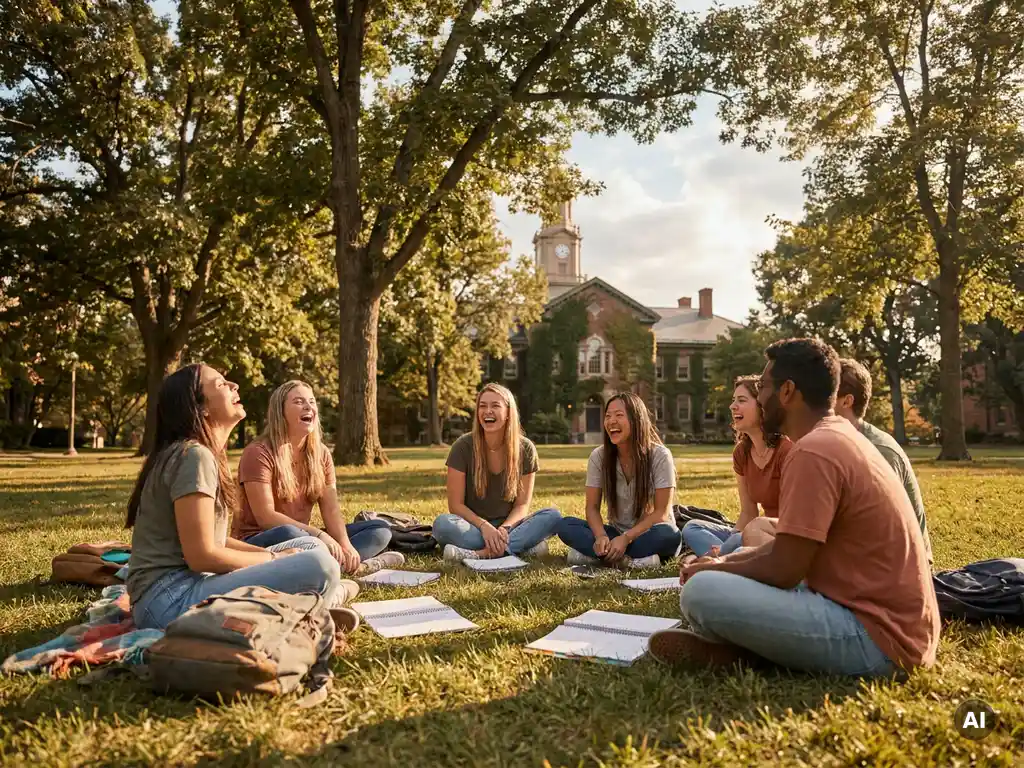
Student life at a Dutch university and at a liberal arts college in the Netherlands differs significantly in scale, structure, and daily experience. At a large Dutch university, students typically navigate a fixed degree programme within a single discipline, a sprawling campus, and a much more independent, anonymous academic environment. At a liberal arts and sciences college like UCR, the experience is deliberately smaller, more flexible, and deeply community-oriented. The sections below break down the most important differences question by question, so you can judge which environment fits you best.
How big is the difference in campus size and community feel?
The difference in campus size and community feel between a Dutch university and a liberal arts college in the Netherlands is substantial. Large Dutch universities typically enrol tens of thousands of students spread across multiple faculties and buildings. A residential liberal arts college like UCR, by contrast, is home to around 500 students, all living and studying within a single, walkable inner-city campus in Middelburg.
At a conventional Dutch university, it is entirely normal to spend three years without ever speaking to most of your classmates. Lecture halls hold hundreds of students, and tutorials may be the only moment of smaller-group interaction. The campus can feel more like a transit hub than a community.
UCR’s campus in the historic centre of Middelburg works differently. Because housing is guaranteed for all students for the full duration of their studies, the social and academic lives of students are genuinely intertwined. You run into your professors at the campus café, your classmates at the library in the evening, and the friends you made in your first week at the student association events on Friday. With over 70 nationalities represented in a community of 500, the international character of that closeness makes it especially distinctive. This is not incidental: it is built into the model of a residential college Netherlands experience.
What does a typical week look like at each type of institution?
At a large Dutch university, a typical week centres on attending lectures, often recorded and available online, completing independent reading, and occasionally joining a tutorial or workgroup. Much of the academic experience is self-directed, and students organise their social lives entirely separately from their studies.
At UCR, a typical week looks considerably more varied and interconnected. Classes are small, usually capped at around 20 students, and formats rotate across the week. A single course might involve a guest lecture one session, a student-led debate the next, and a fieldwork exercise or Community Engaged Learning project after that. Weekly schedules also include time dedicated to the mandatory Personal and Professional Development trajectory, which builds transferable skills like communication, teamwork, and adaptability alongside academic coursework.
Beyond the classroom, the residential campus means that evenings and weekends are part of the broader learning environment too. Student associations organise cultural events, sports, and creative projects. Faculty and staff often live nearby, which keeps the lines between academic and personal mentorship short. For students used to the compartmentalised rhythm of a large institution, this integration of living, learning, and socialising is one of the most noticeable shifts.
How much freedom do students have to choose their own courses?
Students at a large Dutch university typically choose a fixed degree programme in a single discipline, law, psychology, economics, and follow a largely predetermined curriculum with limited room to cross into other fields. Elective space exists but is usually modest, and switching direction requires formally changing programmes.
At a liberal arts and sciences college in the Netherlands, academic freedom is the foundation rather than a bonus. UCR’s liberal arts and sciences programme allows students to design their own curriculum by selecting courses from across six interdisciplinary clusters: Business and Entrepreneurship, Data Science and Intelligent Systems, Environment and Sustainability, Government and Society, Health, Cognition and Behavior, and Media, Culture and Communication. A student can combine philosophy, data science, and environmental policy in a single degree, something structurally impossible at most conventional Dutch universities.
UCR’s Programme Builder tool guides students step by step through selecting courses, balancing their curriculum, and meeting academic requirements. Students can also co-create courses with instructors, which allows genuinely individual academic paths to emerge. If a student takes enough courses within one cluster, they can earn a major, but the degree itself, a Bachelor of Arts or Bachelor of Science from Utrecht University, reflects the breadth of the full programme. For intellectually curious students who feel constrained by single-discipline programmes, this level of autonomy is a defining feature of the UCR student experience.
What are the social and extracurricular differences between the two?
At a large Dutch university, social life and extracurricular activity are largely self-organised and separate from academic life. Student associations, sports clubs, and cultural organisations exist and can be excellent, but they operate independently of the university’s academic rhythm and require students to actively seek them out.
At a liberal arts college like UCR, social and extracurricular life is woven into the fabric of daily campus experience. Because all students live on campus, the community is active around the clock rather than only during teaching hours. Student-led organisations run everything from theatre productions and debate clubs to sustainability initiatives and international cultural events. With over 70 nationalities on campus, social interaction itself becomes a form of intercultural learning.
The extracurricular dimension at UCR also has an academic edge. Community Engaged Learning projects connect students with local government, businesses, and organisations in Zeeland, meaning that volunteering and civic engagement are not just optional add-ons but integrated parts of the educational experience. Exchange opportunities, through UCR’s own partnerships with institutions like Bard College in New York and Glendon College in Toronto, or through Utrecht University’s broader network, extend that international dimension further. The result is a social environment where what you do outside class genuinely complements and enriches what you do inside it.
Which type of institution suits which kind of student?
A large Dutch university suits students who already know exactly what they want to study, are comfortable with independence and anonymity, and prefer to manage their social and academic lives as separate spheres. These institutions are excellent for students with a clear disciplinary focus and the self-motivation to navigate a large, less structured environment.
A liberal arts college in the Netherlands suits a different profile: students who are intellectually broad, curious across multiple fields, and eager to be part of a tight-knit international community from day one. If you find single-discipline programmes limiting, want to design your own academic path, and value personal development as much as academic achievement, the UCR model is built around you.
Students who thrive at UCR tend to share a few characteristics:
- They are high-achieving but not narrowly focused: they want to explore ideas across disciplines
- They value small-group learning and direct access to faculty
- They want to live and grow within a diverse, international community
- They are looking for an undergraduate experience that prepares them for selective master’s programmes worldwide
- They want real-world engagement, through research, projects, and community partnerships, built into their degree
It is worth noting that UCR is a selective programme. Admission requires demonstrated high academic achievement and genuine motivation for a liberal arts and sciences education. This selectivity is part of what shapes the community: everyone on campus has chosen this kind of education deliberately, which creates a shared intellectual culture that is hard to replicate at a larger institution.
How UCR shapes a different kind of student life
UCR directly addresses the limitations that prospective students often feel when looking at conventional Dutch universities. Rather than following a fixed programme in a single discipline within a large, anonymous institution, UCR offers a genuinely different model of studying in the Netherlands:
- Personalised curriculum: Choose from 160+ courses across six interdisciplinary clusters and design a degree that reflects your interests and ambitions
- Guaranteed housing: All students live on campus in Middelburg for the full duration of their studies, creating a close-knit residential community
- Small-scale learning: Classes of around 20 students mean direct faculty access, active participation, and real academic relationships
- Real-world engagement: The living lab approach connects your coursework to sustainability, public health, social justice, and local community challenges from your first semester
- International community: Over 70 nationalities in a campus of 500 students, with exchange opportunities through Utrecht University’s global network
- A Utrecht University degree: Graduate with a BA or BSc that opens doors to master’s programmes at top institutions worldwide
If you are ready to design your own academic path in an international residential community, explore what the UCR admissions process looks like and take the first step toward a different kind of undergraduate experience.
Related Articles
- How much should international students save before moving to the Netherlands?
- How do you deal with homesickness as an international student in the Netherlands?
- How do students balance social life and academic pressure at a residential college?
- What is the cost of living in Middelburg compared to other Dutch cities?
- What Dutch holidays and traditions should international students know about?