


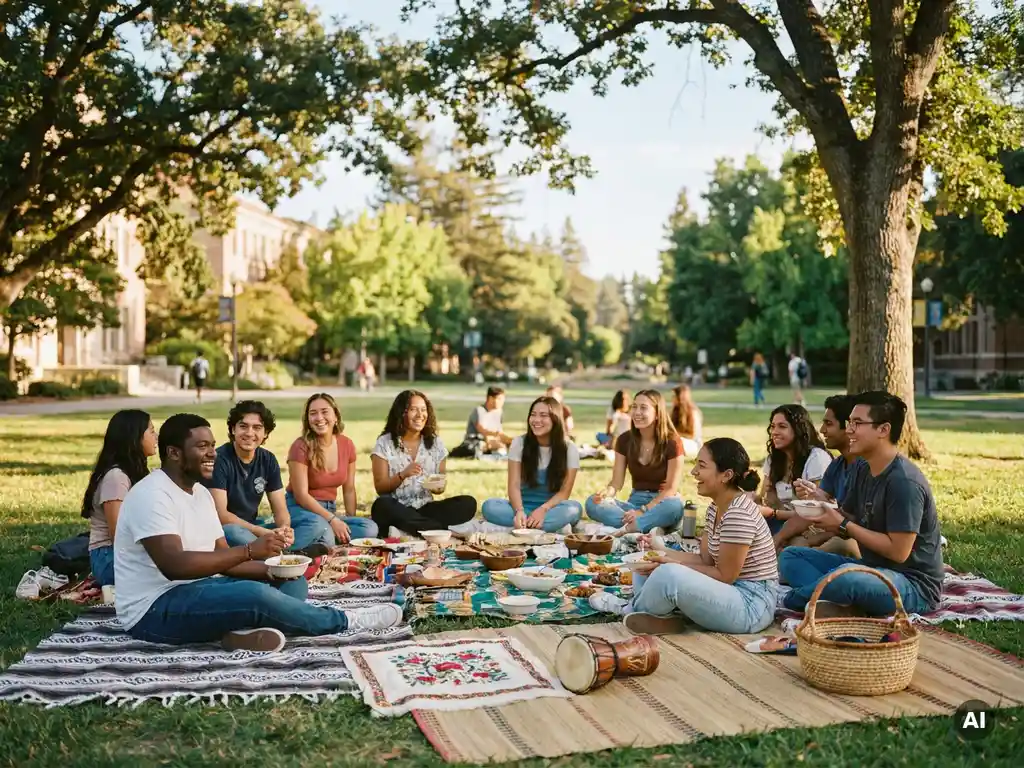
Activities that help international students feel at home on campus include social events, student-led welcome programmes, community-engaged learning, and the daily rhythms of residential life. At a small liberal arts college like UCR, the combination of guaranteed housing, a close-knit campus of around 500 students, and an intentionally international environment means that integration happens quickly and naturally. The sections below unpack the specific activities, spaces, and moments that make the biggest difference.
What kinds of social events help international students connect?
Social events that mix informal fun with genuine interaction are the most effective for helping international students connect. Shared meals, cultural nights, sports sessions, and student-organised parties create low-pressure environments where friendships form across nationalities without the formality of a classroom setting.
At UCR, the student-led campus culture drives a lively calendar of events throughout the academic year. Because the college community is small, events rarely feel anonymous. Whether it is a themed dinner in the dining hall, a debate night, or a weekend trip to the Zeeland coast, students tend to see the same faces repeatedly, which accelerates the move from acquaintance to genuine friendship.
Cultural exchange events are particularly valuable for international students. When students are invited to share food, music, or traditions from their home country, they gain visibility and confidence within the community rather than feeling like outsiders adapting to someone else’s culture. With over 70 nationalities represented on campus, these moments of exchange are a regular part of UCR student life rather than occasional novelties.
How does living on campus affect a sense of belonging?
Living on campus has a profound effect on a sense of belonging because it removes the physical and social distance that often isolates commuter students. When you eat, study, and relax in the same spaces as your peers, community forms organically rather than requiring deliberate effort.
UCR guarantees housing for all students for the full duration of their studies. This is not a minor logistical detail. For international students arriving in a new country, knowing that accommodation is secure from day one eliminates a major source of anxiety and allows energy to go towards settling in socially and academically rather than navigating a stressful housing market.
The residential model also means that the line between academic and social life is intentionally blurred. Conversations that start in a seminar continue over dinner. Study groups form in common rooms. Faculty and staff, many of whom live in or near Middelburg, are genuinely accessible. This proximity builds a sense of trust and familiarity that is difficult to replicate in a large, commuter-oriented university.
What student-led initiatives support international newcomers?
Student-led initiatives are among the most effective support structures for international newcomers because they come from peers who have already navigated the same transition. Buddy programmes, orientation committees, and student associations run by current students offer guidance that feels authentic rather than institutional.
UCR’s active student-led campus culture means that much of the integration support is peer-driven. Students who arrived as international newcomers in previous years often take on mentoring or orientation roles, giving new arrivals a personal point of contact who understands the experience from the inside. This continuity of care is a hallmark of small-campus environments where students are known as individuals rather than enrolment numbers.
Beyond formal buddy systems, student associations organised around shared interests, whether academic, cultural, or recreational, provide ongoing communities that newcomers can join at any point in the year. These groups mean that finding your people is not limited to the first week of orientation but remains possible throughout the academic year.
How do academic activities build cross-cultural connections?
Academic activities build cross-cultural connections by placing students from different backgrounds in collaborative situations where they must listen, debate, and problem-solve together. When the work itself requires diverse perspectives, cultural exchange becomes embedded in the learning rather than treated as a separate social goal.
UCR’s curriculum is designed with this in mind. Weekly coursework incorporates guest lectures, student presentations, fieldwork, and community-engaged learning projects that require students to engage with real-world challenges in the local community. These formats naturally draw on the different experiences and viewpoints that international students bring, making diversity an academic asset rather than simply a demographic fact.
The interdisciplinary structure of the programme reinforces this further. Students from the Business and Entrepreneurship cluster work alongside peers from Environment and Sustainability or Government and Society. These cross-cluster collaborations mirror the complexity of real-world problems and push students to communicate across not only academic disciplines but also cultural and linguistic backgrounds. The mandatory Personal and Professional Development trajectory, which every student completes, explicitly builds skills like effective communication, teamwork, and adaptability, giving students a shared language for navigating difference.
What role does the local city play in helping students settle in?
The local city plays a meaningful role in helping international students settle in by offering a manageable, welcoming environment where students can build a life beyond the campus gates. A smaller city with a strong sense of place tends to be easier to navigate and easier to feel part of than a large, anonymous urban centre.
Middelburg, the historic capital of Zeeland, is a compact and walkable city with a rich cultural heritage, independent shops, cafes, and a lively market square. Its scale means that students quickly learn their way around and begin to feel like residents rather than visitors. The city’s monumental architecture and proximity to Zeeland’s coastline also give it a distinctive character that students frequently describe as part of what makes UCR feel special.
UCR’s community-engaged learning model actively connects students with local government, businesses, and organisations in Zeeland. This means that international students are not simply living in Middelburg but contributing to it through hands-on projects. That sense of contribution accelerates belonging. When you have worked on a sustainability initiative with a local municipality or presented findings to a community organisation, the city stops being a backdrop and starts feeling like home.
The curriculum also offers Dutch language courses specifically for international students. Learning even a basic level of the local language opens doors socially and practically, from reading a menu to chatting with a neighbour, and signals a genuine investment in the community that tends to be warmly received.
When do most international students start feeling at home on campus?
Most international students start feeling at home on campus within the first four to eight weeks, particularly when they are embedded in a residential community with structured social and academic activities from day one. The speed of integration depends on the size of the campus, the quality of peer support, and how quickly meaningful routines develop.
At a small residential college, the timeline tends to be faster than at large universities. When you live, eat, and study alongside the same 500 people, familiar faces become friends relatively quickly. The first few weeks of orientation, social events, and early coursework create a foundation of shared experience that is hard to replicate in a larger, more dispersed environment.
That said, feeling at home is not a single moment but a gradual process. Students often describe a shift that happens when they stop thinking of themselves as new and start thinking of UCR as their place. This shift is accelerated by having a role, whether that means joining a student association, taking on a project with a local partner, or simply becoming a familiar face in the dining hall. The activities, structures, and community culture described throughout this article all contribute to reaching that point sooner rather than later.
How UCR helps international students feel at home on campus
UCR is designed from the ground up to support international students in building a genuine sense of belonging. The combination of a small, residential campus and an intentionally international community means that integration is not left to chance. Here is what makes the difference:
- Guaranteed housing for all students throughout their studies, removing accommodation uncertainty from day one
- A close-knit community of around 500 students and 50 staff, where everyone is known by name
- Student-led campus culture with active associations, peer mentoring, and a year-round social calendar
- Community-engaged learning that connects students with Middelburg and Zeeland, building roots in the local community
- Dutch language courses to help international students navigate daily life and connect with the broader culture
- A mandatory Personal and Professional Development track that builds communication and teamwork skills from the first semester
- Over 70 nationalities on campus, making international experience the norm rather than the exception
If you are looking for a place where you can grow academically, build lasting friendships, and genuinely feel part of a community from your first weeks, explore the Bachelor of Liberal Arts and Sciences at UCR and discover what campus life in Middelburg looks like for yourself.
Related Articles
- What is it like to study in Middelburg instead of Amsterdam?
- How do you apply to a Dutch university as an international student?
- Is studying in the Netherlands worth it for international students?
- Should you learn Dutch if you study in the Netherlands?
- What is the difference between student life at a Dutch university and a liberal arts college?