


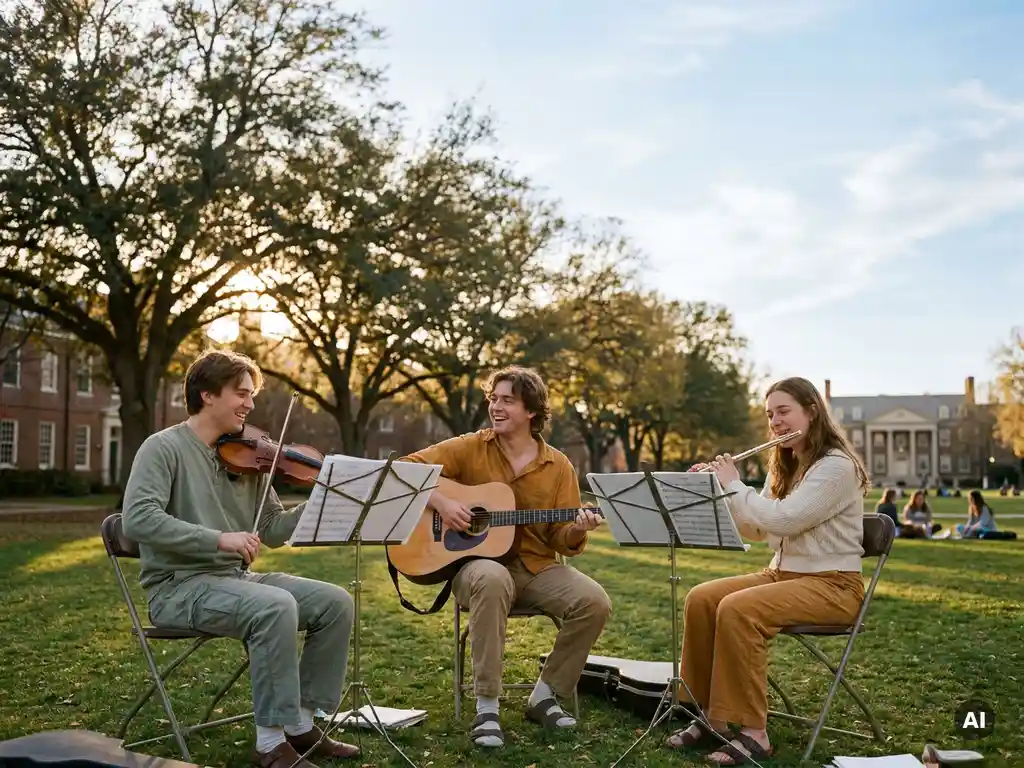
Yes, joining a music club at university can genuinely boost your academic performance. Students who participate in music alongside their studies tend to develop stronger focus, time management habits, and cognitive flexibility, skills that transfer directly into the classroom. The sections below unpack the research-backed reasons why, and what this means for your university experience.
How does participating in music affect university students’ grades?
Participating in music at university is associated with stronger academic outcomes for most students. Regular engagement with a music club builds discipline, sharpens concentration, and creates a structured routine outside of class, all of which support better study habits. Students who balance music with academics often report higher motivation and a stronger sense of purpose, which directly influences how they approach coursework.
The relationship between music participation and grades is not automatic, but the conditions music creates are consistently linked to academic success. Rehearsing for a performance requires sustained attention and memory work. Learning to read music, coordinate with others, and prepare for deadlines mirrors the cognitive demands of academic study. Over time, these habits reinforce one another.
There is also an emotional dimension. Music clubs offer a meaningful outlet for stress, which is one of the most common barriers to academic focus among university students. Managing stress effectively allows students to return to their studies with greater clarity and energy, rather than burning out mid-semester.
What cognitive benefits does playing music have for students?
Playing music strengthens several cognitive functions that are directly relevant to academic work, including memory, attention, pattern recognition, and processing speed. These benefits apply whether a student is a trained musician or a casual participant in a university ensemble or band. The mental demands of music practice engage the brain in ways that complement formal study.
Memory and information retention
Learning and memorising music, whether a melody, a chord progression, or a full score, exercises working memory and long-term recall. These are the same cognitive systems students rely on when retaining lecture material, revising for exams, or synthesising information across sources. Regular music practice essentially trains the brain to hold and retrieve complex information more efficiently.
Focus and executive function
Playing an instrument or singing in an ensemble demands sustained concentration and real-time decision-making. Musicians must track multiple elements simultaneously: rhythm, pitch, dynamics, and the contributions of others around them. This kind of mental multitasking strengthens executive function, which governs planning, self-regulation, and problem-solving across all areas of academic life.
Can extracurricular activities hurt your academic performance?
Extracurricular activities can hurt academic performance if they are poorly managed, but the risk is usually about balance rather than participation itself. Students who overcommit, join too many clubs at once, or take on leadership roles before establishing solid academic routines may find their grades suffer. The activity is rarely the problem: time and energy management are.
For most students, one or two well-chosen extracurricular activities actually protect academic performance rather than threaten it. They provide structure to the week, create social accountability, and offer mental recovery from intensive study. A music club that meets two or three times a week, for example, gives students a reliable rhythm to organise their schedule around.
The key is intentionality. Students who join a music club with clear expectations of the time commitment, and who plan their academic workload accordingly, rarely experience a negative impact. Those who join impulsively and without planning are more likely to feel stretched. The solution is honest self-assessment before committing, not avoiding extracurriculars altogether.
What social skills do music clubs build at university?
Music clubs at university build a distinct set of social skills: active listening, collaborative problem-solving, adaptability, and the ability to give and receive constructive feedback. These are not soft extras: they are competencies that employers and postgraduate programmes actively look for, and that students rarely develop as naturally through academic coursework alone.
Ensemble music in particular requires every member to listen carefully to others while contributing their own part. This trains a form of attentiveness that carries into seminars, group projects, and professional meetings. Students who play in a band or orchestra learn quickly that their individual performance affects the whole group, which builds a genuine sense of collective responsibility.
Music clubs are also one of the most accessible social entry points at university, especially for international students or those new to a campus community. Shared creative goals create bonds that cross language barriers, academic backgrounds, and cultural differences. In a diverse university environment, this kind of connection has real value beyond the music itself.
How do music clubs fit into a liberal arts and sciences degree?
Music clubs fit naturally into a liberal arts and sciences degree because they embody the same values: intellectual curiosity, interdisciplinary thinking, and learning that extends beyond the formal curriculum. A liberal arts education is built on the idea that a well-rounded student is a more capable thinker, and music is one of the oldest expressions of that philosophy.
In a liberal arts programme, students are encouraged to draw connections across disciplines and to develop as whole people, not just specialists. Music sits at the intersection of mathematics, culture, history, psychology, and performance, making it a genuinely interdisciplinary pursuit. Students studying media and communication, for example, might explore how music shapes public identity. Those in health and cognition might examine music’s neurological effects.
Beyond the academic overlaps, music clubs contribute to the kind of campus culture that liberal arts colleges deliberately cultivate. A vibrant student-led community where ideas, creativity, and collaboration thrive outside the classroom is not an accident: it is part of the educational model. Participating in that culture is itself a form of learning.
Should you join a music club if you are not a music major?
Yes, you should absolutely consider joining a music club even if you are not studying music. Most university music clubs welcome students of all skill levels and academic backgrounds, and some of the greatest benefits, cognitive, social, and emotional, are available regardless of formal musical training. You do not need to be an expert to gain real value from participation.
For students outside music-specific programmes, a music club offers something that coursework rarely provides: a space to engage with a creative discipline purely for the joy of it. This matters more than it might seem. Students who have outlets for genuine enjoyment and self-expression tend to be more resilient, more motivated, and better equipped to handle the pressures of academic life.
There is also a practical dimension. University is one of the few moments in life when joining a choir, a jazz ensemble, or a student band carries almost no barrier. The infrastructure is there, the community is ready, and the time investment is manageable. Waiting until after graduation to explore music means missing the environment most designed to support exactly that kind of exploration.
How UCR supports student life beyond the classroom
At University College Roosevelt, the connection between academic performance and student life is built into the educational model. UCR’s approach recognises that the most capable graduates are not just academically strong: they are curious, creative, and socially engaged. Here is how UCR’s environment supports that:
- A close-knit residential campus of around 500 students, where student-led clubs and activities are a natural part of daily life
- Guaranteed housing for all students, creating the stability and community proximity that makes extracurricular involvement easy and accessible
- A mandatory Personal and Professional Development track that builds transferable skills: communication, teamwork, adaptability, that music clubs also strengthen
- An interdisciplinary curriculum across six clusters that encourages students to connect creative, scientific, and humanistic perspectives
- A student community of over 70 nationalities, where shared activities like music create genuine cross-cultural connection
If you are looking for a university where academic ambition and personal growth are treated as equally important, explore the UCR Bachelor’s programme and discover what it means to design your own educational journey.