


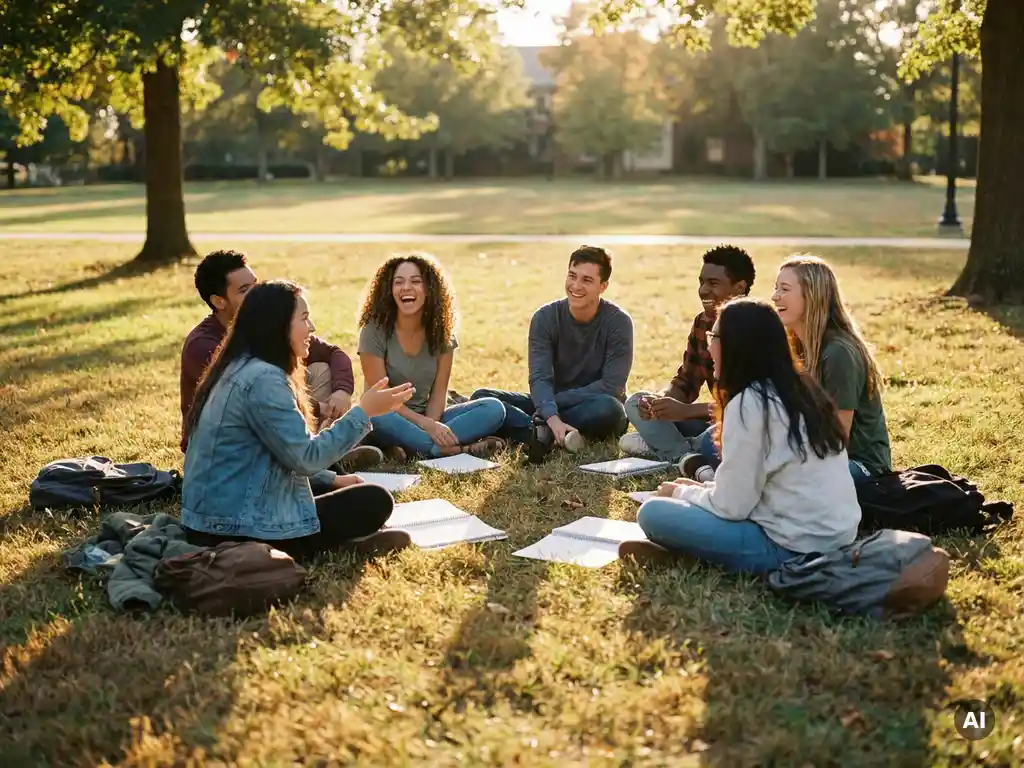
Making friends at university happens faster than most people expect, but it rarely happens on its own. The key is showing up consistently, being open to conversations, and putting yourself in situations where repeated contact is natural. Most students find their closest friendships within the first semester, often through shared housing, classes, or student activities.
The social environment matters enormously. A smaller, residential campus creates far more organic opportunities for connection than a large commuter university, because daily life itself becomes a shared experience. Below, you will find direct answers to the questions most first-year students are actually searching for.
Why is it hard to make friends in the first weeks of university?
Making friends in the first weeks of university feels difficult because everyone is navigating the same unfamiliar situation at the same time, and social anxiety tends to peak when the environment is new. You are meeting dozens of people rapidly, without the shared history or routine that normally builds friendships. The pressure to find your people quickly can make interactions feel forced rather than natural.
There is also a mismatch between expectation and reality. Many students arrive imagining that friendships will form instantly, the way they appear to in films. In practice, real connection takes repeated exposure and a little vulnerability. The good news is that the first weeks of university are the one moment in life when almost everyone around you is equally open to meeting new people. That window is genuinely rare and worth using deliberately.
Another factor is that early conversations tend to stay surface-level: where are you from, what are you studying, where do you live. These exchanges feel repetitive, but they are actually the necessary groundwork. Each one is a small deposit toward a friendship that may deepen later.
Where are the best places to meet people at university?
The best places to meet people at university are the ones you return to regularly. Proximity and repetition are the foundations of friendship, so shared spaces where you naturally encounter the same people again and again are far more valuable than one-off social events.
- Your residence or dormitory floor: Hallways, shared kitchens, and common rooms create low-pressure moments of contact every single day. You do not need to plan anything. Just being present and approachable does most of the work.
- Small-group classes and seminars: Unlike large lecture halls, smaller classes require you to speak, listen, and respond to classmates. Opinions get shared. Disagreements happen. Connections form.
- Dining areas and cafes: Meals are natural social anchors. Sitting with someone you vaguely recognise, or asking to join a group, is far less awkward than it feels in your head.
- Campus common areas: Libraries, courtyards, and student lounges are places where people linger. Lingering together, even in comfortable silence, builds familiarity.
- Orientation and welcome events: These exist precisely to give you a reason to start a conversation. Use them, even if they feel slightly artificial.
The underlying principle is simple: go to the same places at roughly the same times, and the same faces will appear. Familiarity is the first step toward friendship.
How do student clubs and activities help you make friends faster?
Student clubs and activities accelerate friendship because they give you an immediate shared identity and a recurring reason to spend time with the same group. Instead of searching for common ground in conversation, you already have it. You both care about the same thing, whether that is debate, sustainability, music, sports, or entrepreneurship.
Joining a club also removes the social pressure of trying to be interesting. You are there to do something, not to perform. That shift in focus makes conversations feel easier and more genuine. Over time, the shared experiences within the group, a competition, a project, a performance, become the stories that bond people together.
Clubs also provide structure. You meet at a fixed time each week, which means you see the same people repeatedly without having to organise anything yourself. That regularity is exactly what friendship formation requires. Research in social psychology consistently points to repeated, unplanned interaction as one of the strongest predictors of close friendship, and clubs create that condition naturally.
If you are unsure where to start, choose one activity that genuinely interests you rather than one that seems socially strategic. Authentic enthusiasm is far more magnetic than calculated networking.
What should you actually say when meeting new people at university?
When meeting new people at university, the most effective approach is to ask a genuine question and then actually listen to the answer. You do not need a clever opening line. A simple, direct question about something in your shared context is more than enough to start a real conversation.
Here are some approaches that work in practice:
- Ask about their experience, not just their facts: “What made you choose this university?” lands differently than “Where are you from?” It invites a real answer rather than a one-word response.
- React honestly: If something they say surprises or interests you, say so. Authentic reactions signal that you are actually paying attention, which is rare and noticeable.
- Share something small about yourself: Reciprocal disclosure, even at a low level, builds trust quickly. You do not need to overshare. Mentioning something you are curious about or uncertain about is enough.
- Suggest something concrete: Ending a good conversation with “we should grab coffee sometime” is vague. Ending it with “I’m going to the dining hall at six if you want to join” is an actual plan.
The goal of early conversations is not to impress. It is to find one point of genuine connection that gives you a reason to talk again. That is all you need from any single interaction.
How long does it usually take to make real friends at university?
Making real friends at university typically takes between three and six months. Acquaintances form quickly in the first few weeks, but the deeper friendships that feel genuinely close usually solidify after shared experiences, honest conversations, and enough time for trust to build. This timeline is normal and does not mean something is going wrong.
The first month tends to be high in social activity but low in depth. You meet many people, have a lot of similar conversations, and start to notice who you naturally gravitate towards. By the end of the first semester, most students have a clearer sense of who their real friends are, even if those friendships are still developing.
A few factors can speed the process up. Living in close proximity to others, joining a group with a shared goal, and being willing to have conversations that go beyond small talk all shorten the timeline. Vulnerability helps too. Admitting you are finding something hard, or sharing a genuine opinion, signals that you are open to real connection rather than just social comfort.
It is also worth knowing that some of the friendships that feel most intense in the first few weeks do not last, while quieter connections made later often turn out to be the most durable. Give it time, and try not to judge your social life against what you see on social media.
Does living on campus make it easier to make friends?
Yes, living on campus makes it significantly easier to make friends. Residential students have a structural advantage: they share meals, hallways, study spaces, and downtime with the same group of people every day. That constant, low-stakes contact is the single most reliable condition for friendship to form.
When you live off campus, socialising requires effort and planning. You have to decide to go somewhere, travel there, and then return home. When you live on campus, social interaction is woven into the ordinary rhythm of your day. A conversation in the kitchen at midnight, a spontaneous study session in a common room, or running into a classmate on the way to breakfast are all small moments that accumulate into genuine closeness.
Campus living also creates a sense of shared context that is hard to replicate. You are all navigating the same environment, dealing with the same new experiences, and building the same memories in the same place. That shared frame of reference gives you a natural foundation for conversation and connection.
For students who are naturally introverted or who find social situations draining, a residential campus is particularly valuable. You do not need to seek out social contact aggressively. Simply being present and open is often enough, because the environment does much of the work for you.
How UCR helps you build a social life from day one
University College Roosevelt is built around the conditions that make friendship and community formation genuinely easy. As a small, fully residential college in Middelburg, everything about the campus experience is designed to bring students together consistently and meaningfully.
- Guaranteed housing for all students: Every student lives on campus for the full duration of their studies, creating a shared residential community of around 500 students from over 70 nationalities.
- Small-scale learning environment: With small class sizes and a tight-knit campus, you encounter the same people in class, in the dining hall, and in your residence. Repetition and proximity happen naturally.
- Personal and Professional Development track: A mandatory programme that builds communication, teamwork, and adaptability skills from the first semester, giving every student a shared vocabulary for collaboration and connection.
- Active student-led campus culture: Student associations, clubs, and community-engaged projects give you immediate, structured reasons to meet people who share your interests.
- Community-Engaged Learning: Working with local organisations and real-world challenges means you build friendships through doing, not just socialising.
If you are looking for a university experience where making friends is built into the structure rather than left entirely to chance, UCR offers exactly that environment. Explore admission requirements and take the first step towards a community that is ready to welcome you.
Related Articles
- How do you deal with homesickness as an international student in the Netherlands?
- How does the Dutch higher education system work?
- What are the most popular student clubs at small liberal arts colleges?
- What is student life really like at a liberal arts college?
- How does participating in campus life prepare students for the real world?