


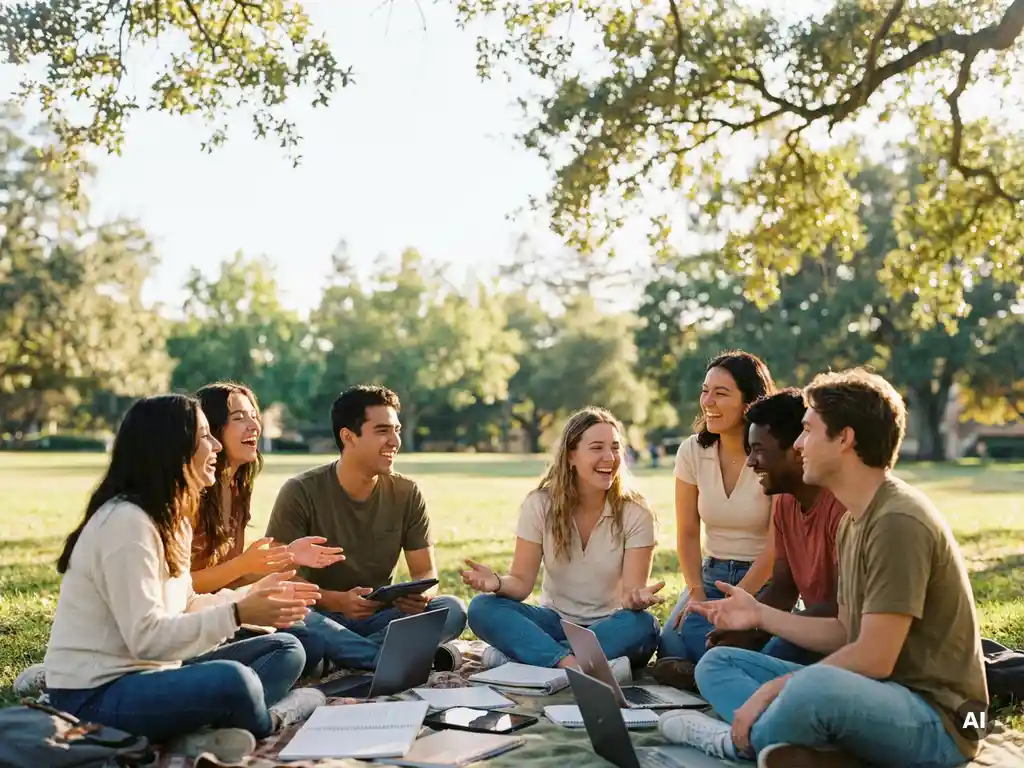
Participating in campus life prepares students for the real world by developing the practical, interpersonal, and professional skills that academic coursework alone cannot fully provide. Living alongside peers, engaging in extracurricular activities, navigating cross-cultural relationships, and contributing to community projects all translate directly into capabilities employers and graduate programmes value. The questions below unpack exactly how each dimension of student life builds real-world readiness.
What real-world skills does campus life actually build?
Campus life builds a distinct set of transferable skills, including communication, teamwork, adaptability, leadership, and problem-solving. These are not abstract qualities; they emerge from the daily reality of sharing living spaces, collaborating on projects, managing competing commitments, and working with people whose backgrounds and perspectives differ from your own.
Academic study sharpens analytical thinking and subject-matter expertise, but campus life adds the behavioural layer that makes those skills usable in professional settings. A student who can write a compelling essay but struggles to communicate ideas in a group setting, manage conflict constructively, or adapt when plans change is not yet fully prepared for the workforce. Campus involvement closes that gap.
At a liberal arts college, the skills built through campus life are also reinforced by the curriculum itself. When your degree programme integrates community-engaged learning, interdisciplinary collaboration, and structured personal development alongside academic coursework, the boundary between classroom preparation and real-world preparation becomes productively blurred.
How does living on a residential campus prepare students for independent life?
Living on a residential campus prepares students for independent life by requiring them to manage their own time, finances, relationships, and wellbeing, often for the first time, within a structured and supportive environment. The residential experience is essentially a scaffolded transition into adult autonomy.
When students live on campus, they make daily decisions that accumulate into genuine self-management competence. They learn to balance academic deadlines with social commitments, navigate disagreements with housemates, cook and budget, and seek help when they need it. These are precisely the capabilities that distinguish graduates who thrive in their first years of independent adult life from those who struggle.
The residential college model takes this further by making the campus itself a community rather than simply accommodation. When students, faculty, and staff live and work in close proximity, as they do at UCR’s inner-city campus in Middelburg, the environment fosters mentorship, accountability, and a sense of belonging that supports both personal development and academic performance. Guaranteed housing removes one of the most stressful variables of student life, freeing students to focus on growth rather than logistics.
What role do student clubs and activities play in career readiness?
Student clubs and extracurricular activities build career readiness by giving students a low-stakes environment in which to practise leadership, project management, collaboration, and initiative. Employers consistently identify these experiences as evidence that a candidate can function effectively in real organisational contexts, not just academic ones.
Running a student organisation requires the same core competencies as running a team in a professional setting: setting goals, dividing responsibilities, motivating peers, managing resources, and delivering results. Students who take on leadership roles in campus activities often develop these capabilities years before their peers who limit themselves to coursework alone.
Extracurricular involvement also signals character. Choosing to invest time in a cause, a creative pursuit, or a student-led initiative beyond the demands of a degree demonstrates curiosity, commitment, and the ability to self-direct, qualities that stand out in competitive graduate programme applications and job searches alike. On a small, active campus, the range and accessibility of these opportunities tends to be greater precisely because the community is close-knit and student-led culture is genuinely encouraged.
How does an international campus community develop cross-cultural competence?
An international campus community develops cross-cultural competence through sustained, everyday exposure to people whose cultural frameworks, communication styles, and assumptions differ from your own. This is not a workshop or a module; it is an immersive, ongoing experience that builds empathy, adaptability, and global awareness over time.
Cross-cultural competence is one of the most consistently cited skills in global hiring contexts, and it cannot be fully developed through reading or classroom instruction alone. It requires genuine relationship-building across difference: working through misunderstandings, learning to listen across language barriers, appreciating that the same situation can be interpreted in genuinely different ways by people from different backgrounds, and finding common ground anyway.
With over 70 nationalities represented in a student body of around 500, student life at UCR offers this kind of immersive cross-cultural experience as a natural feature of daily life rather than a curated programme add-on. Students who spend three years navigating a genuinely international community graduate with a depth of intercultural understanding that is difficult to replicate in larger or more homogeneous university settings.
How does community-engaged learning connect campus life to real-world impact?
Community-engaged learning connects campus life to real-world impact by replacing hypothetical problem-solving with actual collaboration on genuine challenges facing local communities, governments, and organisations. Students apply academic knowledge to real situations with real consequences, which accelerates both learning and a sense of civic responsibility.
When students work alongside municipalities, businesses, and community organisations, not as observers but as active contributors, they experience what it means to be accountable to stakeholders beyond the classroom. They learn that solutions need to be practical, communicable, and sensitive to the needs of real people. This is fundamentally different from solving a case study.
UCR’s living lab approach is built on this principle. Because the college is embedded in Middelburg and the broader Zeeland region, students have direct access to partnerships with local government and industry from their first semester. Projects addressing sustainability, public health, and social equity are not theoretical exercises; they involve real communities and produce outcomes that matter beyond the assignment grade. This kind of experiential learning cultivates the critical thinking, creativity, and problem-solving skills that are genuinely valued in the labour market.
Should students prioritise academics or campus involvement?
Students should treat academics and campus involvement as complementary rather than competing priorities. The most well-prepared graduates are those who engage seriously with both, not because they are overachievers, but because the two dimensions of student life reinforce each other in ways that neither can fully replace.
Academic rigour provides the knowledge base, analytical frameworks, and intellectual discipline that underpin professional credibility. Campus involvement provides the interpersonal skills, self-awareness, and practical experience that make that knowledge usable in the world. Prioritising one at the complete expense of the other produces graduates who are either academically strong but professionally underprepared, or socially confident but lacking the substantive expertise to back it up.
The more useful question is not which to prioritise but how to integrate them effectively. Programmes that embed personal development, community engagement, and interdisciplinary collaboration directly into the curriculum make this integration more natural. When your degree already requires you to work across disciplines, engage with real-world challenges, and develop transferable skills alongside academic content, the tension between academics and campus life largely dissolves.
How UCR prepares students for life beyond graduation
UCR’s approach to student development is built on the understanding that real-world preparation happens through the full experience of campus life, not just the classroom. Here is how the UCR experience directly addresses the skills and experiences covered in this article:
- Personal and Professional Development track: A mandatory programme running throughout the degree that builds communication, teamwork, adaptability, and career readiness.
- Guaranteed residential housing: A secure, community-oriented living environment that supports independent life skills and meaningful peer relationships.
- Living lab learning: Hands-on projects with local government, industry, and community organisations that connect academic study to real-world challenges.
- International community: Over 70 nationalities in a student body of around 500, offering genuine cross-cultural immersion as a daily experience.
- Flexible, interdisciplinary curriculum: A Bachelor of Liberal Arts and Sciences that allows students to design their own academic path across six clusters, preparing them for diverse careers and selective master’s programmes worldwide.
If you are looking for a university experience that prepares you for the real world in every sense, explore what UCR has to offer and take the first step towards designing your own future.
Related Articles
- What mental health support is available for students in the Netherlands?
- How hard is it to learn Dutch as an international student?
- How do you start a new student club or society at university?
- What is it really like to study in the Netherlands as an international student?
- Why do international students choose to learn Dutch even when classes are in English?