


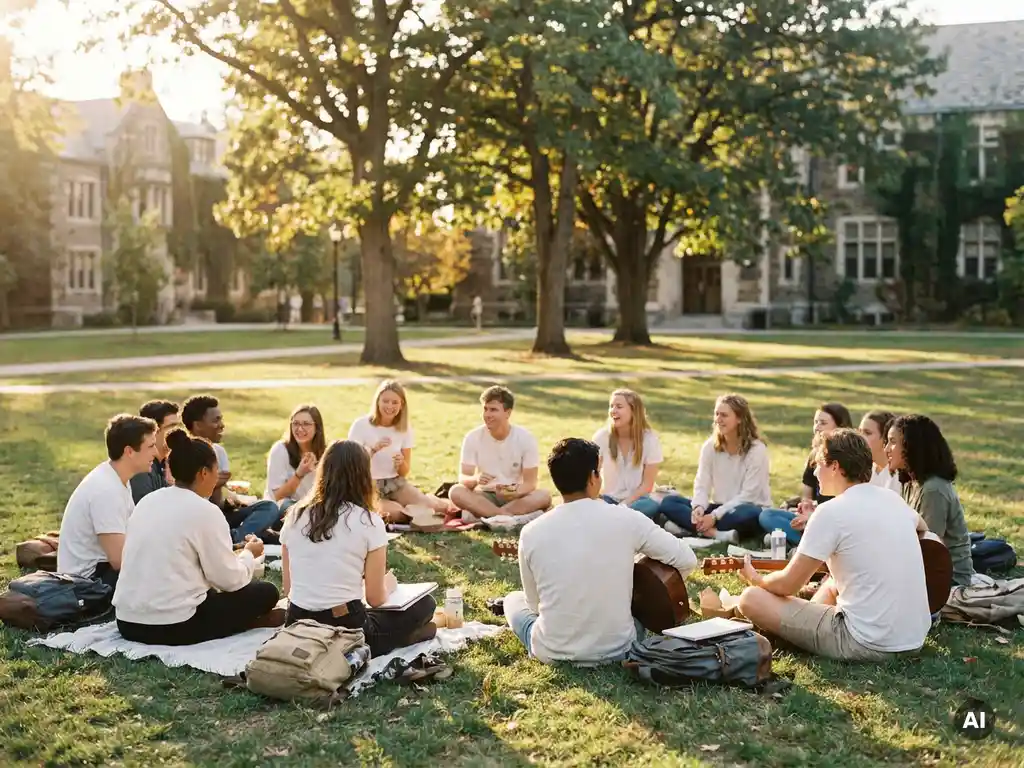
The unwritten social rules of a tight-knit university community are the shared, informal norms that govern how students treat each other, use shared spaces, collaborate academically, and navigate conflict without a rulebook telling them what to do. These norms emerge organically from close daily contact, and they carry real social weight precisely because they are unspoken. In a small residential college, where you see the same people in class, at dinner, and in the hallway outside your room, learning these invisible rules quickly is not just helpful, it is essential to feeling at home. The questions below unpack where these norms come from and how they shape everyday campus life.
How do unwritten rules form in small campus communities?
Unwritten rules in small campus communities form through repeated social interaction, shared space, and a collective need for harmony. When a group of people lives, studies, and socialises together in a compact environment, informal norms emerge naturally to fill the gaps that formal policies leave open. The smaller the community, the faster these norms take hold and the more consistently they are enforced by social pressure rather than official authority.
In a residential college setting, the process accelerates because there is no escape from the community at the end of the day. Students cannot go home to a separate world. That constant proximity creates an unspoken incentive to get along, to read the room, and to develop shared expectations around noise, respect, and social behaviour. Over time, these expectations solidify into recognisable patterns that new students pick up by observation and gentle correction.
The diversity of the student body also shapes which norms emerge. In an international community where students arrive from dozens of different cultural backgrounds, the unwritten rules tend to emphasise openness, curiosity, and a willingness to question assumptions rather than enforce a single cultural standard. The result is a community culture that is genuinely negotiated rather than simply inherited.
What are the most common unspoken norms around shared spaces?
The most common unspoken norms around shared spaces in small campus communities centre on noise levels, cleanliness, and the social boundaries of communal areas. In a tight-knit residential college, shared kitchens, study rooms, and common areas are where community culture becomes most visible, and where friction is most likely to surface if informal expectations are not respected.
A few of the norms that tend to appear across small residential campuses include:
- Quiet hours without signs: Students quickly learn which spaces are for focused work and which are for socialising, often before any official designation is made.
- Clean-up as a social contract: Leaving shared kitchens or bathrooms clean is understood as a basic act of respect for neighbours, not just a hygiene standard.
- Headphone culture in study spaces: Wearing headphones signals “do not disturb” even in open areas, an unspoken request for concentration that others generally honour.
- Door etiquette: In residential halls, a half-open door typically signals that visitors are welcome; a closed door signals privacy.
What makes these norms powerful is that they are self-enforcing. When a community is small enough that everyone knows everyone, the social cost of violating shared expectations is immediate and personal. You are not ignoring an anonymous neighbour, you are inconveniencing someone you will sit next to in class tomorrow morning.
How do tight-knit communities handle conflict without formal rules?
Tight-knit communities handle conflict without formal rules primarily through direct conversation, peer mediation, and the social pressure that comes from sustained close contact. Because everyone in a small community is visible and interconnected, unresolved conflict carries a social cost that motivates resolution in ways that larger, more anonymous environments do not.
In practice, this means that most interpersonal friction in a small campus community gets addressed informally before it ever reaches a resident advisor or formal complaint process. A student who plays music too loudly is more likely to receive a direct knock on the door than a written complaint, because the person affected knows them by name and will see them again at breakfast.
This dynamic has genuine strengths. It builds communication skills, encourages empathy, and teaches students to navigate disagreement constructively, qualities that carry real value beyond university life. It also has limits. When conflict involves a power imbalance, or when the parties involved lack the tools to have a productive conversation, the absence of formal structure can leave people without adequate support. Healthy small communities tend to pair their informal culture with accessible formal channels, so that students always have somewhere to turn when direct resolution is not enough.
What social norms govern academic collaboration in small colleges?
In small colleges, the social norms around academic collaboration are shaped by the tension between genuine intellectual partnership and the need to maintain individual academic integrity. The unspoken rules tend to draw a clear line between sharing ideas freely and sharing work inappropriately, and in a community where everyone knows each other, that line is policed as much by social trust as by academic policy.
Common informal norms around academic collaboration in small campus settings include:
- Study groups are open by default: In close communities, it is generally expected that you invite others in rather than guard your study strategies. Hoarding resources or notes is seen as going against the community spirit.
- Credit is given openly: If a conversation with a classmate shapes your thinking on an essay, acknowledging that informally, even outside of formal citation, is considered good form.
- Intellectual generosity is valued: Helping a peer understand a concept is respected, not seen as giving away a competitive advantage. In a liberal arts environment especially, knowledge is treated as something to be shared and built upon collectively.
- Boundaries around assessed work are respected: Despite the collaborative culture, students in tight-knit academic communities generally understand and respect where collaboration ends and individual work begins, because violating that trust damages relationships as well as academic standing.
These norms align naturally with the kind of interdisciplinary, discussion-based learning that defines a liberal arts education, where the exchange of ideas across disciplines is not just permitted but expected.
Why do social hierarchies in small communities work differently?
Social hierarchies in small campus communities work differently because visibility and accountability flatten the traditional structures that form in larger, more anonymous environments. When a community numbers in the hundreds rather than the thousands, status cannot be built on distance or mystique. Everyone is too accessible, too knowable, and too present for that kind of hierarchy to survive.
In larger universities, social status often attaches to clubs, sports teams, or academic programmes that create clear in-group and out-group dynamics. In a small residential college, those boundaries are harder to maintain. The student who leads the debate society also shares a kitchen with the student who runs the environmental campaign, who takes the same research methods course as the student who organises the music nights. The overlapping social circles make rigid hierarchies impractical.
What tends to replace traditional hierarchy in tight-knit communities is a reputation-based social order grounded in contribution and character. Students who are generous with their time, intellectually engaged, and genuinely curious tend to earn social respect regardless of their background or the prestige of their home country. This is particularly true in international communities, where no single cultural definition of status goes unchallenged.
That said, informal hierarchies do still exist. Students who arrive with more social confidence, stronger language skills in the dominant campus language, or more prior experience living independently may find the transition easier. Being aware of these invisible advantages is itself part of the unwritten social literacy that a small campus community develops over time.
How do newcomers learn the unwritten rules of campus life?
Newcomers learn the unwritten rules of campus life primarily through observation, early social interaction, and the guidance of more experienced students. In a small residential community, this process happens quickly and organically, within the first few weeks, most new students have developed a working understanding of the informal norms that govern daily life, even if they could not articulate them explicitly.
The most effective ways newcomers absorb these norms include:
- Watching before acting: Paying attention to how existing students use shared spaces, interact in class, and navigate social situations provides a fast and accurate education in community expectations.
- Making small mistakes and recovering: Most communities are forgiving of early missteps from new students. A gentle correction from a peer is often the most direct and memorable way to learn a norm.
- Asking questions openly: In communities that value intellectual curiosity and openness, asking “how does this work here?” is generally welcomed rather than seen as a sign of weakness.
- Joining early activities: Orientation events, communal meals, and student-led activities are specifically designed to accelerate social integration, giving newcomers concentrated exposure to community culture in a low-stakes setting.
The speed of this learning process is one of the distinctive features of small campus life. Because the community is compact and the social environment is consistent, the feedback loop between behaviour and social response is tight. Students do not need a semester to understand the culture, they often have a working map of the unwritten rules within their first month.
How UCR prepares you to navigate campus community life
At University College Roosevelt, the tight-knit campus community is not just a backdrop to your studies, it is an active part of your education. With around 500 students from over 70 nationalities living and learning together in Middelburg, the social dynamics described throughout this article are ones you will encounter and navigate every day. UCR supports that process in several concrete ways:
- Guaranteed housing places you inside the community from day one, removing the social distance that commuter students often experience.
- The Personal and Professional Development track builds the communication, teamwork, and adaptability skills that make navigating unwritten social rules easier and more intentional.
- Small class sizes and interdisciplinary learning mean you collaborate closely with peers across different academic backgrounds, developing the social and intellectual flexibility that small community life rewards.
- A student-led campus culture gives you real agency in shaping community norms from early in your first year, rather than simply inheriting them.
If you are drawn to the kind of community where the social and academic dimensions of your education reinforce each other, explore the Bachelor of Liberal Arts and Sciences at UCR and discover what life in a genuinely close-knit international college looks like in practice.
Related Articles
- How do you apply to a Dutch university as an international student?
- How many hours can international students work in the Netherlands?
- What is it like to join a first aid club at a university?
- How does participating in campus life prepare students for the real world?
- How do you deal with rainy Dutch weather as someone from a warmer country?