


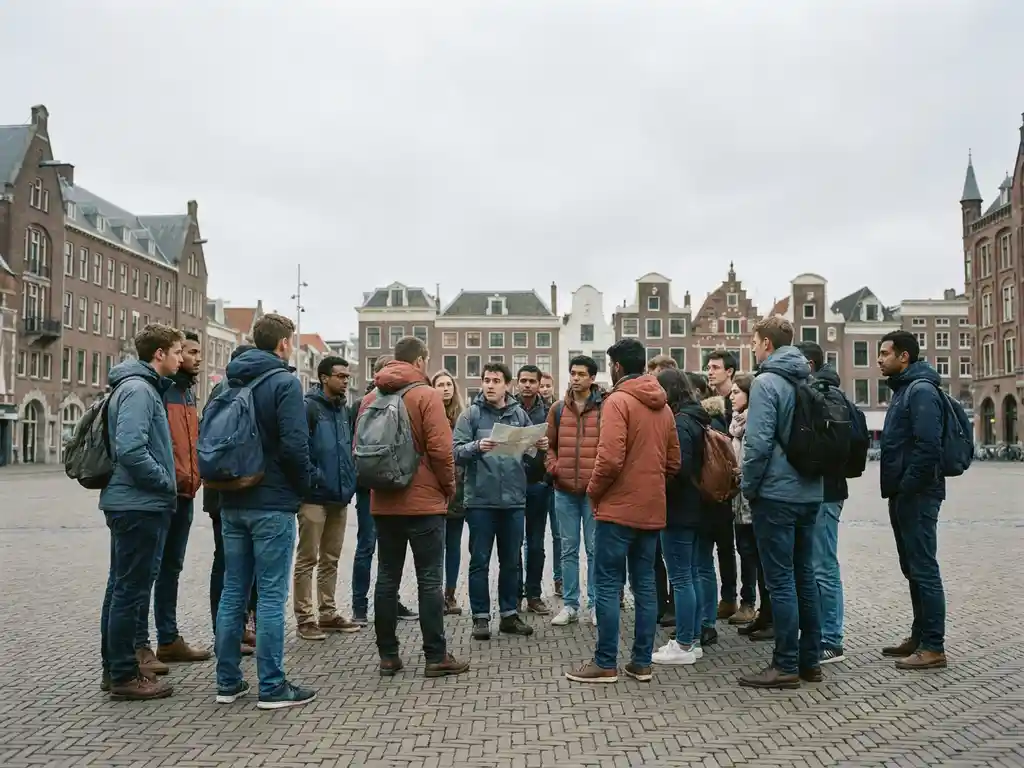
Dutch social customs confuse international students more than almost any other aspect of life in the Netherlands. The Dutch are famously direct, informal, and fiercely independent, and those traits show up in everything from how they split a restaurant bill to how they say goodbye at the end of an evening. For students arriving from cultures where politeness, hierarchy, and social ritual play a bigger role, these differences can feel jarring at first. The questions below tackle the most common points of confusion, one by one.
Why do Dutch people seem so blunt to international students?
Dutch people seem blunt to international students because directness is a deeply embedded cultural value in the Netherlands, not a sign of rudeness. When a Dutch person tells you your idea has a flaw, or declines an invitation without a polite excuse, they are being respectful in the Dutch sense: they trust you enough to be honest. Indirectness, by contrast, is often seen as evasive or even dishonest.
This cultural norm has a name in Dutch: doe normaal, meaning roughly “just be normal.” There is a strong social expectation to say what you mean, mean what you say, and not dress things up unnecessarily. In academic settings, this plays out in seminars and tutorials where students are expected to challenge ideas, including the professor’s, without softening every critique with diplomatic hedging.
For international students arriving from cultures where saving face or maintaining harmony takes priority, this can feel like a cold shower. The adjustment takes time, but most students come to appreciate it. Once you understand that a Dutch classmate’s blunt feedback is a form of genuine engagement rather than hostility, collaboration becomes much easier.
What is the Dutch ‘going Dutch’ custom and how does it work?
Going Dutch means splitting a bill equally, with each person paying their own share rather than one person treating the group. The term actually originates from Dutch cultural norms around financial independence and equality. In the Netherlands, splitting costs is the default expectation in almost every social situation, from coffee to dinner to a night out, regardless of whether you are with friends, colleagues, or a date.
In practice, this means you should never assume someone else will cover you, and you should not feel obligated to offer to pay for others either. Payment apps and pin terminals that allow split payments are widely used and socially accepted. Asking to split the bill is not considered cheap or awkward; it is simply how things work.
For international students, this norm can feel transactional at first, particularly if you come from a culture where treating friends to meals is a way of expressing warmth or building relationships. In the Dutch context, going Dutch is actually an expression of equality. Nobody is indebted to anyone else, and that keeps friendships clean and uncomplicated. Once you internalize this, navigating social situations in the Netherlands becomes much more straightforward.
How do Dutch people greet each other compared to other cultures?
Dutch greetings are informal and relatively brief compared to many other cultures. Among friends and peers, a single kiss on the right cheek is the traditional greeting, though in practice this has become less consistent since the COVID-19 pandemic, with many people defaulting to a wave or a simple “hoi” (hi). Handshakes are used in formal or professional contexts. Elaborate multi-kiss greetings or prolonged embraces are not the norm.
One thing that surprises many international students is how quickly Dutch people move from greeting to the point of the conversation. There is rarely an extended warm-up phase of small talk. Asking “hoe gaat het?” (how are you?) is common, but it is often rhetorical, and a detailed answer is not expected. The Dutch tend to get to the substance of a conversation quickly, which ties back to the same directness that characterizes their communication style more broadly.
In a student community with over 70 nationalities, greeting norms can vary enormously from person to person. The practical advice for international students is to follow the other person’s lead, keep it relaxed, and not read too much into a low-key greeting. A brief “hoi” from a Dutch classmate is warm by Dutch standards, even if it does not feel that way by yours.
Why do Dutch hosts expect guests to leave early?
Dutch hosts tend to expect guests to leave at a predictable time because Dutch social culture places a high value on planning, structure, and personal boundaries. Visits, including dinner parties, often have an implicit or even explicit end time. It is not unusual for a Dutch host to have indicated in the invitation when the evening will wrap up, and guests are generally expected to respect that without needing to be hinted at repeatedly.
This is sometimes described by expats as the “Dutch goodbye,” which is itself a multi-step process involving a round of handshakes or cheek kisses with every person present before leaving. Paradoxically, while the end of the evening is expected to come on schedule, the leaving ritual itself can take a surprisingly long time.
For international students used to open-ended gatherings where staying late signals you are having a good time, this can feel like being pushed out. It is worth reframing it: a Dutch host who ends the evening on time is not being inhospitable. They planned the event carefully, and ending it as planned is part of that care. Respecting the rhythm of the evening is a way of respecting your host.
What does it mean when Dutch people say ‘doe maar gewoon’?
‘Doe maar gewoon’ translates literally as “just act normal” and is one of the most revealing phrases in Dutch social culture. The full expression is often extended to “doe maar gewoon, dan doe je al gek genoeg,” meaning “just act normal, that’s crazy enough.” It reflects a cultural preference for modesty, restraint, and not standing out unnecessarily. Showing off, boasting, or being overly dramatic is generally frowned upon.
This norm shapes Dutch social behaviour in ways that international students notice quickly. Dutch people tend not to flaunt wealth, academic achievement, or social status. Someone who brags about their grades or makes a point of their prestigious background may be met with visible discomfort rather than admiration. Equality is a core social value, and doe maar gewoon is its informal enforcement mechanism.
For students coming from cultures where achievement is celebrated loudly and publicly, this can feel like a dampening of enthusiasm. The adjustment is worth making, though. Once you understand the norm, you can channel ambition and curiosity in ways that fit the Dutch context: through the quality of your ideas, the depth of your questions, and genuine engagement with others, rather than through self-promotion.
How quickly do Dutch people typically form close friendships?
Dutch people typically form close friendships more slowly than students from many other cultures expect. Initial interactions tend to be friendly but surface-level, and Dutch people often maintain a clear boundary between acquaintances and genuine friends. Moving from the first category to the second takes consistent contact over time, not a single intense social experience.
This can be disorienting for international students who are used to forming bonds quickly in shared circumstances, such as a first week of university. Dutch classmates may seem perfectly pleasant but slow to open up. This is not indifference; it reflects a cultural tendency to invest in a smaller number of deep, reliable friendships rather than a wide network of lighter connections.
The good news for students living in a residential campus environment is that proximity and repetition do the work over time. Shared meals, late-night study sessions, and campus activities gradually build the familiarity that Dutch friendships are built on. Patience matters more than intensity. Students who give Dutch peers time and space, rather than pushing for closeness too quickly, tend to find that those friendships, once formed, are genuinely solid and lasting.
How UCR helps international students navigate Dutch culture
Adjusting to Dutch social customs is a real part of the international student experience, and University College Roosevelt builds support for that transition directly into its programme. Here is how:
- Dutch language courses: UCR offers Dutch language classes specifically for international students, giving you practical tools to understand not just the words but the cultural logic behind them.
- Personal and Professional Development track: This mandatory programme covers communication, adaptability, and cross-cultural skills, helping you navigate unfamiliar social norms with confidence.
- A genuinely international community: With over 70 nationalities on a residential campus of around 500 students, you are surrounded by peers who are all navigating cultural differences together, which makes the adjustment feel shared rather than solitary.
- Small-scale, human environment: Faculty and staff live nearby and are accessible. The close-knit setting means you are never left to figure things out alone.
- Interdisciplinary learning culture: UCR’s academic programme encourages the kind of open, curious, cross-disciplinary thinking that translates naturally into cross-cultural understanding.
If you want to know more about student life in Middelburg and how UCR supports international students from day one, connect with the UCR admissions team and ask your questions directly.
Related Articles
- Can you combine data science and sustainability at university?
- How do you balance academics and extracurricular activities at college?
- What is the value of joining a student society in your first semester?
- What role does sport play in the social life of university students?
- Can international students work part-time while studying in the Netherlands?