


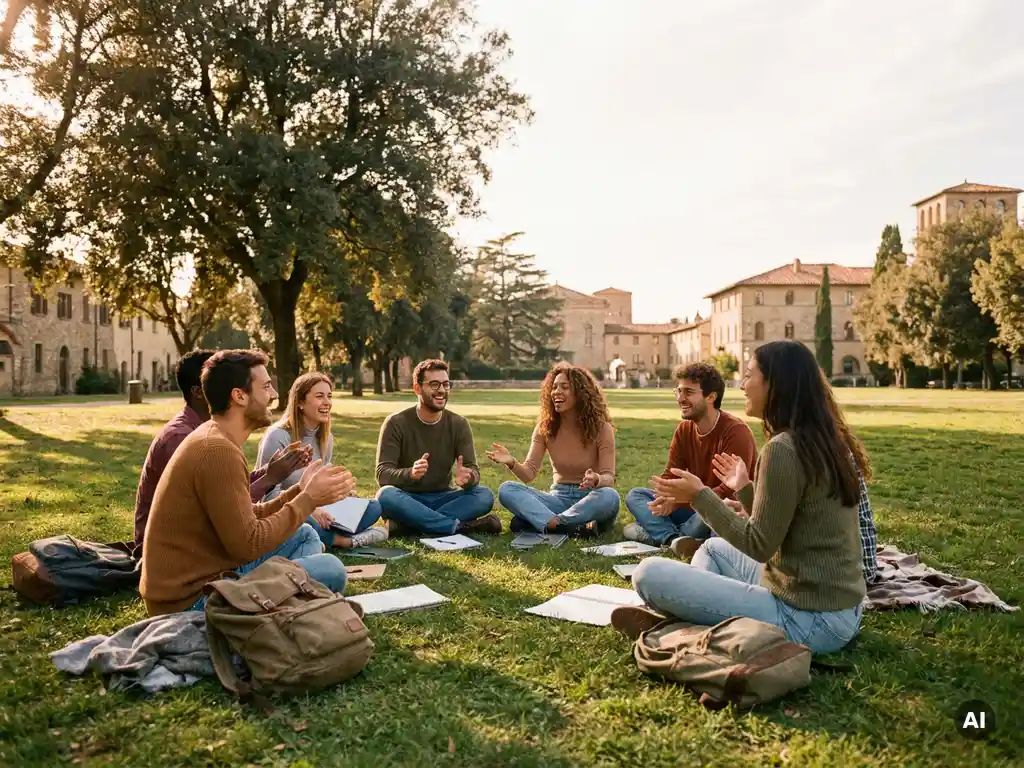
The first-year social experience is so important at a residential college because it forms the relational foundation that shapes everything else: academic motivation, mental wellbeing, and a sense of belonging that carries students through their entire degree. When students live, learn, and socialise in the same close-knit environment from day one, the connections they build are deeper and more lasting than those formed in a commuter setting. The sections below explore exactly why that foundation matters, and how it plays out across every dimension of student life.
How does living on campus shape a student’s first year?
Living on campus transforms the first year of university from a series of scheduled events into a continuous, immersive experience. When students share the same residential spaces, they encounter each other constantly, at meals, in hallways, during late-night study sessions, and those informal moments are where real social bonds form. Campus life removes the logistical barriers that prevent commuter students from building community, making connection the default rather than the exception.
At a residential college, the campus itself becomes a social infrastructure. Students do not have to plan interactions; they happen naturally and repeatedly. This repeated exposure is precisely what social psychology tells us drives trust and friendship: familiarity built through consistent, low-stakes contact. A student who might feel shy in a formal classroom setting often finds it far easier to open up in a shared kitchen or a courtyard conversation.
Guaranteed housing, as offered at University College Roosevelt, takes this a step further. When every student lives on campus for the full duration of their studies, no one is left on the outside of the community looking in. The social playing field is level from the first week, and that equality of access makes college social life richer for everyone.
Why do friendships formed in the first year tend to last?
Friendships formed in the first year of a residential college tend to last because they are built during a uniquely formative period, under conditions that accelerate bonding: shared novelty, mutual vulnerability, and constant proximity. Students arrive at the same time, face the same uncertainties, and navigate the same transitions together. That shared experience creates a depth of connection that is hard to replicate later in life.
The residential setting amplifies this effect considerably. When you live alongside the people you study with, friendships are not confined to classroom hours. You see each other at your best and your worst, stressed before an exam, enthusiastic about a new idea, homesick on a quiet Sunday. That range of shared experience is what gives first-year friendships their durability.
In a small college community of around 500 students, the social circle is tight enough that friendships have time to deepen before anyone drifts apart. Students at UCR, for example, often describe their peer group not as acquaintances but as a genuine community, people who challenge them intellectually and support them personally at the same time. That combination is rare, and it is one of the most frequently cited residential college benefits by alumni looking back on their undergraduate years.
What role does social belonging play in academic performance?
Social belonging plays a direct and significant role in academic performance. Students who feel that they genuinely belong in their academic community are more likely to engage with coursework, seek help when they struggle, take intellectual risks, and persist through difficulty. Isolation, by contrast, is one of the strongest predictors of dropout, particularly in the first year.
The mechanism is straightforward: when students feel socially secure, cognitive resources that would otherwise go toward anxiety and self-monitoring are freed up for learning. A student who knows they have people to turn to, peers who will study with them, staff who know their name, a campus that feels like home, can focus on ideas rather than on whether they belong there at all.
This is one reason why the residential college model consistently produces strong academic outcomes. The social and the academic are not separate tracks; they reinforce each other. At UCR, this integration is built deliberately into the design of student life. The small scale means that faculty and staff are genuinely accessible, and the campus community means that intellectual conversation does not stop when class ends. Discussions that begin in a seminar room continue over dinner, and that continuity deepens understanding in ways that a purely formal academic setting cannot replicate.
How does a small-college community change the social experience?
A small-college community changes the social experience by making it personal. In a large university, students can spend years without forming a meaningful connection with a single faculty member or without being known by name outside their immediate friend group. In a small college of a few hundred students, anonymity is simply not an option, and that turns out to be a profound advantage.
When the community is small enough that faces become familiar quickly, trust develops faster. Students feel more comfortable speaking up in class, joining a new activity, or introducing themselves to someone they have only seen in passing. The social environment becomes self-reinforcing: because everyone is engaged, it is easier for each individual to engage.
Depth over breadth in social connection
In a small community, students tend to develop fewer but much deeper relationships. Rather than accumulating a wide network of acquaintances, they build a core group of peers who know them well, across academic interests, personal backgrounds, and ambitions. This depth is particularly valuable in an international environment, where students arrive from dozens of different countries and cultural contexts. Getting to know a smaller number of people properly, rather than superficially engaging with hundreds, builds genuine cross-cultural understanding.
Staff and faculty as part of the community
At a college like UCR, where many faculty and staff live in or near the campus town of Middelburg, the social community extends beyond the student body. Professors are not distant figures behind a lectern; they are people students might run into at a local market or chat with after an evening event. That accessibility changes the nature of mentorship and makes academic support feel natural rather than formal. It also models what an intellectually engaged life actually looks like, something that has a lasting influence on how students approach their own development.
What social challenges do first-year residential students commonly face?
First-year residential students commonly face challenges around homesickness, navigating new social dynamics, and managing the intensity of living and studying in the same tight-knit environment. The very closeness that makes residential college life so rewarding can also make it feel overwhelming, particularly in the first weeks when everything is unfamiliar and social hierarchies have not yet settled.
Homesickness is perhaps the most universal challenge. Even students who were eager to leave home often experience a period of disorientation when the novelty of arrival gives way to the reality of being far from familiar people and places. In an international college where students may have moved across continents, this adjustment can be particularly acute.
Social comparison is another common pressure. When students live alongside peers who seem confident, academically accomplished, and socially at ease, it is easy to feel that everyone else has adapted faster or more successfully. This is rarely accurate, most first-year students are navigating the same uncertainties, but the residential setting can make those comparisons feel more immediate and visible.
Managing conflict in close quarters is a skill that most students have not had to develop before university. Disagreements with housemates or course partners carry more weight when you cannot simply go home at the end of the day. Learning to navigate those tensions constructively is genuinely difficult, but it is also one of the most valuable things the first-year social experience teaches. Students who work through early social friction in a residential setting leave with interpersonal skills that serve them for decades.
How does the first-year social experience prepare students beyond graduation?
The first-year social experience at a residential college prepares students beyond graduation by developing the interpersonal, collaborative, and adaptive skills that employers and graduate programmes consistently identify as essential. Learning to build relationships across cultural and disciplinary boundaries, navigate conflict, communicate in diverse group settings, and contribute to a shared community are not soft extras, they are core competencies for any career that involves working with other people.
Students who have lived through the intensity of a first year in a residential college know how to establish trust quickly, how to work through disagreement productively, and how to find their footing in an unfamiliar environment. These are exactly the capacities needed when starting a new job, joining a new team, or moving to a new city, which most graduates will do multiple times across their careers.
In an international residential setting, the preparation goes further still. Students who have built genuine friendships across more than seventy nationalities, debated ideas with peers from radically different backgrounds, and learned to communicate across cultural difference have a form of global fluency that is increasingly difficult to acquire elsewhere. That fluency is not just a personal asset; it is a professional one, particularly in careers that require cross-cultural collaboration or an understanding of global challenges.
The Personal and Professional Development track at UCR formalises some of this preparation, building transferable skills like communication, teamwork, and adaptability into the curriculum from the first semester. But much of the preparation happens organically, through the daily reality of living and learning alongside a diverse, engaged community of peers.
How UCR shapes the first-year social experience
University College Roosevelt is designed around the conviction that the social and the academic are inseparable. Every element of the UCR model supports a first-year social experience that is rich, intentional, and genuinely formative:
- Guaranteed housing for all students ensures that no one is excluded from campus life, and that the community is built together from the very first day.
- A close-knit community of around 500 students means that relationships form quickly and run deep, with faculty and staff who are genuinely accessible.
- Over 70 nationalities on campus create a social environment where cross-cultural learning happens naturally, every day.
- A mandatory Personal and Professional Development trajectory builds the interpersonal and collaborative skills that make community life, and life after graduation, more successful.
- A residential inner-city campus in Middelburg connects students to a real community beyond the college gates, extending the social experience into the wider world.
If you are looking for a liberal arts college community where the first-year experience is built to last, UCR offers something genuinely distinctive. Explore what student life looks like at ucr.nl and find out whether UCR is the right place for you to grow, academically, socially, and personally.
Related Articles
- How do you know if a residential university college is right for you?
- How do you get involved in extracurricular activities at university?
- What is it like to study and live in the same place as your classmates?
- Why do students say campus community changed their university experience?
- How do you transfer money internationally as a student living in the Netherlands?