


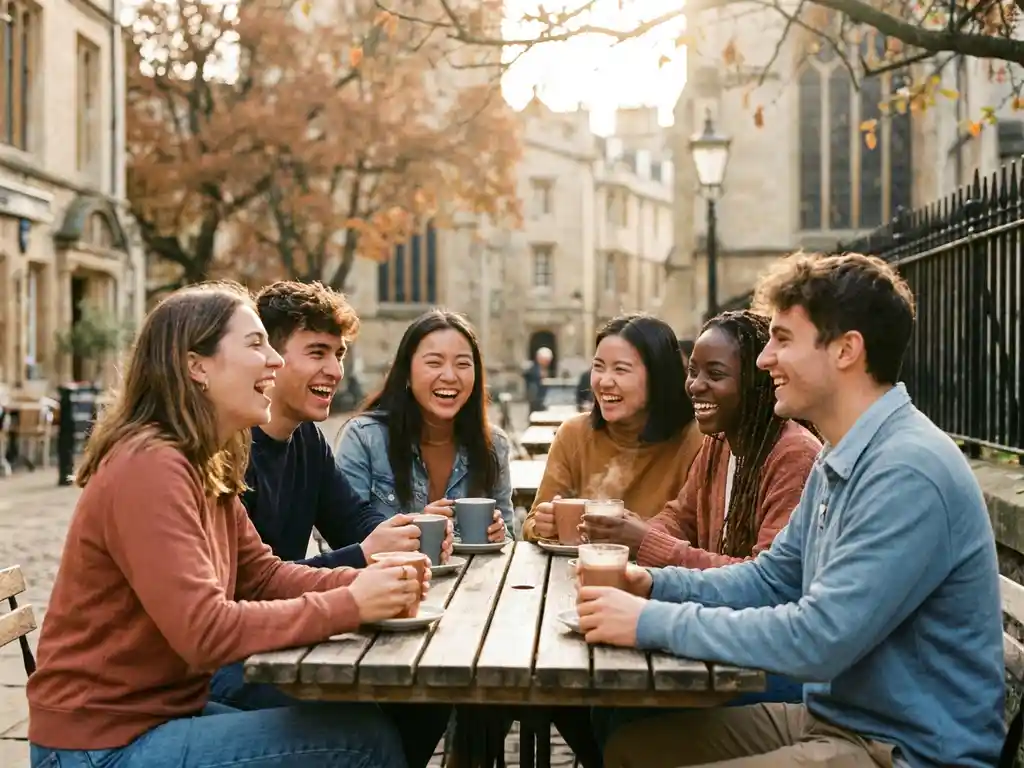
International students make friends in a small Dutch university town more easily than you might expect, especially at a residential college where daily life is built around shared spaces, shared meals, and a shared campus. The combination of guaranteed on-campus housing, a small student body, and a genuinely international community means that meaningful connections tend to form quickly and naturally. The questions below unpack exactly how that social life takes shape, from the first week onwards.
What makes it easier to make friends at a small residential college?
At a small residential college, the structure of daily life does much of the social work for you. When every student lives on the same campus, eats in the same spaces, and attends small classes together, repeated contact happens automatically, and repeated contact is one of the strongest predictors of friendship formation. You do not have to seek out social situations because you are already in them.
At a college like UCR, with around 500 students all living on a compact inner-city campus in Middelburg, the scale itself is an advantage. You recognise faces within days. You run into classmates at the supermarket, the library, and the courtyard. Unlike a large university where a student can disappear into anonymity, a small college makes invisibility almost impossible, and that visibility accelerates connection.
Several structural features make friendship easier in this kind of setting:
- Guaranteed housing for all students means no one is isolated in a private apartment across town while everyone else bonds on campus
- Small class sizes mean you work closely with the same people across seminars, group projects, and presentations rather than sitting anonymously in a lecture hall
- A mandatory Personal and Professional Development track puts students in structured group settings from day one, building communication and teamwork skills alongside genuine peer relationships
- Proximity of faculty and staff, many of whom live in or near Middelburg, creates an unusually flat social hierarchy where students feel known rather than processed
How do international students typically meet people in their first weeks?
In the first weeks at a residential college, international students typically meet people through orientation activities, shared housing, and the first round of classes. These early touchpoints matter enormously because they set the social map for the rest of the year, and in a small community, first connections tend to deepen rather than fade.
At UCR, the opening weeks are deliberately designed to lower social barriers. Orientation programmes bring the entire incoming cohort together before academic pressure sets in, giving students space to explore the campus, meet staff, and simply spend time with peers. Because all students live on campus, there is no commute separating people after events end, and informal socialising continues naturally into the evening.
First-year courses also play a direct role. The interdisciplinary curriculum means students from different academic backgrounds share the same classrooms from the start. A student interested in environmental science sits beside someone drawn to media studies or government, and the discussion-based format of liberal arts seminars encourages everyone to speak, listen, and engage. By the end of the first month, most students have had substantive conversations with a wide cross-section of the cohort, not just the people in the room next door.
Does living in a small Dutch town make socialising harder or easier?
Living in a small Dutch town like Middelburg makes socialising easier for international students at a residential college, not harder. Because the town is compact and the campus is embedded in its historic centre, students naturally share the same streets, markets, and cafes, which extends social life beyond the college walls without requiring much effort.
Middelburg is the provincial capital of Zeeland, a region known for its coastline, monumental architecture, and slower pace of life compared to Amsterdam or Rotterdam. For some students arriving from large cities, that quietness takes adjustment. But the upside is significant: the town is walkable, affordable, and genuinely welcoming to the international student community that UCR brings to it.
In a larger city, students scatter across neighbourhoods and social life fragments. In Middelburg, the UCR community is concentrated enough that bumping into friends on a Saturday afternoon is the norm rather than the exception. The town also offers a genuine sense of place, with local festivals, markets, and cultural events that students can explore together, giving friendships context and shared memory beyond campus life.
International students also benefit from Dutch language courses offered at UCR, which help them engage more confidently with the local community and feel at home in Dutch culture, adding another layer to their social experience in the region.
What role do student clubs and campus activities play in building friendships?
Student clubs and campus activities play a central role in building friendships because they bring together people who share specific interests rather than just geography. At a residential college, shared interests become the basis for deeper bonds that go beyond simply knowing someone from class or the corridor.
UCR has an active, student-led campus culture that reflects the diversity of its community. With over 70 nationalities represented among 500 students, the range of clubs, events, and initiatives is broad and genuinely driven by student initiative rather than top-down programming. Students organise cultural evenings, sports activities, debate events, film screenings, and community projects, often drawing on the interdisciplinary spirit of the academic programme itself.
The Community Engaged Learning component of the curriculum also creates friendship-building opportunities that extend into the local community. When students work together on hands-on projects addressing real challenges in Zeeland, whether in sustainability, public health, or social equity, they form the kind of collaborative bonds that come from doing something meaningful together. These are not superficial connections formed at a welcome event; they are relationships built through shared effort and shared purpose.
How does a multicultural student body affect social dynamics?
A multicultural student body enriches social dynamics by exposing students to different communication styles, cultural norms, and perspectives on everyday life. At a small residential college where students live and learn together around the clock, this diversity becomes a daily experience rather than an abstract value, and navigating it together is itself a bonding process.
With more than 70 nationalities represented at UCR, no single cultural group dominates the social environment. That balance matters. In universities where one nationality makes up the majority of international students, social clustering by background is common. At UCR, the spread of nationalities means that forming a tight group with only your compatriots is structurally difficult, which nudges students toward broader, more genuinely international friendships.
This does not mean the process is without friction. Adjusting to different social norms, humour, and communication styles takes patience and curiosity. But the liberal arts environment actively cultivates those qualities. Seminars that require students to articulate and defend their perspectives, and to genuinely engage with opposing views, build the interpersonal skills that make cross-cultural friendships sustainable. Students leave UCR not just with friends from around the world, but with the capacity to build those friendships in the first place.
Can exchange and study abroad opportunities help international students expand their social network?
Exchange and study abroad opportunities can meaningfully expand an international student’s social network by adding an entirely new set of peers, institutions, and cultural contexts to their experience. For students already comfortable in an international environment, a semester abroad builds on existing social confidence and creates connections that often last well beyond the exchange itself.
Because UCR is part of Utrecht University, students have access to a wide range of exchange programmes beyond UCR’s own partnerships. UCR also maintains its own exchange agreements with institutions including Bard College in New York, the University of Nebraska at Kearney, and Glendon College in Toronto. These partnerships place UCR students in different academic cultures, giving them the opportunity to build friendships with students who may not have encountered the liberal arts model before.
Returning exchange students often describe the experience as a social reset: they come back to Middelburg with new stories, new perspectives, and often new long-distance friendships that stay active through ongoing academic and professional networks. For international students who arrived at UCR already navigating a new country, the exchange semester adds another layer of adaptability and social breadth that serves them well beyond graduation.
How UCR helps international students build a social life from day one
UCR is structured specifically to make social life at UCR feel natural and immediate for international students, rather than something they have to build from scratch on their own. The combination of residential living, small cohorts, and an internationally diverse community creates the conditions for genuine friendship to form early and deepen over time.
- Guaranteed on-campus housing for all students throughout their studies, so no one is isolated off-campus while friendships form
- A student body of around 500 across more than 70 nationalities, creating a genuinely multicultural community without any single group dominating
- Small, discussion-based classes that require real interaction rather than passive listening, building peer relationships through academic engagement
- A mandatory Personal and Professional Development track that develops communication, teamwork, and adaptability skills from the first semester
- Dutch language courses to help international students connect with local culture and the Middelburg community
- An active student-led campus culture with clubs, events, and Community Engaged Learning projects that bring students together around shared interests and real-world challenges
- Exchange partnerships with institutions in the US and Canada for students who want to expand their network further during their studies
If you want to learn more about studying at UCR and what life looks like on campus, or if you have specific questions about the community, housing, or academic programme, the UCR team is ready to help. Connect with UCR and find out whether this is the right place for you to grow, learn, and build friendships that last.
Related Articles
- How do you choose the right English-taught bachelor's degree in the Netherlands?
- What are the admission requirements for Dutch universities?
- Can being part of a student club help you find your career direction?
- Why is the first-year social experience so important at a residential college?
- How do student clubs improve your university experience?